

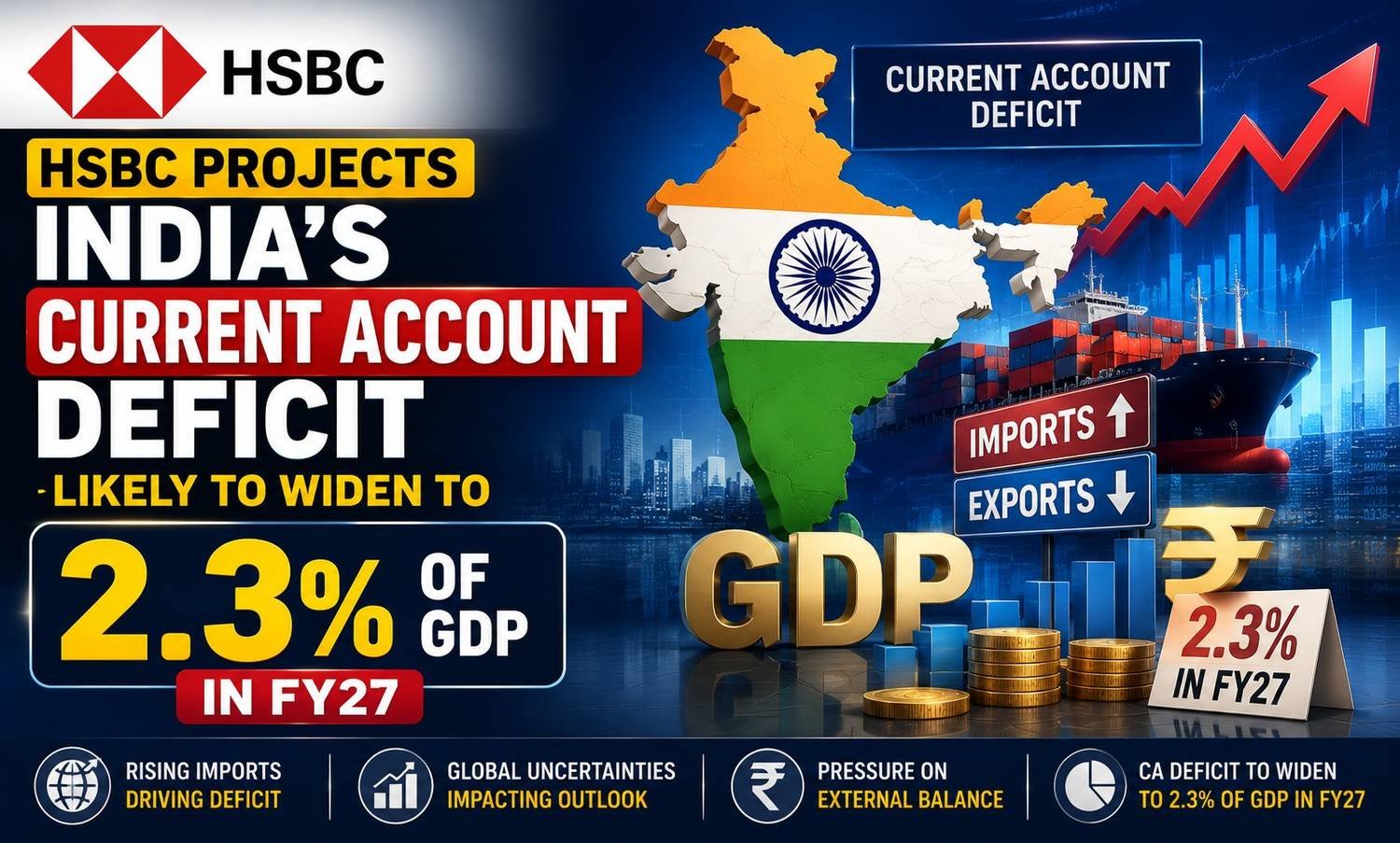
India’s Current Account Deficit (CAD) is projected to widen sharply to 2.3% of GDP in FY27 from an estimated 0.9% in FY26, according to a report by HSBC.
The report also estimates that India’s balance of payments (BoP) deficit could increase to nearly $65 billion in FY27 compared to about $35 billion in FY26.
What is Current Account Deficit (CAD)?
The Current Account Deficit occurs when a country’s total imports of goods, services and transfers exceed its exports.
A rising CAD generally indicates:
- Higher import dependence
- Increased outflow of foreign exchange
- Greater external sector pressure
However, moderate CAD levels are manageable if supported by strong capital inflows such as foreign investment.
Reasons Behind the Expected Rise in CAD
HSBC’s estimates are based on several external sector assumptions, including:
- Average crude oil prices of around $95 per barrel
- Rising oil and gold imports
- Trends in core goods trade
- Services exports
- Remittance inflows
Higher crude oil prices are expected to significantly increase India’s import bill, putting pressure on the external account.
Balance of Payments (BoP) Concerns
The report noted that India’s BoP deficit may widen because of:
- Slower foreign direct investment (FDI) inflows
- Volatile portfolio investments
- Trends in external commercial borrowings (ECBs)
The Balance of Payments records all economic transactions between India and the rest of the world.
A widening BoP deficit can increase pressure on:
- The Indian rupee
- Forex reserves
- External financing needs
Forex Reserves Still Comfortable, But Risks Remain
India currently holds foreign exchange reserves of nearly $700 billion, which remain comfortable by traditional standards.
However, HSBC warned that in today’s environment of recurring global shocks and geopolitical uncertainty, reserve adequacy should be assessed dynamically rather than through static benchmarks.
The report stated that if current projections materialise, India could fall below its historical safety threshold based on the lowest 10th percentile reserve adequacy levels.