

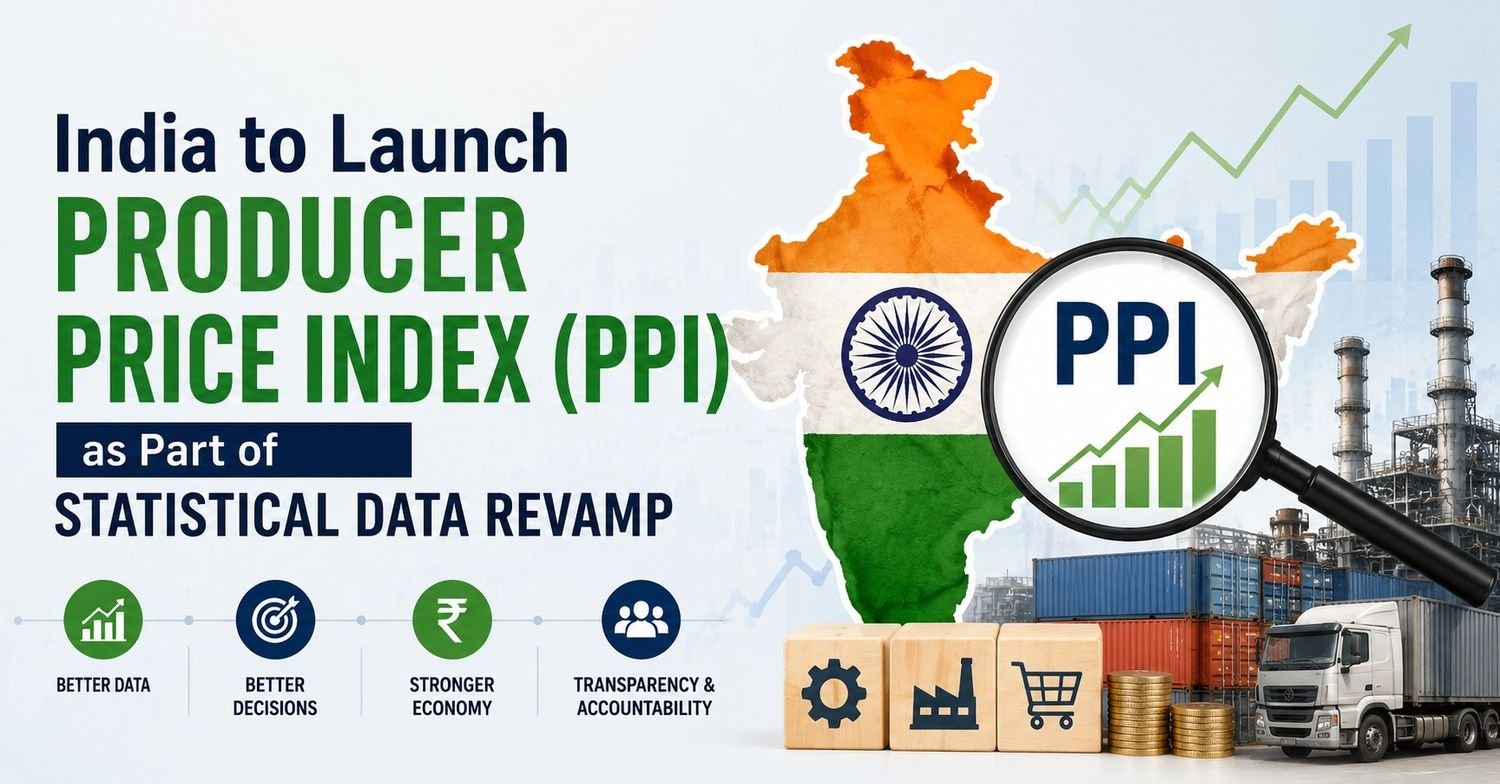
India is set to introduce its first-ever Producer Price Index (PPI), marking a significant milestone in the modernization of the country’s economic statistics framework. The new index, to be launched by the Ministry of Commerce and Industry, will provide a broader and more comprehensive measure of producer-level inflation by covering both goods and services.
The PPI will complement the existing Wholesale Price Index (WPI), which has traditionally been used to measure producer inflation in India.
What is the Producer Price Index (PPI)?
The Producer Price Index (PPI) measures the average change over time in the prices received by producers for their goods and services before they reach consumers.
Unlike consumer inflation indicators, which track prices paid by consumers, PPI focuses on prices at the production stage.
Key Features of PPI
- Measures prices received by producers.
- Covers both goods and services.
- Acts as an early indicator of inflationary pressures.
- Helps identify cost increases before they affect consumers.
- Widely used in advanced economies for inflation analysis.
Difference Between PPI and WPI
| Feature | Producer Price Index (PPI) | Wholesale Price Index (WPI) |
|---|---|---|
| Coverage | Goods and Services | Primarily Goods |
| Measures | Prices received by producers | Wholesale prices of goods |
| Services Included | Yes | No |
| Inflation Signal | Broader and more comprehensive | Limited to goods sector |
| International Usage | Widely adopted globally | Less commonly used internationally |
The existing WPI captures wholesale price movements of goods but excludes services, despite the services sector contributing nearly 55% of India’s Gross Domestic Product (GDP).
The introduction of PPI will bridge this gap.
Why is India Introducing PPI?
India’s economy has undergone substantial structural changes over the past few decades.
The services sector now dominates economic activity, making traditional inflation indicators less representative of the economy’s true structure.
The new PPI aims to:
- Better reflect India’s evolving economy.
- Capture inflation trends in services.
- Improve economic policymaking.
- Enhance data quality for investors and analysts.
- Align India’s statistical system with global best practices.
Part of a Larger Statistical Modernization Exercise
The launch of PPI forms part of a broader effort by the Government of India to modernize official economic statistics.
Earlier in 2026, the government introduced:
- New GDP series
- Revised Consumer Price Index (CPI) series
These changes were made because existing benchmarks had become outdated and no longer fully reflected India’s changing economic landscape.
International Practice
Most major economies already use Producer Price Indices as a key inflation indicator, including:
- United States
- United Kingdom
- Japan
India’s adoption of PPI brings its statistical framework closer to international standards.
Benefits for Policymakers
Economists believe that PPI can serve as an important early-warning system for inflation.
Since producer prices often rise before consumer prices, policymakers may receive advance signals about future inflationary trends.
According to economists, the index can help:
- Detect inflation pressures earlier.
- Improve inflation forecasting.
- Support better monetary policy decisions.
- Distinguish between supply-side and demand-side inflation shocks.
Impact on Monetary Policy
While economists do not expect an immediate change in monetary policy because of the new index, they believe it will provide the:
- Reserve Bank of India (RBI)
with a more comprehensive understanding of production costs and inflation dynamics.
A broader measure of inflation can improve policy responses and strengthen macroeconomic management.
Improving GDP Measurement
One of the important long-term benefits of PPI is expected to be improved GDP estimation.
Economists argue that the index will provide a more accurate tool for removing the effects of inflation from nominal GDP data, thereby producing better estimates of real economic growth.
This can help policymakers assess the true performance of the economy more accurately.
Significance for Investors and Businesses
The new data series is likely to be welcomed by:
- Investors
- Credit rating agencies
- Businesses
- Researchers
- Financial institutions
The availability of more granular inflation data will improve economic analysis and forecasting.
Conclusion
The introduction of the Producer Price Index represents a major advancement in India’s statistical and economic policy framework. By covering both goods and services, the PPI will provide a more complete picture of inflationary pressures in the economy, strengthen policymaking, improve GDP measurement, and align India with global best practices in economic statistics.