

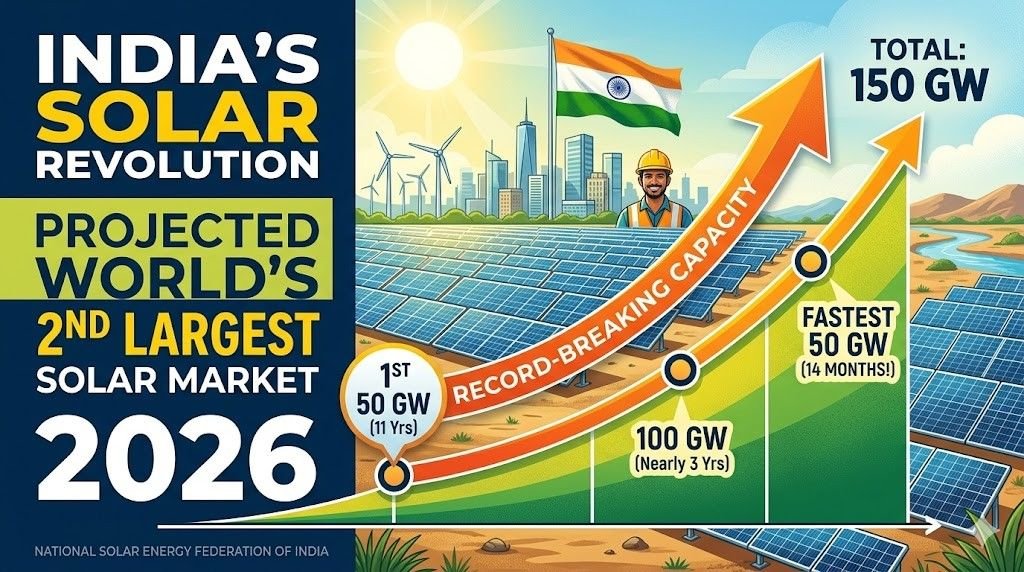
India is on track to become the world’s second-largest solar market in 2026 in terms of annual installations, according to the National Solar Energy Federation of India.
This reflects the country’s rapid progress in renewable energy and its growing global position in the solar sector.
Record-Breaking Solar Capacity Growth
India has achieved its fastest-ever expansion by adding 50 GW of solar capacity in just 14 months, reaching a total of 150 GW.
This marks a major acceleration compared to:
- 11 years to reach the first 50 GW
- Nearly 3 years to reach 100 GW
Ambitious Targets for 2030
According to Subrahmanyam Pulipaka, India’s solar capacity is expected to reach 280–300 GW to support the country’s target of 500 GW non-fossil fuel capacity by 2030.
With the current pace, India is nearing an annual addition rate of 50 GW, aligning strongly with this goal.
Key Drivers of Solar Growth
Several government initiatives are boosting solar expansion, including:
- PM Surya Ghar Yojana
- PM KUSUM 2.0 (upcoming)
- Floating solar policies
- National Green Hydrogen Mission
These initiatives, along with rising energy demand, are expected to push solar capacity beyond current projections.
Global Scenario and India’s Advantage
While major markets like the United States and the European Union may see a slowdown in solar capacity additions, India continues to accelerate.
This positions India strongly to secure the second spot globally in annual solar installations by 2026.
Rise of Distributed and C&I Solar
Distributed Renewable Energy (DRE) and Commercial & Industrial (C&I) solar are expected to drive future growth:
- C&I installations have crossed 10 GW annually for the first time
- Policies like Green Energy Open Access, VPPAs, and RCO are boosting demand
In the coming years, C&I capacity may match utility-scale solar projects.
Growing Role of Distributed Renewable Energy
Currently, DRE accounts for around 20% of India’s solar capacity.
This share is expected to rise to 35% by 2030, supported by flagship schemes like:
- PM Surya Ghar
- PM KUSUM
Boost to Domestic Manufacturing
India is strengthening its solar manufacturing ecosystem through:
- Production-Linked Incentive (PLI) schemes
- Approved List of Models and Manufacturers (ALMM)
- Basic Customs Duty (BCD)
These measures are helping the country move towards self-reliance in solar cells and modules.
Focus on Supply Chain Development
The next phase of growth will depend on building strong upstream supply chains, including:
- Wafers
- Ingots
- Polysilicon
- Quartz
This will ensure long-term sustainability of the solar sector.
Energy Storage to Play a Key Role
Energy storage is expected to become crucial for India’s clean energy future.
NSEFI forecasts:
- Double-digit energy storage capacity within the next 18 months
Supportive policies like viability gap funding (VGF) and improved connectivity are expected to accelerate deployment.
Conclusion
India’s solar journey is entering a high-growth phase, driven by strong policy support, rising demand, and rapid infrastructure development. With continued momentum, the country is well-positioned to become a global leader in renewable energy and achieve its ambitious climate goals.