

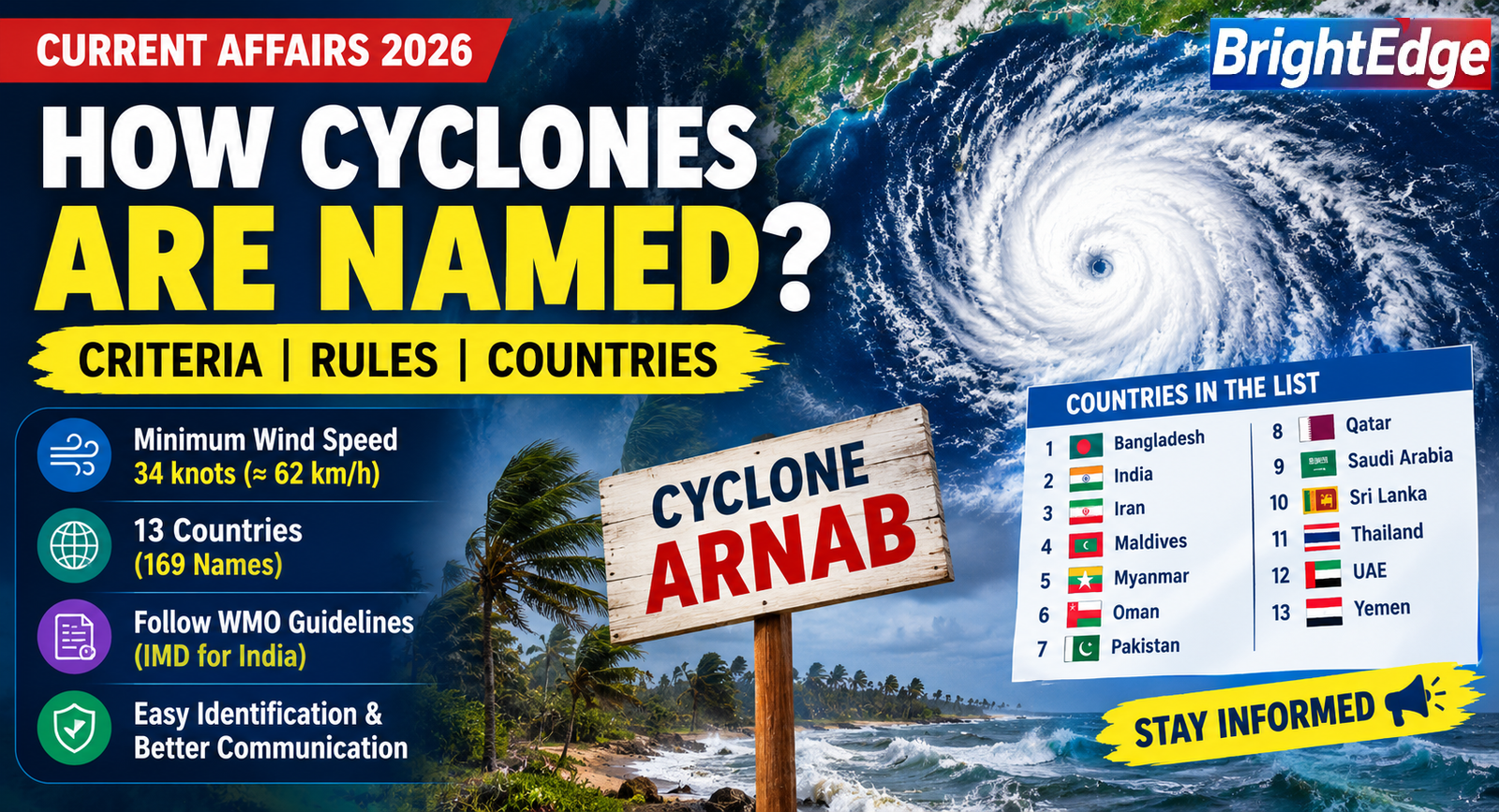
Cyclones are not named randomly. Their names are selected in advance by meteorological organisations under internationally coordinated regional systems.
For India, the India Meteorological Department (IMD) is responsible for naming tropical cyclones that develop over the Bay of Bengal and the Arabian Sea. The naming system follows guidelines established under the World Meteorological Organization (WMO) and the United Nations Economic and Social Commission for Asia and the Pacific (ESCAP).
1. Why Are Cyclones Given Names?
Cyclones are named for several important reasons:
- Easy identification: Helps distinguish one cyclone from another.
- Effective communication: Makes weather warnings easier to communicate.
- Public awareness: Helps people remember and follow a storm.
- Emergency management: Helps authorities coordinate disaster response.
- Avoiding confusion: Particularly useful when multiple storms are active.
For example, names such as Amphan, Biparjoy and Fani make it easier to identify specific storms than using geographical coordinates alone.
2. What Are the Criteria for Naming a Cyclone?
A tropical cyclone must meet specific meteorological conditions before it receives an official name.
Criterion 1: Minimum wind speed
In the North Indian Ocean region, a tropical cyclone is named when its maximum sustained surface wind speed reaches at least 34 knots (approximately 62 km/h).
A weather system does not receive a cyclone name merely because it produces heavy rainfall, strong winds or rough seas.
Criterion 2: An approved name must be available
The name must come from the official list prepared by participating countries. Meteorologists do not invent a new name every time a cyclone develops.
Criterion 3: The responsible meteorological centre assigns the name
The Regional Specialised Meteorological Centre (RSMC), New Delhi, operated by IMD, is responsible for naming qualifying tropical cyclones over the Bay of Bengal and Arabian Sea.
Criterion 4: The name follows the prescribed sequence
The approved names are used in the established order. The name does not depend on which country the cyclone is expected to affect.
Important: A cyclone’s name does not indicate its intensity. Its strength must be assessed using meteorological observations and forecasts.
3. Which Countries Name Cyclones in India’s Region?
Thirteen countries participate in the North Indian Ocean cyclone-naming system.
| No. | Country |
|---|---|
| 1 | Bangladesh |
| 2 | India |
| 3 | Iran |
| 4 | Maldives |
| 5 | Myanmar |
| 6 | Oman |
| 7 | Pakistan |
| 8 | Qatar |
| 9 | Saudi Arabia |
| 10 | Sri Lanka |
| 11 | Thailand |
| 12 | United Arab Emirates |
| 13 | Yemen |
4. What Are the Rules for Selecting Cyclone Names?
The names proposed by participating countries must follow specific guidelines.
| Rule | Explanation |
|---|---|
| Short name | The name should be brief and easy to communicate. |
| Maximum length | A proposed name must not exceed eight letters. |
| Easy pronunciation | It should be easy to pronounce and understand. |
| Neutrality | It should not be associated with political figures, religious beliefs, cultures or gender in a discriminatory way. |
| Non-offensive | It must not hurt the sentiments of any group or be rude or cruel. |
| Pronunciation guidance | The proposed name must be accompanied by pronunciation information. |
| Official approval | The responsible regional panel can reject unsuitable names. |
| No repetition | A name used for a North Indian Ocean cyclone is not used again. |
These criteria are intended to make cyclone warnings clear, culturally appropriate and easy to communicate internationally.
5. Complete List of Remaining Names
The following table provides the remaining names in the official list, arranged by the sequence in which they are scheduled to be used. The list contains 169 names in total, contributed by 13 countries.
| No. | Bangladesh | India | Iran | Maldives | Myanmar | Oman | Pakistan | Qatar | Saudi Arabia | Sri Lanka | Thailand | UAE | Yemen |
|---|---|---|---|---|---|---|---|---|---|---|---|---|---|
| 1 | Arnab | Murasu | Akvan | Kaani | Ngamann | Sail | Sahab | Lulu | Ghazeer | Gigum | Thianyot | Afoor | Diksam |
| 2 | Upakul | Aag | Sepand | Odi | Kyarthit | Naseem | Afshan | Mouj | Asif | Gagana | Bulan | Nahhaam | Sira |
| 3 | Barshon | Vyom | Booran | Kenau | Sapakyee | Muzn | Manahil | Suhail | Sidrah | Verambha | Phutala | Quffal | Bakhur |
| 4 | Rajani | Jhar | Anahita | Endheri | Wetwun | Sadeem | Shujana | Sadaf | Hareed | Garjana | Aiyara | Daaman | Ghwyzi |
| 5 | Nishith | Probah | Azar | Riyau | Mwaihout | Dima | Parwaz | Reem | Faid | Neeba | Saming | Deem | Hawf |
| 6 | Urmi | Neer | Pooyan | Guruva | Kywe | Manjour | Zannata | Rayhan | Kaseer | Ninnada | Kraison | Gargoor | Balhaf |
| 7 | Meghala | Prabhanjan | Arsham | Kurangi | Pinku | Rukam | Sasar | Anbar | Nakeel | Viduli | Matcha | Khubb | Brom |
| 8 | Samiron | Ghurni | Hengame | Kuredehi | Yinkaung | Watad | Badban | Oud | Haboob | Ogha | Mahingsa | Degl | Shuqra |
| 9 | Pratikul | Ambud | Savas | Thundi | Linyone | Al-Jarz | Sarrab | Bahar | Bareq | Salitha | Phraewa | Athmad | Fartak |
| 10 | Sarobor | Jaladhi | Tahamtan | Faana | Kyeekan | Rabab | Gulnar | Seef | Alreem | Rivi | Asuri | Boom | Darsah |
| 11 | Mahanisha | Vega | Toofan | — | Bautphat | Raad | Waseq | Fanar | Wabil | Rudu | Thara | Saffar | Samhah |
6. How Was Cyclone Arnab Named?
- The name Arnab appears in the official North Indian Ocean naming list as a name contributed by Bangladesh.
- Under the regional naming system, the name is assigned when the relevant weather system meets the prescribed cyclone-naming threshold and reaches its turn in the sequence. It is not selected because the cyclone is expected to strike Bangladesh.
- The same principle applies to names contributed by India, Oman, Pakistan and other participating countries. A country contributing a name does not determine where the cyclone will make landfall.
7. Are Cyclones Named the Same Way Around the World?
No. The rules vary by region.
| Region | Common storm terminology | Naming system |
|---|---|---|
| North Indian Ocean | Cyclones | Names contributed by 13 regional countries and used sequentially |
| North Atlantic | Hurricanes | Predetermined lists, generally rotating over a six-year cycle |
| Eastern North Pacific | Hurricanes | Predetermined regional lists |
| Western North Pacific | Typhoons | Regional naming lists contributed by participating countries |
| South Pacific | Tropical cyclones | Regional naming arrangements |
The terms hurricane, typhoon and cyclone refer to the same general type of tropical weather system; the terminology depends primarily on the region where it develops.
8. What Happens If a Cyclone Is Extremely Destructive?
- Naming practices differ across regions.
- In the North Indian Ocean, a name is not reused once it has been assigned to a cyclone.
- In some other regions, such as the North Atlantic, a particularly deadly or destructive cyclone’s name may be formally retired and replaced on the regional list.
- This prevents a notorious storm’s name from being used again in that naming system.