

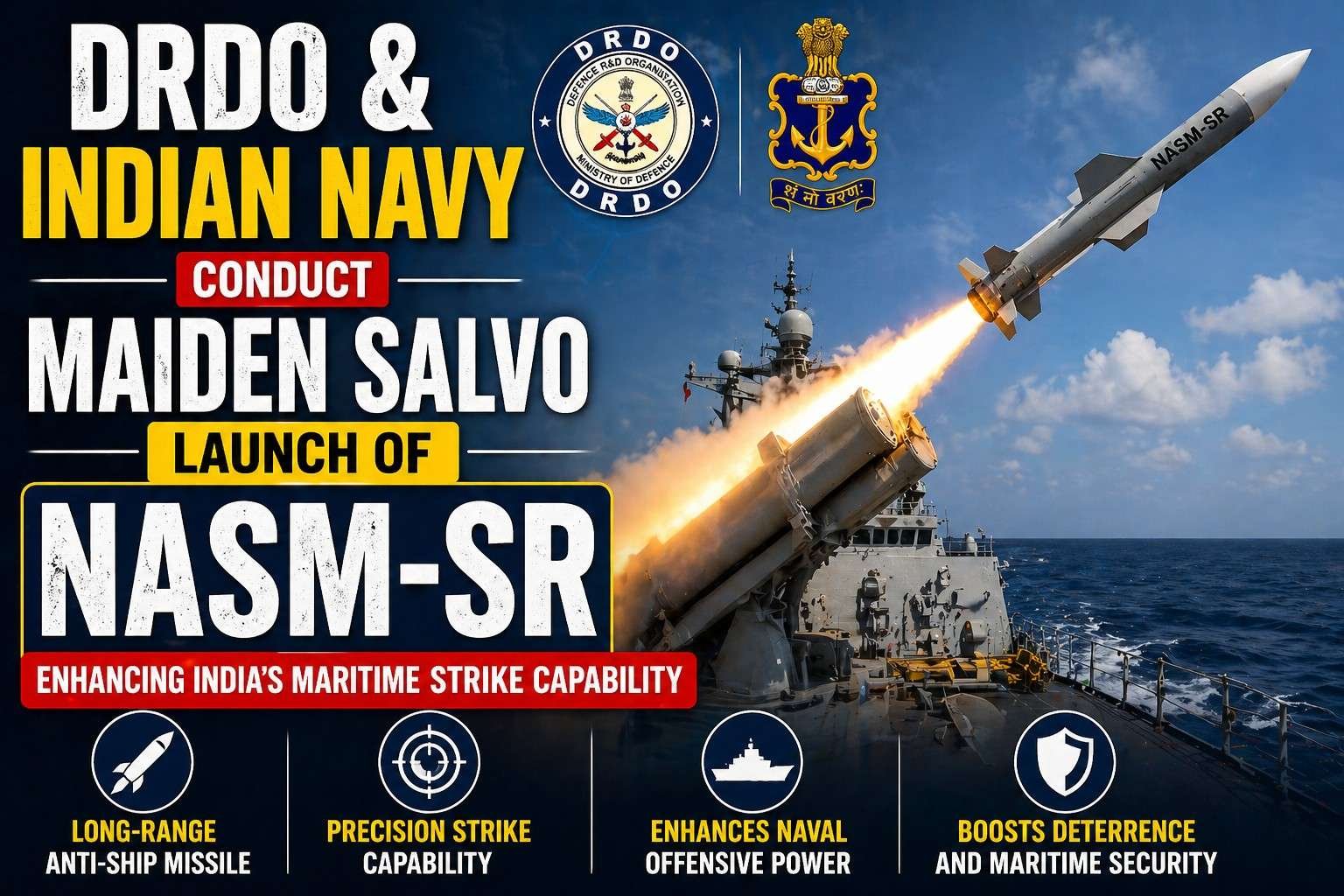
In a major milestone for India’s defence capabilities, the Defence Research and Development Organisation (DRDO) and the Indian Navy have successfully conducted the maiden salvo launch of the Naval Anti-Ship Missile–Short Range (NASM-SR).
The test was carried out from a naval helicopter platform off the coast of the Bay of Bengal near Odisha, marking a significant advancement in India’s indigenous missile technology and maritime strike capability.
What Makes This Test Significant?
The highlight of the trial was the salvo launch capability:
- Two missiles launched in quick succession
- Fired from the same helicopter platform
- First-ever demonstration of such capability in this category
This proves that India can engage multiple naval targets rapidly, enhancing combat effectiveness in real-world scenarios.
Key Achievements of the Test
The trial successfully met all mission objectives:
- Salvo launch capability validated
- Waterline hit accuracy demonstrated
- All systems performed as expected
The missile’s ability to strike at the waterline of a target ship is critical, as it can cause maximum structural damage, potentially disabling enemy vessels quickly.
Advanced Technologies Used in NASM-SR
The NASM-SR missile is a highly sophisticated, indigenously developed system featuring:
Propulsion System
- Solid booster for initial thrust
- Long-burn sustainer for extended flight
Navigation & Guidance
- Fibre-optic gyroscope-based Inertial Navigation System (INS)
- Advanced guidance algorithms
- Radio-altimeter for precise altitude tracking
Targeting & Control
- Advanced seeker technology
- Jet-vane control system
- High-bandwidth two-way data link
All these components have been developed indigenously, showcasing India’s growing self-reliance in defence technology.
Indigenous Development: A Multi-Lab Effort
The missile system has been developed under the leadership of:
- Research Centre Imarat
With collaboration from multiple DRDO labs:
- Defence Research and Development Laboratory
- High Energy Materials Research Laboratory
- Terminal Ballistics Research Laboratory
- Integrated Test Range
The project also involved Indian industries and start-ups, highlighting strong public-private collaboration.
Role of Testing Infrastructure
The test was closely monitored using advanced tracking systems at ITR Chandipur, including:
- Radar systems
- Electro-optical tracking
- Telemetry systems
These ensured accurate validation of missile performance.
Conclusion:
The successful maiden salvo launch of the NASM-SR missile marks a major leap in India’s naval warfare capabilities. With advanced targeting, precision strike ability, and indigenous development, the system strengthens India’s position as a technologically capable maritime power.