

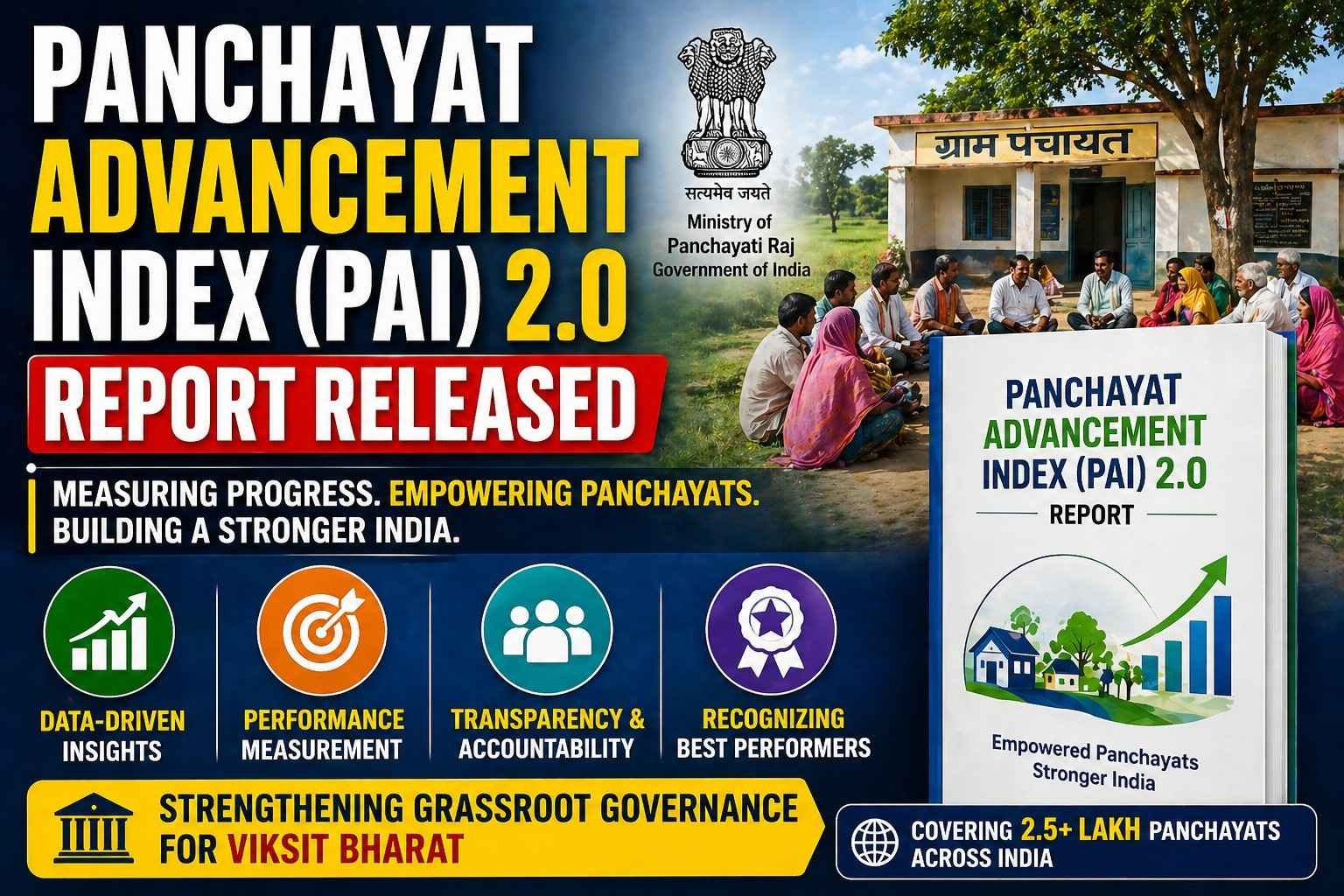
In a major boost to grassroots governance and data-driven rural development, the Ministry of Panchayati Raj has released the Panchayat Advancement Index (PAI) 2.0 Report (FY 2023–24) on the occasion of National Panchayati Raj Day (April 24, 2026).
The report acts as a performance scorecard for Gram Panchayats, highlighting significant improvements in participation, governance, and development outcomes across rural India.
Key Highlights of PAI 2.0 Report
Performance Classification
- 3,635 Gram Panchayats ranked as Front Runners (A grade)
- 1,18,824 Panchayats (45.72%) classified as Performers (B grade)
This classification is based on composite performance scores, enabling benchmarking across the country.
Record Participation Achieved
PAI 2.0 witnessed exceptional national participation:
- 97.30% participation rate
- 2,59,867 Gram Panchayats submitted validated data
- Coverage across 33 States and Union Territories
This is a major jump from 80.79% participation in PAI 1.0, reflecting stronger engagement at the grassroots level.
Top Performing Themes
The report highlights strong outcomes in key development areas:
1. Poverty-Free & Enhanced Livelihoods
- 3,313 Panchayats achieved A+ grade
- Indicates success in:
- Poverty reduction
- Employment generation
- Local economic development
2. Healthy Panchayats
- 1,015 Panchayats secured A+ grade
- Strong performance in:
- Preventive healthcare
- Nutrition awareness
- Sanitation and hygiene
- Community participation
What is Panchayat Advancement Index (PAI)?
PAI is India’s first nationwide data-driven framework to evaluate the performance of Gram Panchayats.
Key Features:
- Covers 2.5 lakh+ Panchayats
- Based on:
- 150 indicators
- 230 data points
- Aligned with Localization of Sustainable Development Goals (LSDGs)
9 Thematic Areas Under PAI 2.0
The index evaluates Panchayats across:
- Poverty
- Health
- Child Welfare
- Water
- Environment
- Infrastructure
- Social Justice
- Good Governance
- Women’s Empowerment
This ensures a holistic assessment of rural development.
Performance Categories Explained
| Category | Score Range | Meaning |
|---|---|---|
| Achiever | 90+ | Top performers |
| Front Runner | 75–89 | Strong performers |
| Performer | 60–74 | Moderate progress |
| Aspirant | 40–59 | Needs improvement |
| Beginner | Below 40 | Low performance |
This classification promotes healthy competition and targeted interventions.
Major Improvements in PAI 2.0
Compared to Version 1.0, the new framework is more streamlined and efficient:
- Indicators reduced from 516 → 150
- Data points reduced from 794 → 230
- Single integrated data entry system
- Mandatory Gram Sabha validation (transparency)
- Auto-data integration from government portals
- Real-time dashboards
- Vernacular language support
These upgrades improve accuracy, usability, and accountability.
Why PAI 2.0 Matters
For Governance:
- Enables evidence-based planning
- Improves monitoring of rural development schemes
For Panchayats:
- Helps prepare Gram Panchayat Development Plans (GPDPs)
- Identifies best-performing Panchayats as role models
For Policy Makers:
- Supports targeted interventions
- Encourages data-driven decision making
Vision: “Viksit Gram Panchayats”
The PAI 2.0 initiative aligns with the government’s vision of:
- Empowered local governance
- Inclusive rural growth
- Transparent administration
By promoting participation and accountability, it strengthens the foundation of India’s democratic decentralisation.
Conclusion:
The PAI 2.0 report marks a transformational step in rural governance, showcasing how data, participation, and transparency can drive development at the grassroots level.
With record participation and strong performance across key sectors like livelihoods and health, India is steadily moving toward empowered and self-reliant Panchayats—the backbone of rural transformation.