

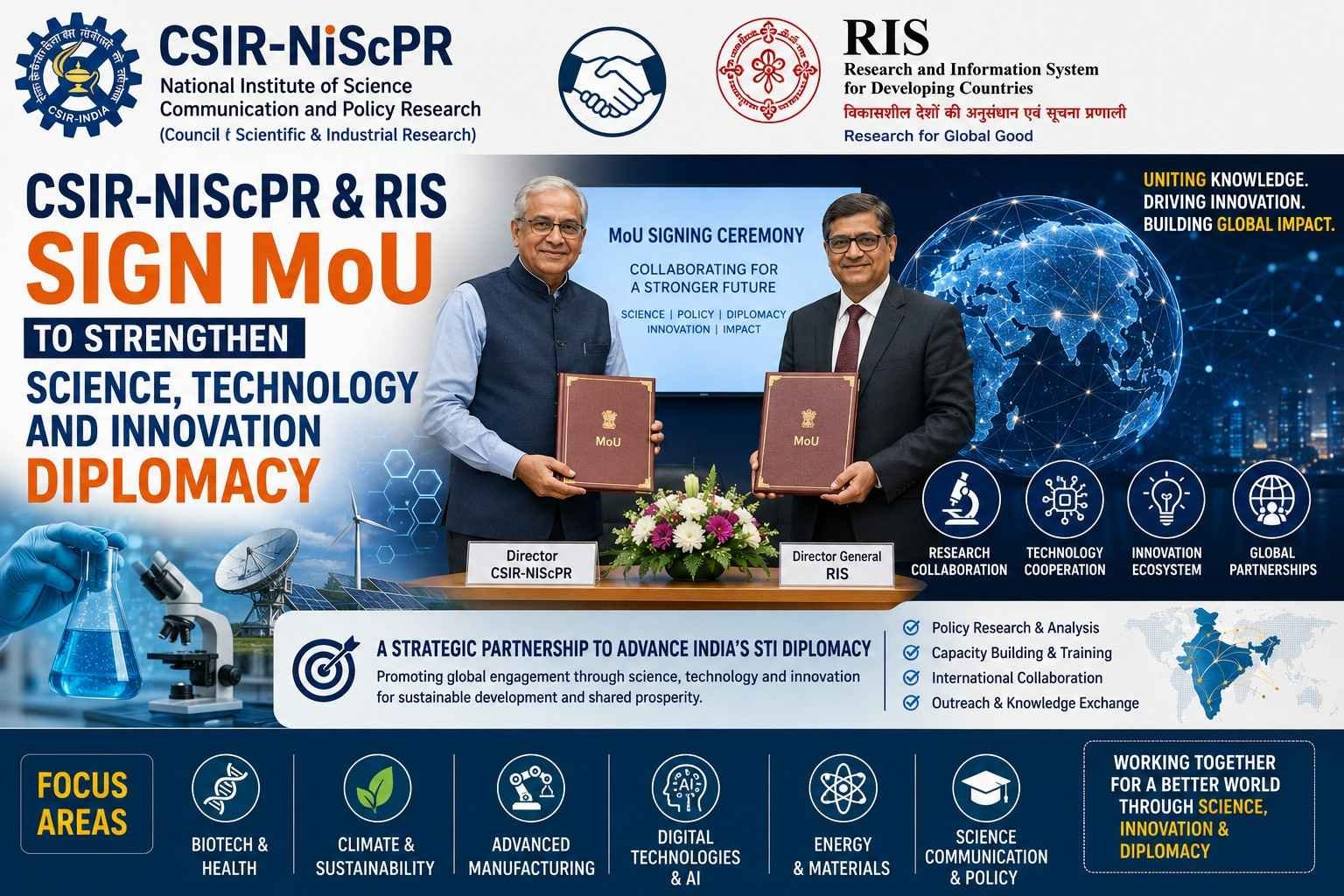
CSIR-National Institute of Science Communication and Policy Research (NIScPR) has signed a Memorandum of Understanding (MoU) with Research and Information System for Developing Countries (RIS) to strengthen collaboration in science, technology, innovation policy, and science diplomacy.
The agreement was signed on May 6, 2026, with the aim of promoting joint research, policy analysis, capacity building, and knowledge sharing for inclusive and sustainable development.
Focus on Science Policy and Diplomacy
The partnership seeks to expand cooperation in areas such as:
- Science policy research
- Science communication
- Science diplomacy
- Traditional knowledge systems
- Innovation policy
The two institutions will jointly work on:
- Research projects
- Policy dialogues
- Publications
- Workshops
- Outreach activities
The collaboration also aims to strengthen the role of the Global South in international scientific governance.
RIS Highlights Importance of Science Diplomacy
Sachin Kumar Sharma emphasized that science diplomacy has become an important tool for building trust and addressing major global challenges such as:
- Climate change
- Public health issues
- Technological inequalities
He stressed the growing importance of the Global South in shaping future scientific governance frameworks.
He also highlighted several RIS initiatives, including:
- ITEC training courses
- iGOT Karmayogi programmes
- Forum for Indian Science Diplomacy publications
- DAKSHIN and IBSA Fellowship collaborations
NIScPR Emphasizes Collaborative Research
Geeta Vani Rayasam described the partnership as a collaborative and mutually beneficial initiative for the Global South.
She highlighted NIScPR’s contributions in:
- Science communication
- Policy research
- Traditional knowledge validation
- Rural innovation promotion
She also pointed to the broader research ecosystem of Council of Scientific and Industrial Research (CSIR), including affordable HIV drug innovations and the publication of 15 open-access journals.
Importance of South-South Scientific Cooperation
S.K. Varshney stressed the need for stronger South-South scientific cooperation based on:
- Equality
- Sovereignty
- Demand-driven partnerships
He noted that such collaboration could help create context-specific solutions, improve technology sharing, and strengthen resilient healthcare systems.
Roundtable Highlights India-Africa Cooperation
Sneha Sinha highlighted the significance of the roundtable discussion on science diplomacy in the Global South.
The discussions focused particularly on:
- India-Africa scientific cooperation
- Technology sharing
- Integration of science diplomacy into future policy frameworks
The initiative is considered important ahead of the upcoming India-Africa Forum Summit.
Focus on Traditional Knowledge and Rural Innovation
Rajan Sudhesh Ratna emphasized science diplomacy as a driver of development for Global South countries.
Meanwhile, Yogesh Suman highlighted NIScPR’s role in disseminating CSIR technologies to support:
- Rural livelihoods
- Sustainable development
- Community-level innovation
Sarin N. S. also stressed the importance of traditional knowledge and medicine in strengthening cooperation among developing nations.
Release of Key Publications
During the event, dignitaries released three important documents related to science and technology policy:
- India-Republic of Korea S&T Cooperation: Co-Creating the Future
- Proceedings of Workshop on Strengthening India’s Semiconductor Ecosystem: Policies, Challenges and Opportunities
- Policy bulletin titled The Key Drivers of Particulate Pollution from Road Transportation in Indian States
These publications focus on scientific collaboration, semiconductor policy development, and environmental sustainability.
Strengthening India’s Role in Global Science Governance
The MoU between CSIR-NIScPR and RIS reflects India’s growing emphasis on science diplomacy and international policy engagement.
By combining scientific expertise with policy research and international cooperation, the partnership aims to strengthen India’s role in shaping global science and technology governance while promoting sustainable and inclusive development across the Global South.