

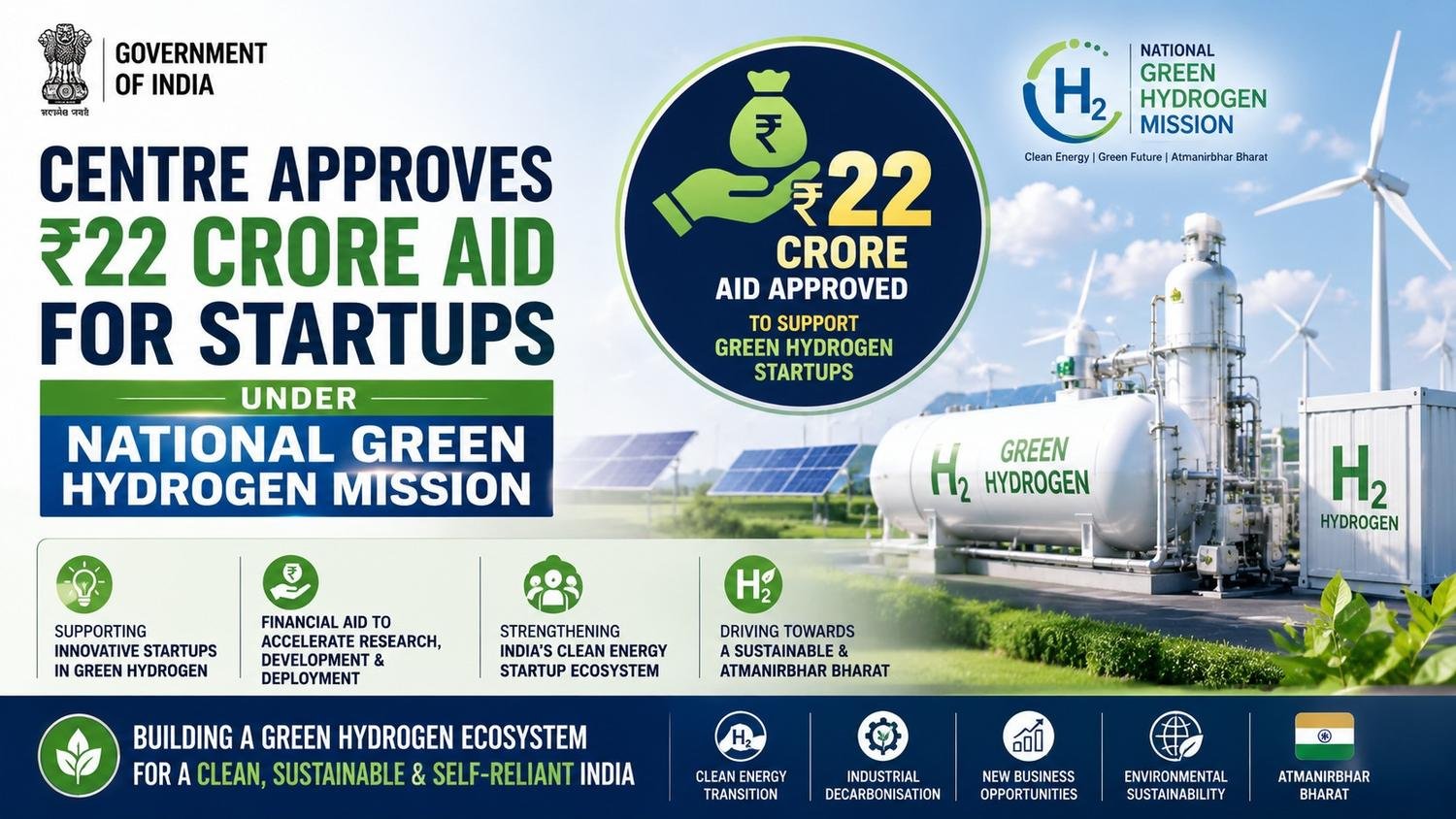
- The Central Government has approved ₹22 crore in financial assistance for nine startups under the National Green Hydrogen Mission (NGHM).
- The announcement marks the first batch of support under the mission’s dedicated ₹100 crore startup programme.
- Union Minister for New and Renewable Energy Pralhad Joshi made the announcement during a National Green Hydrogen Mission workshop organized by the Ministry of New and Renewable Energy (MNRE).
- The government also launched the Green Hydrogen Certification Portal of India (GHCI), a significant initiative aimed at improving transparency, certification, and regulatory compliance within the emerging green hydrogen sector.
First Batch of Startup Funding Approved
- The newly approved ₹22 crore support package will benefit nine startups working in various segments of the green hydrogen value chain.
- The assistance comes under the ₹100 crore startup support programme established as part of the National Green Hydrogen Mission.
- The objective is to:
- Encourage innovation in hydrogen technologies.
- Support indigenous research and development.
- Accelerate commercialization of hydrogen solutions.
- Build a strong domestic hydrogen ecosystem.
- Promote startup participation in India’s energy transition.
The funding is expected to help startups scale technologies and contribute to India’s clean energy ambitions.
Green Hydrogen Certification Portal Launched
- Alongside the funding announcement, the government launched the Green Hydrogen Certification Portal of India (GHCI).
- The portal will play a crucial role in implementing the Green Hydrogen Certification Scheme of India.
Key Objectives of the Portal
- Verify green hydrogen production standards.
- Ensure regulatory compliance.
- Facilitate certification processes.
- Improve transparency in hydrogen markets.
- Support domestic and international trade.
The certification framework is expected to boost investor confidence and help establish India’s credibility in the global hydrogen economy.
States Asked to Accelerate Policy Implementation
Addressing stakeholders during the workshop, Union Minister Pralhad Joshi urged state governments to expedite the implementation of their green hydrogen policies.
He emphasized that states which have already finalized their policies should focus on execution and achieving their intended targets.
According to the government:
- Six states have notified dedicated green hydrogen policies.
- Seven states have integrated hydrogen into existing industrial and renewable energy policies.
- Four additional states are currently finalizing their policy frameworks.
The Centre has assured full support to states for the development of hydrogen-related infrastructure and projects.
Incentives Offered by States
MNRE Secretary Santosh Sarangi highlighted several facilitation measures introduced by states to attract green hydrogen investments.
These include:
Capital Expenditure (Capex) Subsidies
Financial assistance for setting up hydrogen production facilities and associated infrastructure.
Electricity Duty Waivers
Reduction or elimination of electricity-related taxes to lower production costs.
Wheeling Charge Exemptions
Waivers on charges associated with the transmission of renewable electricity used in hydrogen production.
These incentives are expected to improve project viability and attract private investment.
Technology Advancements Reducing Costs
One of the biggest challenges in green hydrogen production has been high energy consumption.
However, technological advancements are steadily improving efficiency.
Alkaline Electrolyzers
Earlier technologies required approximately:
- 55 units of electricity to produce one kilogram of hydrogen.
Proton Exchange Membrane (PEM) Technology
Newer systems have reduced consumption to:
- 46–48 units per kilogram of hydrogen.
Solid Oxide Electrolyzer Cells (SOEC)
Emerging technologies could further reduce electricity requirements to:
- 38–42 units per kilogram.
- Potentially as low as 33 units.
Lower electricity consumption can significantly improve the economics of green hydrogen production.
What is Green Hydrogen?
- Green hydrogen is hydrogen produced using renewable energy sources such as solar and wind power through a process called electrolysis.
- Unlike conventional hydrogen production methods that rely on fossil fuels, green hydrogen generates little to no carbon emissions.
Key Uses of Green Hydrogen
- Fertilizer production
- Steel manufacturing
- Refining industries
- Heavy transport
- Shipping
- Aviation fuels
- Power generation
It is widely regarded as a critical component of global decarbonization efforts.
National Green Hydrogen Mission
- The National Green Hydrogen Mission was launched by the Government of India in 2023.
- Mission Outlay: ₹19,744 crore
- Main Objective: 5 million metric tonnes (MMT) of annual green hydrogen production capacity by 2030.
Broader Goals
- Reduce fossil fuel imports.
- Strengthen energy security.
- Promote clean energy manufacturing.
- Create green jobs.
- Position India as a global hydrogen hub.
The mission is one of the world’s largest government-backed hydrogen initiatives.
Why This Matters for India
- India is among the largest importers of fossil fuels globally.
- The development of a robust green hydrogen ecosystem can provide several long-term benefits:
- Energy Independence: Reducing dependence on imported oil, gas, and coal.
- Climate Commitments: Supporting India’s net-zero and climate mitigation goals.
- Industrial Competitiveness: Providing low-carbon energy solutions to key industries.
- Export Opportunities: Positioning India as a major exporter of green hydrogen and hydrogen derivatives.
- Employment Generation: Creating new opportunities in manufacturing, technology, and clean energy sectors.
Conclusion
- The approval of ₹22 crore support for green hydrogen startups and the launch of the Green Hydrogen Certification Portal represent important milestones in India’s clean energy transition.
- By supporting innovation, reducing regulatory barriers, and encouraging state-level participation, the government is laying the foundation for a robust hydrogen economy.
- As technology continues to improve and investments increase, the National Green Hydrogen Mission is expected to play a pivotal role in achieving India’s energy security, industrial growth, and climate objectives by 2030.