

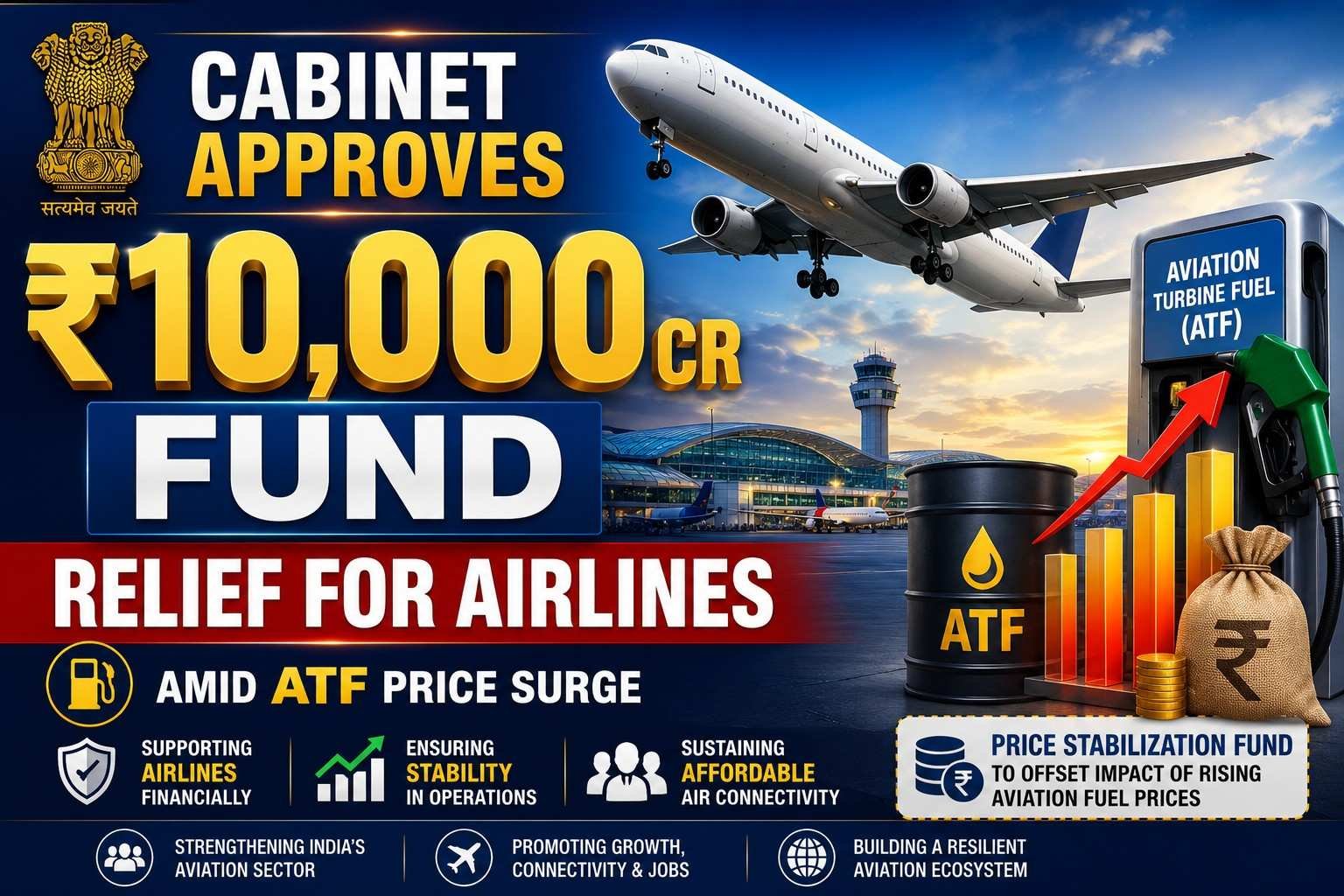
- The Union Cabinet, chaired by Prime Minister Narendra Modi, has approved a one-time budgetary support of up to ₹10,000 crore to help stabilize Aviation Turbine Fuel (ATF) prices for Scheduled Indian Airlines.
- The decision comes in response to the sharp rise in global fuel prices triggered by the ongoing West Asia crisis.
- The support will be provided to Oil Marketing Companies (OMCs) in the form of interest-free advances through the Ministry of Petroleum and Natural Gas, enabling them to offer ATF price stabilization support to Indian airlines for both domestic and international operations.
Why Was the Fund Needed?
The aviation sector has been severely impacted by the sharp increase in global ATF prices.
- ATF prices surged from ₹60.50 per litre in March 2026 to ₹142 per litre in May 2026.
- ATF accounts for nearly 40% of airline operating costs and can rise to 60% during periods of extreme volatility.
- The closure of Pakistani airspace for Indian airlines has further increased fuel consumption and operational costs due to longer flight routes.
These developments have put significant pressure on airline finances and led to rising airfares on several international routes.
Key Features of the Price Stabilization Fund
Interest-Free Support to OMCs
- The government will provide up to ₹10,000 crore as an interest-free advance to OMCs.
- The fund will compensate OMCs whenever international ATF prices exceed a benchmark price established under the approved mechanism.
Recovery Mechanism
- When global ATF prices decline, the differential amount will be recovered from OMCs and returned to the Consolidated Fund of India.
- The arrangement will continue until the entire support amount is fully recovered.
Coverage of Domestic and International Operations
The scheme will be available to all willing Scheduled Indian Airlines for:
- Domestic flights
- International flights
This ensures comprehensive support across the aviation sector.
Fixed ATF Price Arrangement
The mechanism introduces a fixed-price arrangement for ATF, helping airlines reduce exposure to sudden spikes in fuel prices and improve financial planning.
Exclusive Procurement from OMCs
Participating airlines will procure ATF exclusively from OMCs under a Memorandum of Understanding (MoU).
The arrangement will remain in force for:
- Up to three years,
- Subject to annual review, or
- Until the support amount is fully recovered, whichever occurs earlier.
Monitoring and Oversight
A dedicated Monitoring Committee will supervise implementation.
The committee will include representatives from:
- Ministry of Civil Aviation
- Ministry of Petroleum and Natural Gas
- Department of Expenditure
All claims, recoveries, reconciliations, and settlements will be subject to audit.
Duration of the Scheme
The ATF price stabilization support will remain operational for:
- 36 months, with annual reviews, or
- Until the advance amount is fully recovered and settled.
The scheme may be extended beyond three years if necessary and approved by the competent authority.
Expected Benefits
- Stability for Airlines: The mechanism is expected to provide greater certainty in fuel costs, enabling airlines to improve operational and financial planning.
- Protection for OMCs: The fund will shield OMCs from losses arising due to temporary ATF price caps and volatile international fuel prices.
- Moderation in Airfares: By reducing the impact of fuel price shocks, the scheme may help moderate fare volatility and limit sudden increases in ticket prices for passengers.
- Improved Connectivity: The initiative is expected to support continued air connectivity to:
- Regional airports
- Tier-II cities
- Tier-III cities
- Remote regions, including airports developed under the UDAN scheme.
Employment and Economic Impact
Stable airline operations support employment across:
- Airlines
- Airports
- Ground handling services
- MRO (Maintenance, Repair and Overhaul) services
- Travel agencies
- Hospitality industry
- Logistics sector
The measure is also expected to boost tourism, trade, exports, and regional economic development.
Significance
The approval of the Price Stabilization Fund reflects the government’s effort to protect India’s aviation sector from extraordinary external shocks. By stabilizing fuel costs, the initiative aims to safeguard airline operations, maintain connectivity, support economic activity, and strengthen India’s integration with global markets during a period of geopolitical uncertainty.