

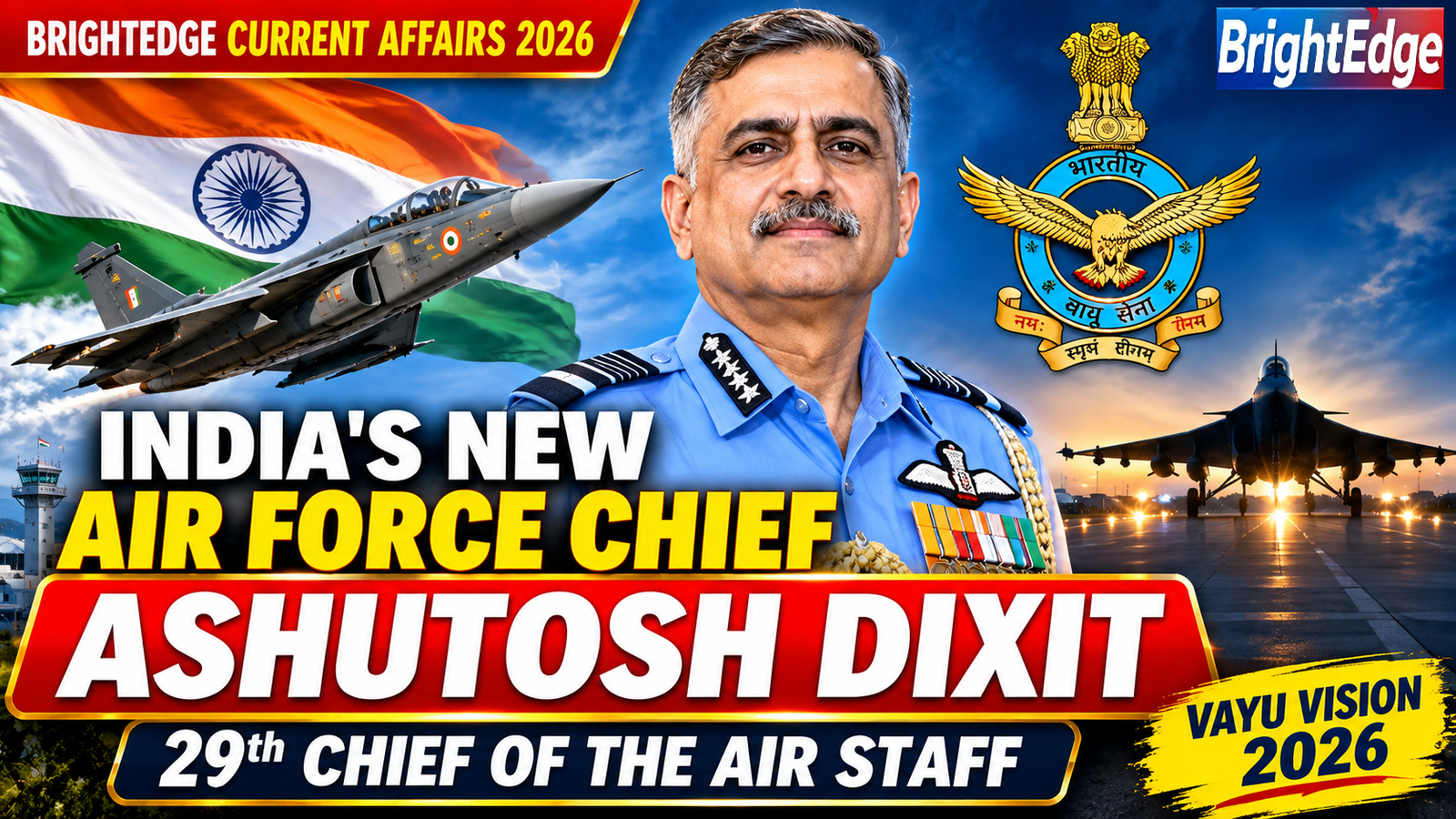
Air Chief Marshal Ashutosh Dixit has officially taken charge as the 29th Chief of the Air Staff (CAS) of the Indian Air Force (IAF) on 31 October 2026. He succeeds Air Chief Marshal Amar Preet Singh, who retired after completing 42 years of distinguished military service.
Before his appointment, Air Chief Marshal Dixit was serving as the Vice Chief of the Air Staff. With a distinguished military career spanning nearly four decades, he brings extensive experience in fighter operations, flight testing, capability development and strategic defence planning.
On 1 November 2026, following ceremonial events at the National War Memorial and Air Force Station New Delhi, the new Air Chief outlined his vision for the Indian Air Force under the guiding theme ‘VAYU’.
The framework focuses on operational readiness, indigenous defence capabilities, technological innovation and stronger coordination among India’s three armed services.
Key Highlights: Ashutosh Dixit Becomes 29th Chief of the Air Staff
- New Chief of the Air Staff: Air Chief Marshal Ashutosh Dixit.
- Position: 29th Chief of the Air Staff of the Indian Air Force.
- Assumed Office: 31 October 2026.
- Predecessor: Air Chief Marshal Amar Preet Singh.
- Previous Position: Vice Chief of the Air Staff.
- Flying Experience: More than 3,500 hours.
- Commissioning Date: 6 December 1986.
- Guiding Vision: VAYU.
- Alma Mater: National Defence Academy (NDA).
Who Is Air Chief Marshal Ashutosh Dixit?
- Air Chief Marshal Ashutosh Dixit is a senior Indian Air Force officer and an accomplished fighter pilot, Qualified Flying Instructor and Experimental Test Pilot.
- Born on 9 December 1966, he joined the Indian Air Force fighter stream on 6 December 1986 after completing his training at the National Defence Academy.
- During his nearly 40-year military career, he served in several important operational, command and strategic appointments.
- He has accumulated more than 3,500 hours of flying experience on different aircraft, including the Mirage-2000, various MiG variants, Kiran, Jaguar, IL-78, Hawk and Tejas.
- His professional expertise covers fighter operations, flight testing, aircraft modernisation, operational planning and defence capability development.
Educational Qualifications and Military Training
Air Chief Marshal Ashutosh Dixit has received professional military education from several prestigious defence institutions.
His educational qualifications include:
- National Defence Academy (NDA), India.
- Defence Services Command and Staff College, Bangladesh.
- National Defence College, New Delhi.
His advanced military education and operational experience have contributed to his career in command, strategic planning and defence leadership.
Major Military Appointments Held by Ashutosh Dixit
Before becoming the Chief of the Air Staff, Air Chief Marshal Dixit served in several important positions within the Indian Air Force and India’s integrated defence establishment.
Some of his significant appointments include:
| Appointment | Organisation / Responsibility |
|---|---|
| Commanding Officer | Mirage-2000 Squadron |
| Commander | Forward Base Support Unit in Western Sector |
| Air Officer Commanding | Air Force Station Bidar |
| Air Defence Commander | Southern Air Command |
| Senior Air Staff Officer | South Western Air Command |
| Deputy Chief of the Air Staff | Indian Air Force |
| Air Officer Commanding-in-Chief | Central Air Command |
| Chief of Integrated Defence Staff | HQ Integrated Defence Staff |
| Vice Chief of the Air Staff | Indian Air Force |
| Chief of the Air Staff | Indian Air Force |
- He also served as Chief of Integrated Defence Staff to the Chairman, Chiefs of Staff Committee during Operation Sindoor.
- His experience across operational commands and integrated defence planning represents an important part of his military career.
Contribution to India’s Indigenous Fighter Aircraft Programmes
- One of the important aspects of Air Chief Marshal Dixit’s professional career has been his contribution to the modernisation of India’s air combat capabilities.
- According to the Ministry of Defence, he played an instrumental role in finalising the Jaguar and MiG-27 upgrade projects.
- He also contributed to the completion of the Initial Operational Clearance (IOC) and Final Operational Clearance (FOC) activities of the Light Combat Aircraft (LCA) Tejas Mk-1 programme.
- These initiatives formed part of India’s efforts to strengthen indigenous aerospace capabilities and modernise its combat aircraft fleet.
- His experience in capability development and aircraft modernisation is particularly relevant as the Indian Air Force continues to expand its indigenous defence technology ecosystem.
Air Chief Marshal Ashutosh Dixit’s Military Awards and Decorations
In recognition of his distinguished military service, Air Chief Marshal Dixit has received several prestigious gallantry and service decorations.
| Award / Decoration | Year |
|---|---|
| Vayu Sena Medal (VM) | 2006 |
| Vishisht Seva Medal (VSM) | 2011 |
| Ati Vishisht Seva Medal (AVSM) | 2023 |
| Param Vishisht Seva Medal (PVSM) | 2026 |
These decorations recognise his contributions and distinguished service to the Indian Air Force.
What Is the VAYU Vision Announced by the New Air Force Chief?
- One of the major developments following Air Chief Marshal Ashutosh Dixit’s appointment was the announcement of his strategic vision for the Indian Air Force under the theme VAYU.
- On 1 November 2026, he outlined four pillars that will guide the future direction of the service.
VAYU represents four strategic priorities:
1. V – Vigilance, Victory and Readiness
The first pillar focuses on maintaining a high level of operational preparedness across all formations of the Indian Air Force.
Its priorities include:
- Maintaining combat readiness across the force.
- Strengthening air defence preparedness.
- Ensuring operational readiness of squadrons and radar units.
- Restoring the IAF’s combat strength towards its sanctioned levels.
The objective is to ensure that the Indian Air Force remains prepared to respond to emerging security challenges.
2. A – Aatmanirbharta
Aatmanirbharta refers to self-reliance in defence manufacturing and technology.
Under this pillar, the IAF will focus on strengthening indigenous capabilities across:
- Aircraft and aerospace platforms.
- Sensors and advanced technologies.
- Indigenous weapons systems.
- Modern defence equipment.
- Sustainable operational capabilities.
The vision emphasises developing and deploying Indian-made defence solutions to enhance the country’s long-term military self-reliance.
3. Y – Yukti
Yukti represents ingenuity, innovation and the application of advanced technology in military operations.
The focus areas include:
- Artificial Intelligence-enabled command and control.
- Advanced military doctrines and operational procedures.
- Counter-drone technologies.
- Improved maintenance systems.
- Force protection and resilience.
- Emerging operational domains, including near-space.
This pillar recognises the growing importance of emerging technologies in modern aerial warfare.
4. U – Unity of Effort
The fourth pillar emphasises stronger coordination and joint operations among India’s three armed services.
It focuses on:
- Better coordination between the Indian Army, Navy and Air Force.
- Integrated operational planning.
- Joint military capabilities.
- Cooperation with national agencies.
- Strengthening India’s overall defence preparedness.
The approach aligns with the national vision of JAI – Jointness, Aatmanirbharta and Innovation.
Through the VAYU framework, the new Air Chief aims to develop an operationally ready, technologically advanced, self-reliant and integrated Indian Air Force.
Important Facts for Competitive Examinations
| Question | Answer |
|---|---|
| Who is the 29th Chief of the Air Staff of India? | Air Chief Marshal Ashutosh Dixit |
| When did he assume charge? | 31 October 2026 |
| Who was his predecessor? | Air Chief Marshal Amar Preet Singh |
| What was his previous position? | Vice Chief of the Air Staff |
| When was he commissioned into the IAF? | 6 December 1986 |
| How many flying hours does he have? | More than 3,500 hours |
| Which institution did he graduate from? | National Defence Academy |
| What is his guiding vision for the IAF? | VAYU |
| What does VAYU stand for? | Vigilance, Victory and Readiness; Aatmanirbharta; Yukti; Unity of Effort |
| Which aircraft upgrade projects did he contribute to? | Jaguar and MiG-27 |
| Which indigenous aircraft programme did he contribute to? | LCA Tejas Mk-1 |
Click here to read: IAF Ranked 3rd Most Powerful Air Force in the World
Click here to read: DRDO and Indian Air Force Successfully Test Indigenous TARA Glide Weapon