

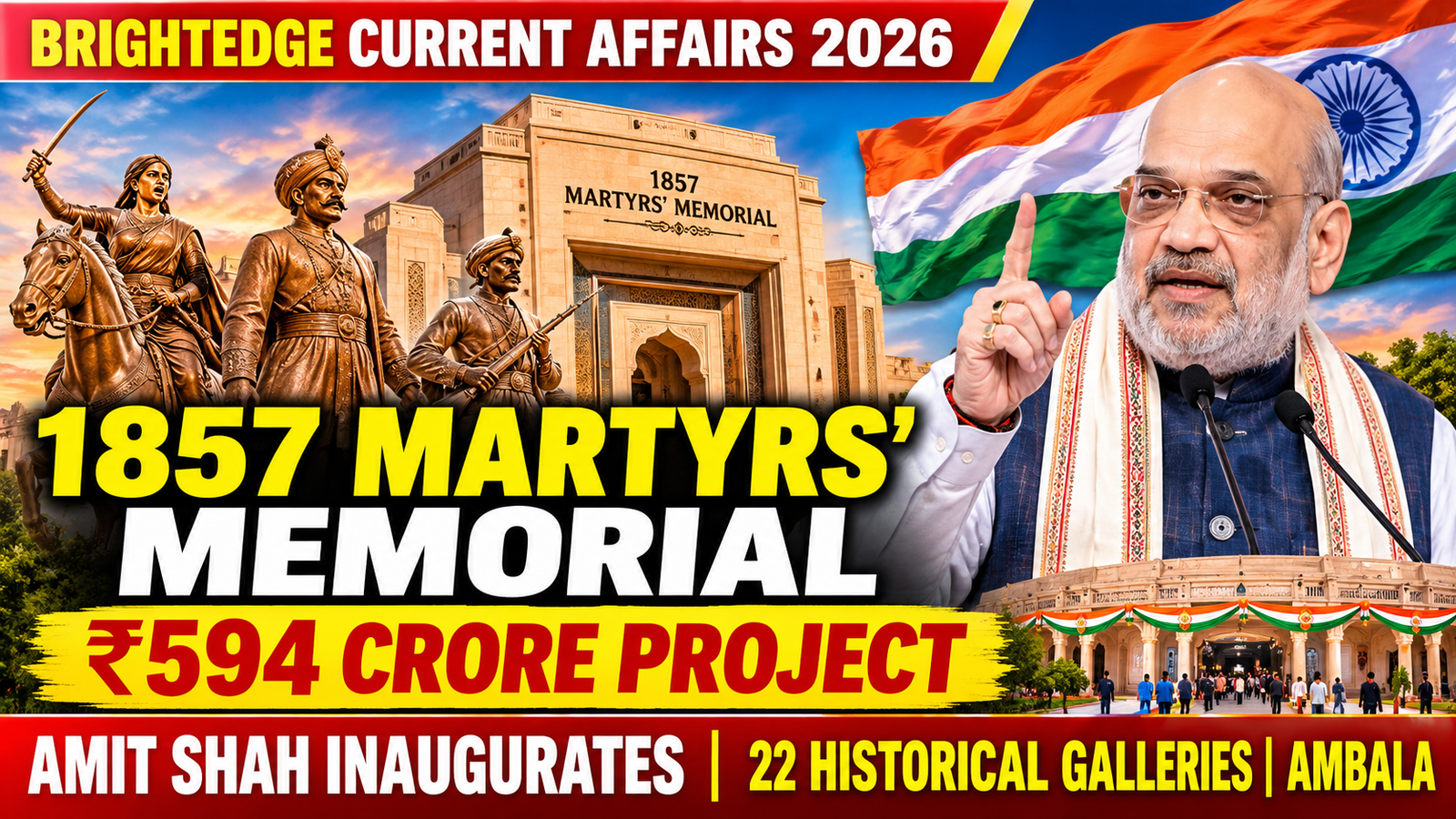
Union Home Minister and Minister of Cooperation Amit Shah inaugurated the Martyrs’ Memorial of the First War of Independence of 1857 in Ambala Cantonment, Haryana, on November 5, 2026.
Built across 22 acres at an estimated cost of ₹594 crore, the memorial has been established to honour the sacrifices of India’s freedom fighters and preserve the historical legacy of the 1857 uprising.
The memorial features 22 galleries showcasing significant events, combines historical documents, traditional Indian craftsmanship and modern technologies, including Virtual Reality (VR), holography and interactive projections, to bring the history of India’s freedom struggle to life.
Haryana Chief Minister Nayab Singh Saini and Union Minister Manohar Lal were among the dignitaries present during the inauguration.
1857 Uprising: Why Ambala Holds Historical Significance
- Ambala occupies an important place in the history of India’s freedom struggle.
- On May 10, 1857, revolutionary soldiers sounded the bugle of armed rebellion against British colonial rule in Ambala Cantonment. The uprising subsequently spread to different parts of the country, challenging the authority of the British East India Company.
- The uprising of 1857 is widely recognised as the First War of Indian Independence. It marked a significant turning point in India’s struggle against colonial domination.
- During his address, Amit Shah highlighted the historical importance of the 1857 uprising and said that the movement shook the foundations of the British Empire.
- He also referred to the writings of Veer Savarkar, who described the 1857 uprising as India’s First War of Independence rather than merely a revolt.
Key Features of the 1857 Martyrs’ Memorial
The newly inaugurated memorial has been designed as an educational, historical and cultural destination.
Its major features include:
1. Spread Across 22 Acres
The memorial has been developed over approximately 22 acres of land in Ambala, Haryana.
2. Construction Cost of ₹594 Crore
The project has been developed at an estimated cost of ₹594 crore, reflecting a major investment in preserving India’s historical heritage.
3. 22 Historical Galleries
The memorial contains 22 galleries depicting important events, personalities and developments associated with the 1857 freedom struggle.
4. Virtual Reality and Holography
Modern technologies such as Virtual Reality, holography and interactive projections have been incorporated to provide visitors with an immersive historical experience.
5. Traditional Haryana Art and Craftsmanship
The memorial showcases traditional regional art forms, including Phulkari embroidery and Sarkanda craftsmanship, connecting India’s freedom struggle with Haryana’s cultural heritage.
6. Open-Air Theatre
A large open-air theatre with a seating capacity of approximately 2,500 people has also been developed within the complex.
7. Light and Sound Show
A special light-and-sound presentation recreates important episodes from the 1857 uprising, helping visitors understand the historical events and sacrifices of freedom fighters.
Freedom Fighters Remembered in the 1857 Memorial
During the inauguration, Amit Shah paid tribute to several prominent personalities associated with the 1857 uprising.
Some of the notable freedom fighters included:
- Nana Saheb Peshwa: One of the prominent leaders of the 1857 uprising.
- Rani Lakshmibai: The legendary Queen of Jhansi who became a symbol of courage and resistance.
- Tatya Tope: A prominent military commander who played a major role in the uprising.
- Begum Hazrat Mahal: A leading figure of the rebellion in Awadh.
These revolutionaries and countless others made immense sacrifices in the struggle against British colonial rule.
Significance of the Martyrs’ Memorial
The inauguration of the 1857 Martyrs’ Memorial is significant for several reasons:
- Historical Preservation: It provides a dedicated space to preserve and showcase the legacy of the 1857 freedom struggle.
- Educational Importance: The 22 galleries offer students, researchers and history enthusiasts an opportunity to understand India’s independence movement.
- Technological Integration: Virtual Reality, holography and interactive projections make historical learning more engaging.
- National Heritage: The memorial honours the contributions of freedom fighters and strengthens awareness of India’s historical identity.
- Tourism Development: The complex has the potential to become an important historical and cultural tourism destination in Haryana.
Click here to read: Sardar Vallabhbhai Patel: The Iron Man Who United India
Click here to read: Ashoke Sen Wins Oskar Klein Medal 2026: First Indian Physicist