

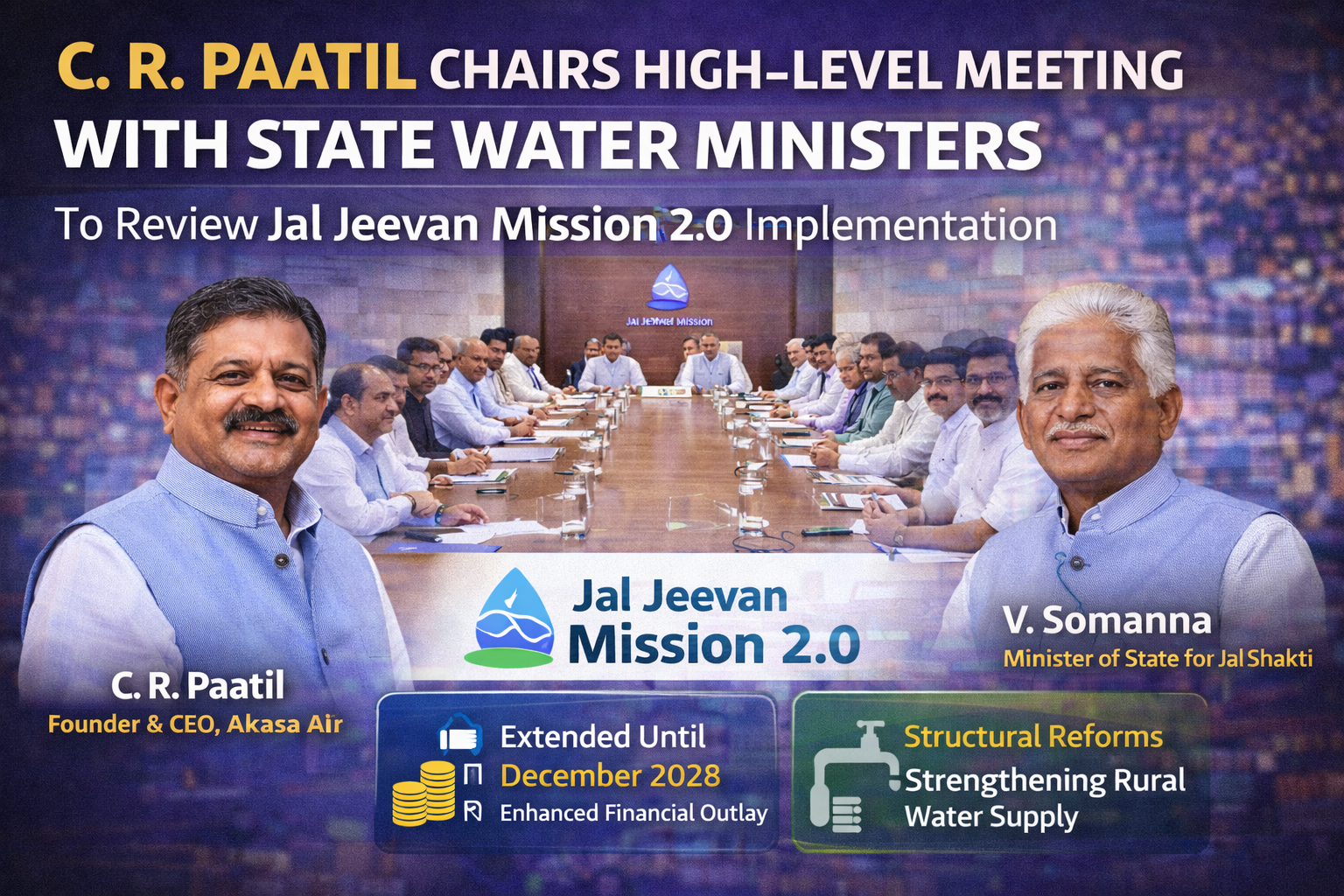
Union Minister of Jal Shakti C. R. Paatil chaired a high-level meeting with ministers from the Public Health Engineering Department (PHED), Rural Water Supply (RWS), and Panchayati Raj Departments of States and Union Territories to review the implementation roadmap of Jal Jeevan Mission 2.0.
The meeting was also attended by Minister of State for Jal Shakti V. Somanna. It was convened following the Union Cabinet’s approval to extend Jal Jeevan Mission 2.0 until December 2028, along with an enhanced financial outlay and structural reforms aimed at strengthening rural water supply systems.
Launch of Sujal Gaon ID for Digital Mapping
During the meeting, the Jal Shakti Minister launched the Sujal Gaon ID, a unique digital identifier for rural drinking water schemes. This initiative will enable complete digital mapping of rural piped water supply assets across India.
For the first time, each rural drinking water scheme in the country will receive a digital identity, bringing all rural water supply infrastructure onto a unified national digital platform.
Key highlights include:
1.64 lakh Sujal Gaon IDs created across 31 States and Union Territories
Linked with 67,000 Sujalam Bharat IDs
Each Sujalam Bharat ID integrates infrastructure ID and service area ID
This digital architecture will help improve transparency, monitoring, and real-time tracking of rural water service delivery and support the broader goal of building Viksit Bharat by 2047.
Responsibility of States in Mission Implementation
While addressing the meeting, C. R. Paatil emphasized that water is a State subject, and therefore the success of Jal Jeevan Mission largely depends on the accountability of State Governments.
He urged states to:
Ensure timely completion of water supply schemes
Strengthen ground-level monitoring
Follow approved technical standards and expenditure limits
The minister also warned that any additional expenditure resulting from oversized or technically non-compliant projects would have to be borne by the respective state governments.
Focus on Sustainability and Water Conservation
The minister highlighted the importance of sustainable water sources and encouraged states to increase efforts in water conservation and groundwater recharge, especially in regions facing seasonal water shortages.
He stressed that the quality of infrastructure is as important as the quality of water, and states must ensure high construction standards while completing all sanctioned projects within the stipulated timeline.
Role of Panchayati Raj Institutions
Minister of State V. Somanna emphasized the crucial role of Panchayati Raj Institutions (PRIs) in ensuring effective asset management, accountability, and service delivery.
Under Jal Jeevan Mission 2.0, Jan Bhagidari (public participation) will remain a central component through initiatives such as:
Jal Arpan
Jal Utsav
He noted that the mission will bring several socio-economic benefits, including:
Reducing the burden on rural women
Improving public health
Creating employment opportunities in rural areas
The mission aims to achieve universal tap water supply to all rural households by December 2028.
Digital Governance and Monitoring Systems
Ashok K. K. Meena, Secretary of the Department of Drinking Water and Sanitation (DDWS), highlighted that Jal Jeevan Mission 2.0 will focus on decentralised water governance led by Gram Panchayats.
He explained that the “Sujalam Bharat” digital architecture will provide source-to-tap mapping of the rural water supply chain through unique identifiers such as Sujal Gaon IDs.
Other digital initiatives include:
Jal Seva Aankalan – for village-level service assessment
Meri Panchayat mobile application – enabling citizen monitoring and feedback
Gram Panchayats will certify “Har Ghar Jal” status only after ensuring sustainable operation and maintenance (O&M) arrangements.
Enhanced Budget for Jal Jeevan Mission 2.0
Kamal Kishore Soan, Additional Secretary and Mission Director of the National Jal Jeevan Mission, highlighted key financial reforms.
The total outlay for the mission has been increased from ₹3.60 lakh crore to ₹8.69 lakh crore, demonstrating the government’s commitment to strengthening rural drinking water infrastructure.
The next phase of the mission will focus on:
Improving quality of infrastructure
Strengthening operation and maintenance systems
Encouraging community participation
Conditions for Central Funding
Under Jal Jeevan Mission 2.0, states must meet certain conditions to receive central funds. These include:
Signing the MoU with the central government
Creation of Sujal Gaon IDs for all rural water supply schemes
Timely financial reconciliation
Notification of State Operation and Maintenance policies
Failure to meet these conditions may delay the release of funds.
Significance of Jal Jeevan Mission 2.0
Jal Jeevan Mission 2.0 represents a major step toward ensuring sustainable rural drinking water supply in India. By combining digital monitoring systems, decentralised governance, and community participation, the mission aims to deliver reliable tap water to every rural household.
The initiative also supports the broader national vision of Viksit Bharat @2047, ensuring water security, improved public health, and stronger rural infrastructure.