

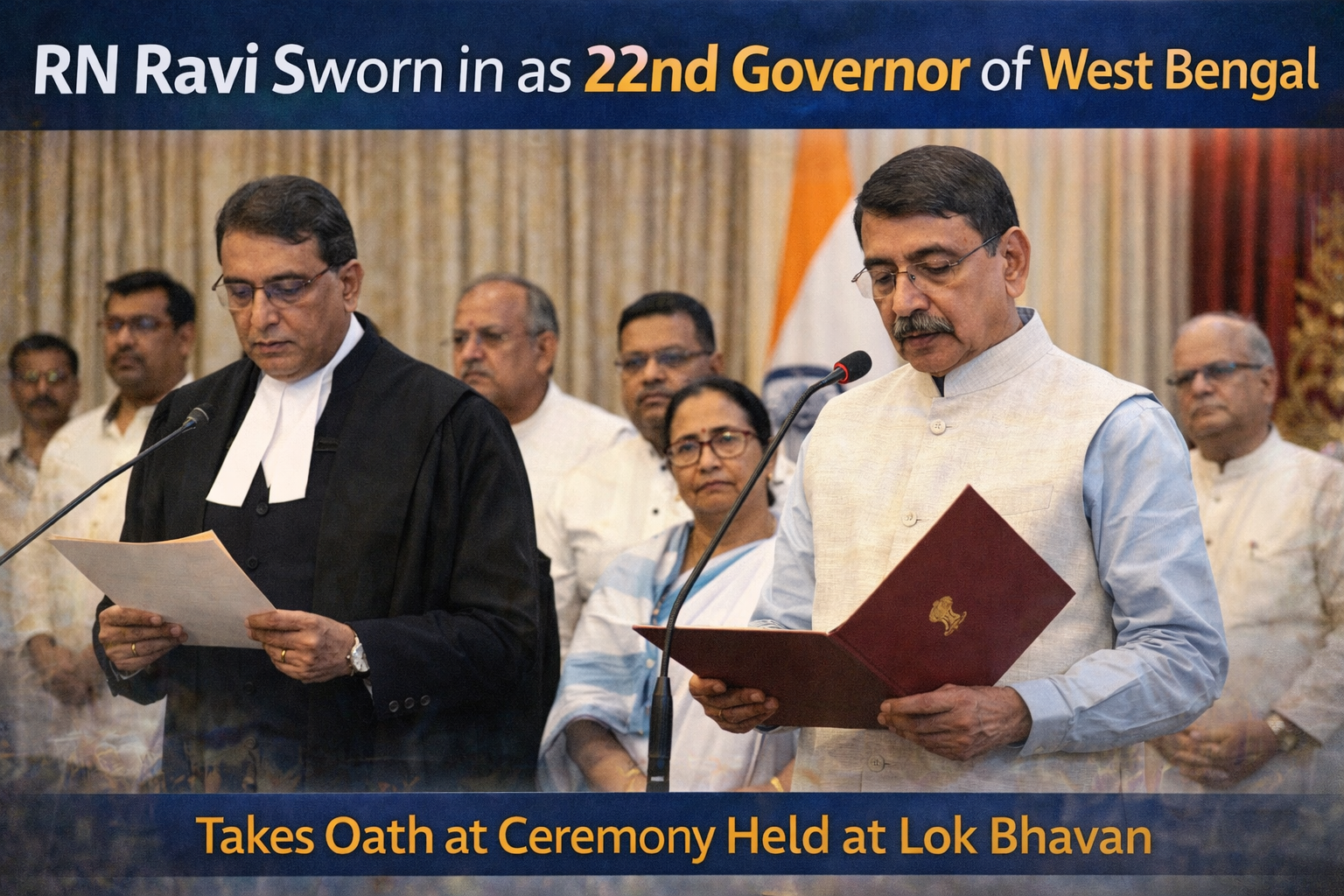
Former IPS officer Ravindra Narayana Ravi (RN Ravi) took oath as the 22nd Governor of West Bengal at a ceremony held at Lok Bhavan. The oath of office was administered by Sujoy Paul, Chief Justice of the Calcutta High Court.

The ceremony was attended by Mamata Banerjee, Chief Minister of West Bengal, Biman Banerjee, Assembly Speaker, Firhad Hakim, Mayor of Kolkata, and Biman Bose, Chairman of the Left Front. Senior officials including Nandini Chakravorty, Chief Secretary of West Bengal, were also present.
RN Ravi assumed office following the resignation of the previous governor C. V. Ananda Bose on March 5. Earlier, he served as Governor of Nagaland, Meghalaya, and Tamil Nadu.
Constitutional Provisions Related to the Governor in India
The office of the Governor is an important constitutional post defined under the Constitution of India. The Governor acts as the constitutional head of a state and represents the President at the state level.
Key Constitutional Articles
Article 153 – Governors of States
Provides that there shall be a Governor for each state. One person can also be appointed as Governor of two or more states.
Article 154 – Executive Power of the State
The executive power of the state is vested in the Governor and exercised either directly or through officers subordinate to him.
Article 155 – Appointment of Governor
The Governor is appointed by the President of India by warrant under his hand and seal.
Article 156 – Term of Office
The Governor holds office during the pleasure of the President. Normally, the tenure is five years.
Article 157 – Qualifications
To become a Governor, a person must:
Be a citizen of India
Be at least 35 years of age
Article 158 – Conditions of Office
The Governor cannot be a member of Parliament or a state legislature.
If such a person is appointed Governor, they must resign from the legislature.
The Governor cannot hold any office of profit.
Article 159 – Oath or Affirmation
The Governor takes oath before the Chief Justice of the High Court of the concerned state.
Powers and Functions of the Governor
1. Executive Powers
Appoints the Chief Minister and other ministers.
Appoints key officials like the Advocate General and State Election Commissioner.
All executive actions of the state government are taken in the name of the Governor.
2. Legislative Powers
Summons, prorogues, and dissolves the state legislative assembly.
Gives assent to bills passed by the state legislature.
Can reserve certain bills for the consideration of the President.
3. Financial Powers
Money Bills can be introduced in the state legislature only with the Governor’s recommendation.
The state budget is presented with the Governor’s approval.
4. Judicial Powers
Can grant pardon, reprieve, respite, or remission of punishment under Article 161.
5. Emergency Powers
The Governor can recommend President’s Rule in a state under Article 356 if constitutional machinery fails.