

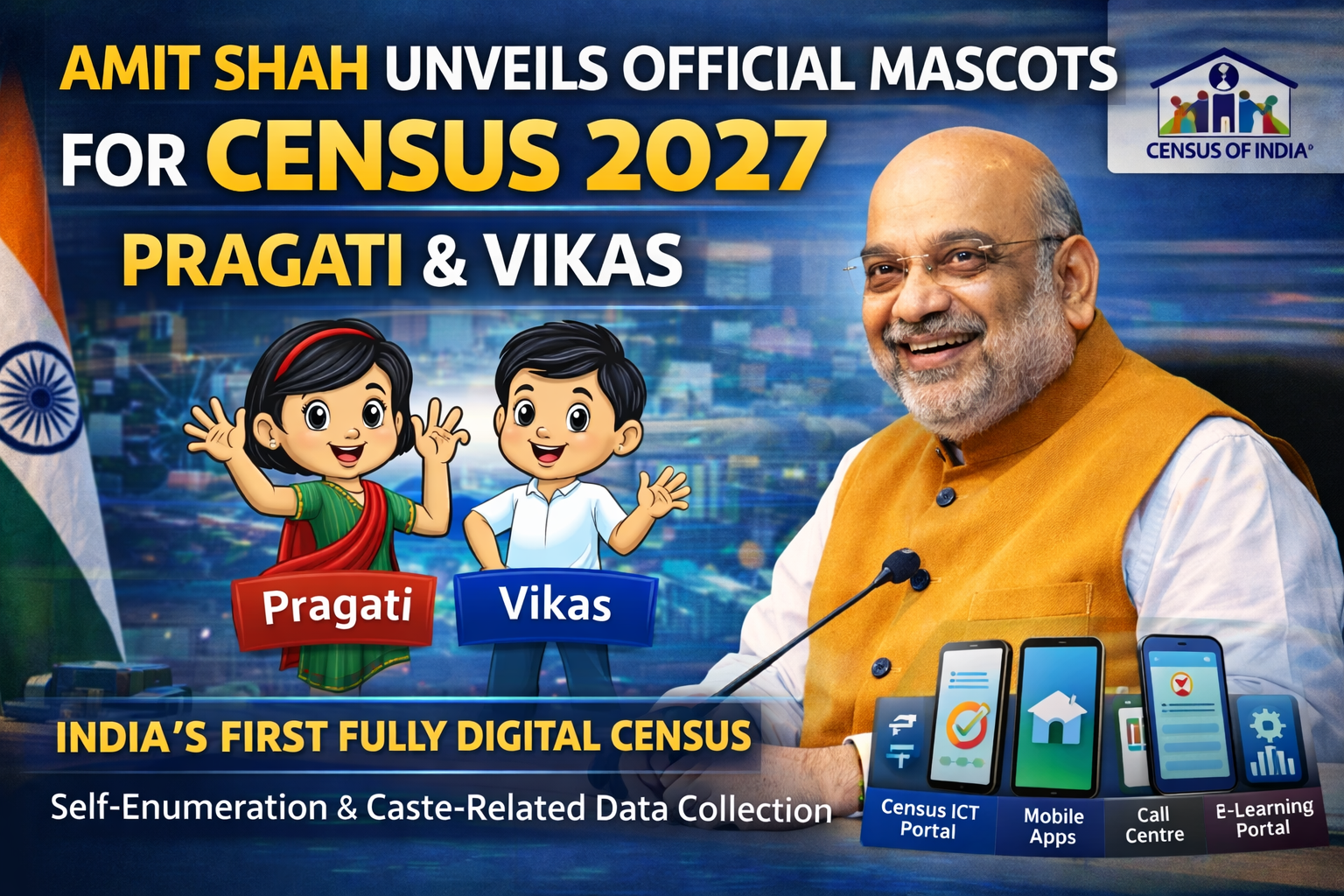
Union Home Minister Amit Shah unveiled two official mascots — Pragati and Vikas — for the upcoming Population Census 2027 on March 5, 2026.
Along with the mascots, the Minister also soft launched four digital platforms that will support the nationwide enumeration exercise. The initiative marks a major step toward modernising the census process through technology.
Notably, Census 2027 will be India’s first fully digital census, and it will also allow self-enumeration and the collection of caste-related data.

India’s First Fully Digital Census
The government is adopting advanced digital tools to improve the accuracy, efficiency, and transparency of the census process. These digital platforms have been developed by Centre for Development of Advanced Computing.
Mascots ‘Pragati’ and ‘Vikas’
The mascots introduced for Population Census 2027 are:
- Pragati – representing a female enumerator
- Vikas – representing a male enumerator
According to the Ministry of Home Affairs, these mascots symbolise equal participation of women and men in nation-building and highlight India’s vision of becoming a developed nation by 2047.
The mascots will help communicate key messages about the census in a citizen-friendly and relatable manner, ensuring wider public awareness and participation.
Four Digital Platforms Launched
To streamline the census process, the government introduced four digital tools:
1. Houselisting Block Creator (HLBC)
HLBC is a web-based mapping application that enables charge officers to digitally create houselisting blocks using satellite imagery. This ensures uniform geographic coverage and improves planning for enumeration.
2. HLO Mobile Application
The HLO mobile app will be used by enumerators to collect houselisting data during field visits.
Key features include:
- Secure and offline data collection
- Direct field-to-server data transmission
- Eliminates traditional paperwork
- Works on Android and iOS
- Supports 16 regional languages
Only enumerators registered on the Census Management and Monitoring System (CMMS) will be able to access the application.
3. Self-Enumeration (SE) Portal
For the first time, households will have the option of self-enumeration.
Through the SE portal, eligible respondents can submit household information online before the field survey begins. Once the information is submitted, the system generates a Self-Enumeration ID (SE ID).
This ID can then be shared with the enumerator, who will verify the details during the survey.
4. Census Management and Monitoring System (CMMS)
The CMMS portal will serve as the central digital platform for planning and monitoring census activities.
Officials at sub-district, district, and state levels will be able to track:
- Enumeration progress
- Field performance
- Operational readiness
The integrated dashboard will provide real-time updates to ensure efficient implementation of the census.
Two Phases of Census 2027
The Population Census 2027 will be conducted in two major phases.
Phase 1: Houselisting and Housing Census
- Period: April 1 to September 30, 2026
- Conducted within a 30-day window notified by each state or union territory
- Includes an optional 15-day self-enumeration period before the survey
Phase 2: Population Enumeration
- Scheduled for February 2027 across the country
- In snowbound regions such as Ladakh, Jammu and Kashmir, Himachal Pradesh, and Uttarakhand, enumeration will take place earlier in September 2026
During this phase, caste-related questions will also be included.
Massive Nationwide Operation
The government plans to deploy over 30 lakh enumerators, supervisors, and census officials for the nationwide exercise.
Data will be collected door-to-door using secure mobile applications, ensuring comprehensive coverage of the population.
The launch of mascots and digital platforms marks a major milestone in preparing for the Population Census 2027. By integrating technology with traditional field operations, the government aims to make the census more accurate, transparent, and efficient.
The introduction of self-enumeration, mobile data collection, and real-time monitoring systems reflects India’s effort to modernise one of the world’s largest administrative exercises while ensuring inclusivity and data reliability.