

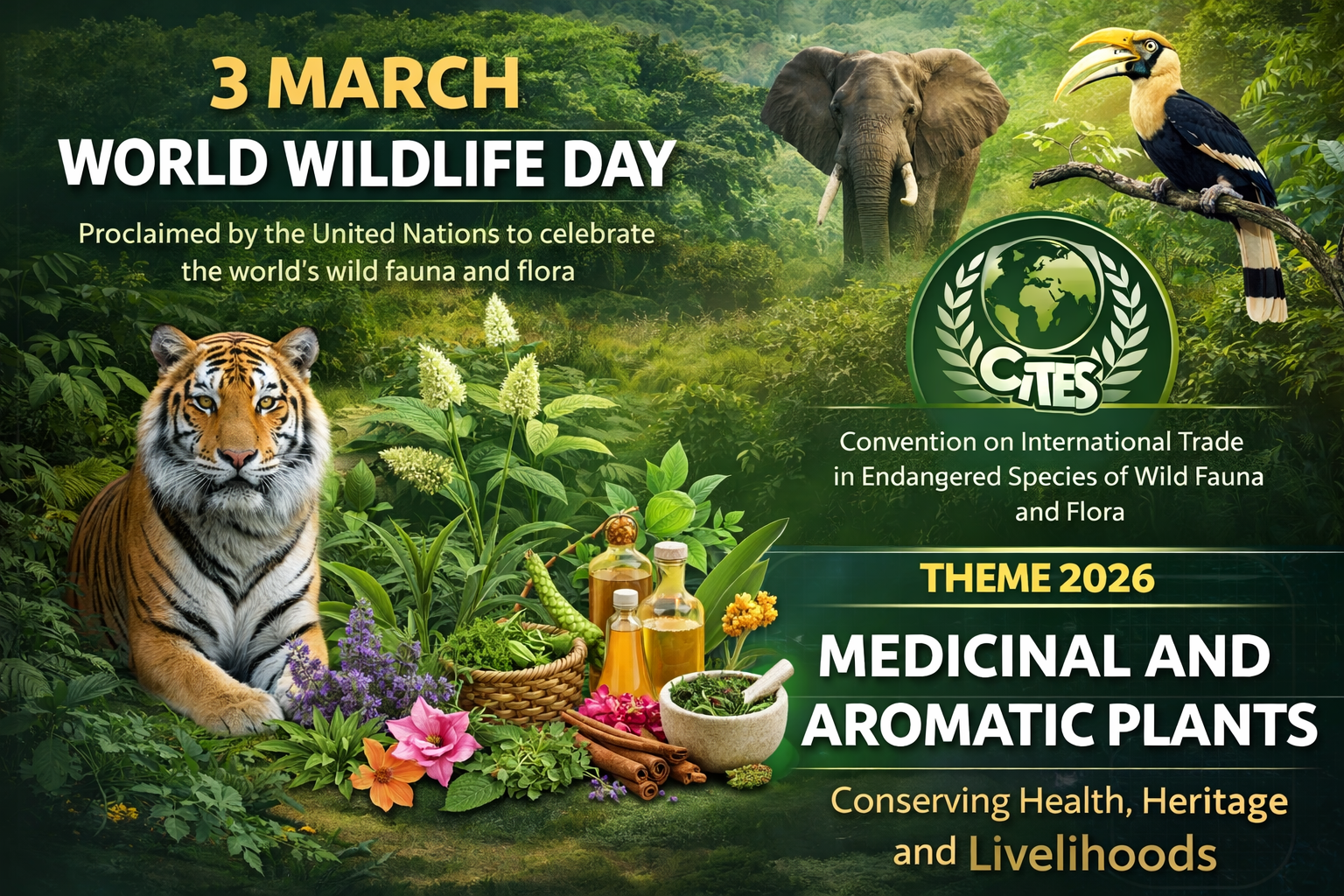
Every year on 3 March, the world observes World Wildlife Day, proclaimed by the United Nations to celebrate wild fauna and flora and raise awareness about their importance to people and the planet. The day marks the adoption of the Convention on International Trade in Endangered Species of Wild Fauna and Flora (CITES), reinforcing the global commitment to ensure that international trade in wildlife does not threaten species survival.

The theme for 2026 — “Medicinal and Aromatic Plants: Conserving Health, Heritage and Livelihoods” — highlights the importance of plant-based resources in healthcare systems, cultural traditions, and local economies.
Globally, nearly 70–95% of people in developing countries rely on traditional medicine for primary healthcare, much of which is derived from plants. Medicinal and aromatic plants form the backbone of traditional medical systems and contribute significantly to modern pharmaceuticals. Beyond healthcare, they also support pollinators, improve soil health, and enhance biodiversity.
For biodiversity-rich nations like India, conserving these plants is both an ecological necessity and a socio-economic priority.
India is one of the 17 mega biodiversity-rich countries and accounts for about 7% of the world’s biodiversity. The country has 15 agro-climatic regions and approximately 45,000 plant species, of which nearly 15,000 are medicinal. Around 8,000 species are actively used in Indian systems of medicine and folk traditions.
Nearly 70% of India’s medicinal and aromatic plants are found in tropical forests of the Western Ghats, Eastern Ghats, the Himalayas, and the Aravalli range.
The Botanical Survey of India has identified over 5,250 plant species and documented more than 9,567 folk medicinal claims.
To protect this rich heritage, the National Medicinal Plants Board (NMPB) plays a central role in promoting conservation, research, farmer training, awareness, and marketing support.
Conservation Mechanisms in India
In-Situ Conservation
- In-situ conservation protects plants in their natural habitats through national parks, biosphere reserves, and gene sanctuaries.
- One key initiative is the Medicinal Plants Conservation Area (MPCA) programme. Currently, 115 MPCA sites across India protect medicinal plant species while preserving associated biological and cultural diversity.
Ex-Situ Conservation
- Ex-situ conservation involves protecting plant genetic resources outside their natural habitats under controlled conditions.
- India conserves 9,361 medicinal plant accessions at the National Seed Gene Bank of the National Bureau of Plant Genetic Resources (NBPGR), New Delhi. These methods are especially useful for species with poor seed formation or vegetative propagation.
Major Government Schemes and Initiatives
National Ayush Mission (NAM)
- The Ministry of AYUSH earlier implemented the Medicinal Plant Component under the National Ayush Mission (2015–16 to 2020–21) to promote medicinal plant cultivation integrated with farming systems.
- Currently, the Ministry of Agriculture and Farmers Welfare promotes medicinal plants under the Mission for Integrated Development of Horticulture (MIDH), covering all States and UTs.
Central Sector Scheme by NMPB
The Government is implementing a Central Sector Scheme for Conservation, Development and Sustainable Management of Medicinal Plants with an outlay of ₹322.41 crore (2021–22 to 2025–26). It supports Medicinal Plants Conservation and Development Areas (MPCDAs), research, quality assurance, and plantation development.
e-CHARAK Platform
To strengthen market access, NMPB launched the e-CHARAK mobile app and web portal. The platform facilitates trade, provides fortnightly market prices of 100 medicinal plants from 25 herbal markets, and enables information exchange among farmers and stakeholders.
Medicinal Plants Business Centre (MPBC)
A new component — Medicinal Plants Business Centre (MPBC) — has been introduced to improve post-harvest management, scientific storage, grading, packaging, quality testing, and marketing infrastructure.
GI-Tagged Medicinal Plants of India
- Geographical Indication (GI) tagging helps protect India’s traditional plant heritage:
- Navara Rice (Kerala) – Used in Ayurvedic Panchakarma treatment.
- Green Cardamom (Kerala & Karnataka) – Used in Ayurveda for respiratory ailments.
- Ganjam Kewda Flower (Odisha) – Used in eye and respiratory treatments.
- Saffron (Jammu & Kashmir) – Used for migraine, wound healing, and skin disorders.
- Nagauri Ashwagandha – GI registered under an NMPB-supported project in 2025.
- These GI tags preserve traditional knowledge and ensure economic benefits to local communities.