

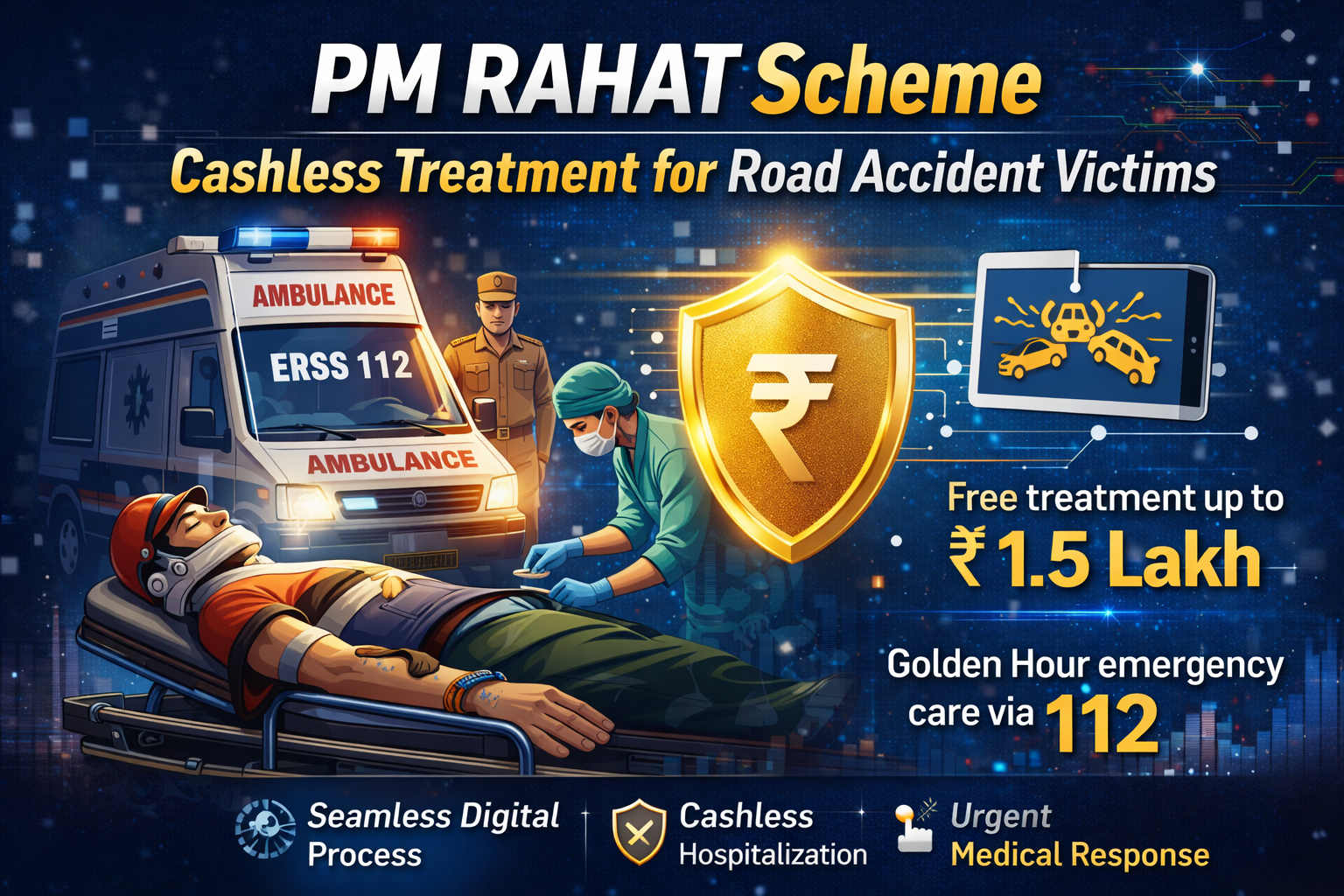
The Government of India has launched PM RAHAT Scheme for Cashless treatment for road accident victims. The new nationwide scheme called PM RAHAT (Road Accident Victim Hospitalization and Assured Treatment) aims to ensure that every road accident victim gets timely medical care without financial burden — especially critical in the “Golden Hour” after an accident.

Necessity of the Scheme:
India sees a large number of road accident fatalities every year, and many of these deaths are preventable if victims receive treatment quickly. Studies suggest that about half of all road accident deaths can be prevented if victims are admitted to a hospital within the first hour.
The Government’s focus with PM RAHAT is to establish a uniform, cashless, technology-driven system that ensures no one is denied treatment due to inability to pay.
Key Features of PM RAHAT
1. Cashless Treatment for Victims
- Every eligible road accident victim — whether on a national highway, state road, or local road — will be entitled to cashless treatment worth up to ₹1.5 lakh.
- This benefit will be available for up to 7 days from the accident date.
2. Golden Hour Rescue through ERSS 112
- The scheme is integrated with the Emergency Response Support System (ERSS) 112 helpline.
- Anyone at the accident site — the victim themselves, a witness, a Good Samaritan (called Rah-Veer in the scheme), etc. — can dial 112 to report the accident and request ambulance transport to the nearest designated hospital.
3. Timeline for Initial Treatment
- For non-life-threatening cases, hospitals will provide initial stabilization care for up to 24 hours.
- For life-threatening cases, stabilization care can extend up to 48 hours.
- These treatments are released quickly and before police confirmation, ensuring no delay in emergency care.
4. Tech-Driven Workflow
PM RAHAT uses an integrated digital system combining:
- eDAR (Electronic Detailed Accident Report) from the Ministry of Road Transport & Highways,
- with the TMS 2.0 (Transaction Management System) of the National Health Authority.
- This digital framework allows accident details to move smoothly from reporting → hospital admission → police authentication → treatment → claim processing → reimbursement without paperwork delays.
How Hospitals Get Paid
Funds will be reimbursed either from:
- Motor Vehicle Accident Fund (MVAF), or
- Payments by General Insurance Companies if the accident involves an insured vehicle.
- For hit-and-run or uninsured vehicles, the payment comes directly from Government of India budgetary allocations.
- Further, once the State Health Agency approves a hospital claim, payment will be made within 10 days, helping ensure hospitals don’t face delays in getting compensated.
Accountability and Grievances
- To make sure the scheme works in practice:
- District authorities (led by the District Collector/Magistrate) will appoint a Grievance Redressal Officer.
- This officer will resolve issues or complaints from victims or families at the district level.
Overall Importance
PM RAHAT represents a major step towards a humane and citizen-centric emergency care system. It ensures:
- No victim waits due to lack of funds,
- Quick hospital access through 112 emergency number,
- Seamless digital coordination between police, hospitals, and health authorities, and financial certainty for hospitals providing lifesaving care.