

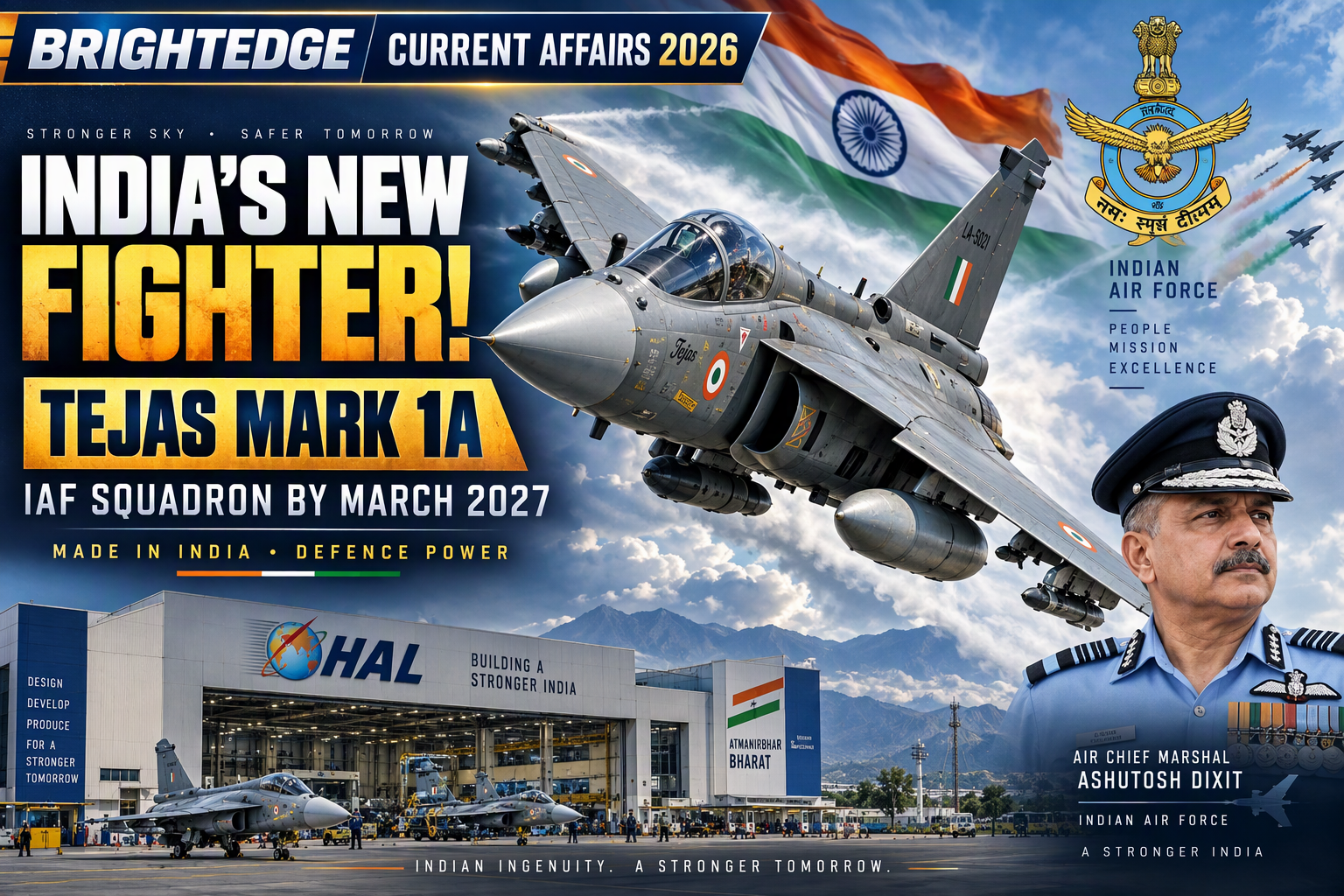
India’s indigenous fighter aircraft programme has received a major boost as the Indian Air Force (IAF) prepares to induct its first squadron of Light Combat Aircraft (LCA) Tejas Mark 1A during the financial year 2026–27.
Air Chief Marshal Ashutosh Dixit announced on November 16, 2026, that the aircraft would join the IAF within the current financial year, marking an important milestone in India’s defence modernisation and self-reliance efforts.
The Air Chief also highlighted progress on the next-generation LCA Mark 2 and India’s fifth-generation Advanced Medium Combat Aircraft (AMCA) programme.
Tejas Mark 1A Induction 2026–27: Important Highlights
- Aircraft: Light Combat Aircraft (LCA) Tejas Mark 1A.
- Inducting Force: Indian Air Force (IAF).
- Expected Induction: Financial Year 2026–27.
- Expected Timeline: By March 2027.
- Announcement Date: November 16, 2026.
- Announced By: Air Chief Marshal Ashutosh Dixit.
- Manufacturer: Hindustan Aeronautics Limited (HAL).
- Designer: Aeronautical Development Agency (ADA), under DRDO.
- Aircraft Category: Indigenous 4.5-generation multirole fighter.
- Major Technologies: AESA Radar, Electronic Warfare Suite and advanced avionics.
What Is LCA Tejas Mark 1A?
- The Light Combat Aircraft (LCA) Tejas Mark 1A is an advanced variant of India’s indigenously developed Tejas fighter aircraft.
- Designed by the Aeronautical Development Agency (ADA) and manufactured by Hindustan Aeronautics Limited (HAL), the aircraft represents India’s growing capabilities in designing and producing modern combat aircraft.
- The Mark 1A variant incorporates significant improvements over the earlier Tejas Mark 1, particularly in radar technology, electronic warfare, avionics and operational capabilities.
It is designed to perform multiple combat missions, including:
- Air defence operations.
- Air-to-air combat.
- Ground attack missions.
- Close air support.
- Maritime operations.
The aircraft is classified as a 4.5-generation fighter and is designed for all-weather operations.
What Makes Tejas Mark 1A Special? Key Advanced Features
The LCA Mark 1A incorporates several advanced technologies that improve its combat effectiveness, pilot awareness and survivability.
1. Active Electronically Scanned Array (AESA) Radar
One of the major upgrades is the integration of an Active Electronically Scanned Array (AESA) radar.
AESA radar technology provides improved target detection and tracking capabilities.
Its important advantages include:
- Faster target detection.
- Improved tracking capabilities.
- Better situational awareness.
- Enhanced air-to-air engagement capabilities.
- Improved performance in modern electronic warfare environments.
2. Advanced Electronic Warfare (EW) Suite
- The aircraft features an advanced Electronic Warfare Suite designed to improve its survivability in hostile environments.
- The system includes radar warning and self-protection jamming capabilities.
- These systems help detect potential radar threats and provide defensive electronic countermeasures against hostile radar systems.
- The development of indigenous electronic warfare technologies also supports India’s defence self-reliance objectives.
3. Beyond Visual Range (BVR) Missile Capability
- The Tejas Mark 1A is designed to employ Beyond Visual Range (BVR) missiles.
- BVR capabilities allow fighter aircraft to engage aerial threats beyond the pilot’s direct visual range, subject to sensor and weapon-system integration.
- This significantly improves the operational flexibility of modern fighter aircraft.
4. Advanced Avionics and Digital Flight Control
- The aircraft incorporates an advanced mission computer, Digital Flight Control Computer (DFCC) and Smart Multi-Function Displays.
- These technologies improve flight management, pilot interaction and aircraft control.
- The quadruplex digital fly-by-wire flight-control system is an important component of the aircraft’s modern flight-control architecture.
5. Air-to-Air Refuelling Capability
- Air-to-air refuelling allows a compatible fighter aircraft to receive fuel from an aerial tanker while in flight.
- This capability can extend operational endurance and provide greater flexibility during missions.
Tejas Mark 1A Technical Specifications
| Specification | Details |
|---|---|
| Aircraft Name | LCA Tejas Mark 1A |
| Aircraft Generation | 4.5 Generation |
| Aircraft Type | Single-engine multirole fighter |
| Manufacturer | HAL |
| Designer | Aeronautical Development Agency |
| Engine | GE F404-IN20 |
| Maximum Speed | Mach 1.6 |
| Maximum Take-off Mass | 13,500 kg |
| Length | 13.2 metres |
| Wingspan | 8.2 metres |
| Height | 4.4 metres |
| Service Ceiling | 50,000 feet |
| Maximum G-Limit | +8g / -3.5g |
| Radar | AESA Radar |
| Major Capabilities | BVR missiles, EW systems and advanced avionics |
Note: Specifications are based on published LCA Tejas Mark 1A programme information. Actual operational configuration may vary.
Why Is the Tejas Mark 1A Important for the Indian Air Force?
- The induction of the Tejas Mark 1A is important because the Indian Air Force needs to strengthen its fighter aircraft fleet and replace ageing combat platforms.
- The aircraft is expected to contribute to several important objectives.
1. Strengthening India’s Fighter Fleet
- The induction of an additional indigenous fighter squadron will improve the IAF’s operational capabilities.
- It will also support the gradual replacement of older aircraft, particularly the retired MiG-21 fleet.
2. Reducing Dependence on Foreign Aircraft
- India has historically depended on foreign suppliers for several advanced military aircraft and technologies.
- The Tejas programme represents a significant step towards developing indigenous fighter aircraft manufacturing capabilities.
3. Promoting Aatmanirbhar Bharat
- The programme involves several Indian organisations, research institutions, defence laboratories and private-sector manufacturing partners.
- It strengthens India’s domestic aerospace ecosystem and encourages the development of indigenous defence technologies.
4. Strengthening National Security
- Modern radar systems, electronic warfare technologies and advanced weapons integration will improve the aircraft’s operational capabilities.
- The induction will contribute to India’s broader military modernisation programme.
Tejas Fighter Aircraft Orders: How Many Jets Has India Ordered?
The Indian government has placed two major orders for the LCA Mark 1A programme.
First Contract – January 2021
The Ministry of Defence approved the procurement of 83 LCA Tejas aircraft for the Indian Air Force.
The order comprised:
- 73 single-seat fighter aircraft.
- 10 twin-seat trainer aircraft.
The contract was valued at approximately ₹48,000 crore, including associated infrastructure and development provisions.
Second Contract – September 2025
The Ministry of Defence signed another contract with Hindustan Aeronautics Limited for 97 additional LCA Mark 1A aircraft.
The order comprised:
- 68 fighter aircraft.
- 29 twin-seat trainer aircraft.
The contract was valued at over ₹62,370 crore, excluding taxes.
With these two orders, the total number of LCA Mark 1A aircraft ordered by the Indian Air Force stands at 180 aircraft.
The second contract also provides for increased indigenous content and the participation of Indian defence manufacturers.
LCA Mark 1A vs LCA Mark 2: What Is the Difference?
India is simultaneously working on the development of the next-generation LCA Mark 2.
| Feature | LCA Mark 1A | LCA Mark 2 |
|---|---|---|
| Programme Status | Advanced production variant | Under development |
| Aircraft Category | 4.5-generation fighter | More advanced medium-weight fighter |
| Engine | GE F404-IN20 | GE F414 |
| Role | Multirole combat operations | Enhanced multirole combat operations |
| Development Focus | Improved radar, EW and avionics | Greater payload, range and performance |
| Expected Milestone | IAF squadron induction in FY 2026–27 | Rollout indicated for 2027 |
Air Chief Marshal Ashutosh Dixit indicated that the LCA Mark 2 could roll out next year.
The Mark 2 programme is expected to provide a more capable indigenous fighter platform for the future requirements of the Indian Air Force.
What Is India’s AMCA Programme?
The Advanced Medium Combat Aircraft (AMCA) is India’s proposed fifth-generation stealth fighter aircraft programme.
The programme aims to develop an advanced indigenous combat aircraft with capabilities such as:
- Stealth technology.
- Advanced avionics.
- Sensor fusion.
- Internal weapons carriage.
- Advanced electronic warfare.
- Network-centric warfare capabilities.
The AMCA programme is being developed under the leadership of the Aeronautical Development Agency.
The Air Chief also highlighted that work on the AMCA programme is progressing as India continues to strengthen its indigenous aerospace capabilities.
Who Is Air Chief Marshal Ashutosh Dixit?
- Air Chief Marshal Ashutosh Dixit is the Chief of the Air Staff of the Indian Air Force.
- He assumed office on October 31, 2026, becoming the 29th Chief of the Air Staff.
- His recent announcement regarding the Tejas Mark 1A induction highlights the IAF’s focus on strengthening indigenous defence manufacturing and modernising its combat aircraft fleet.