

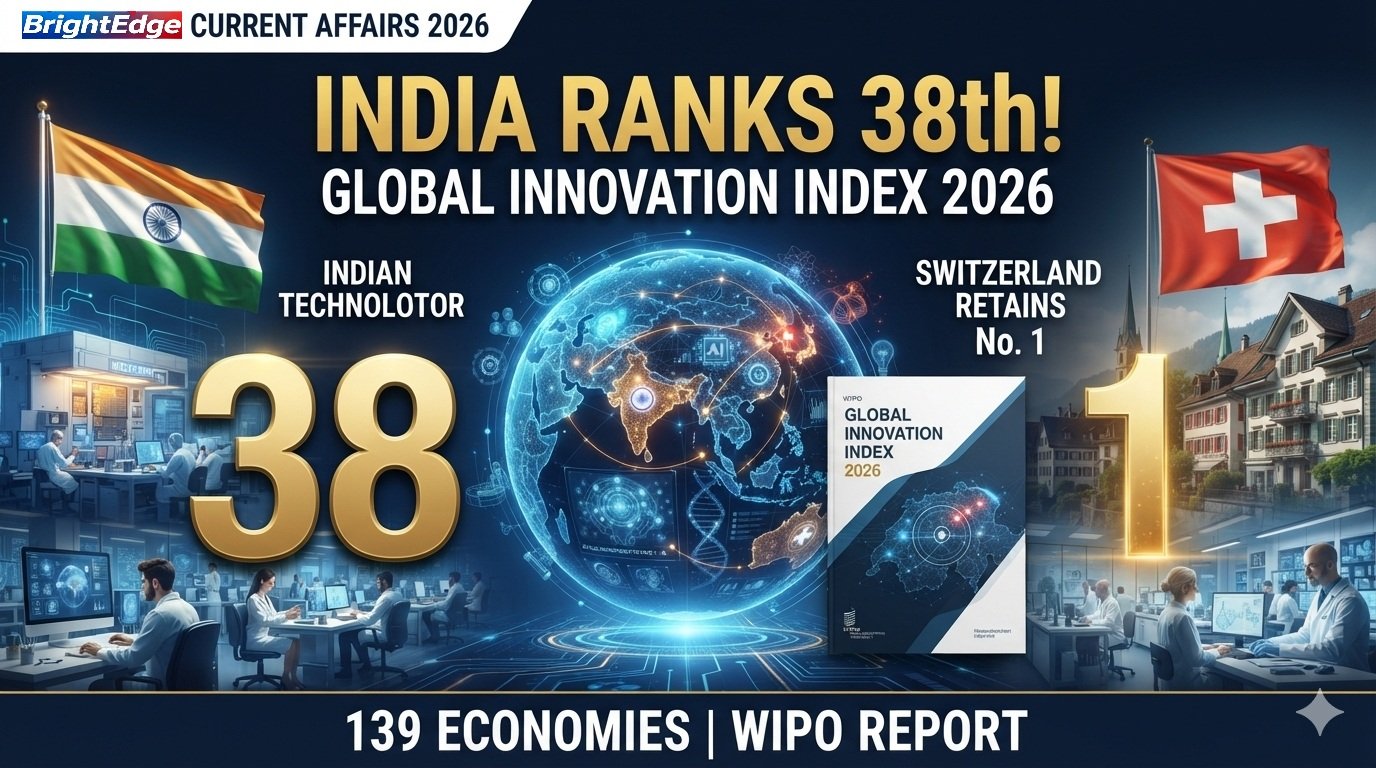
India has secured 38th position among 139 economies in the Global Innovation Index (GII) 2026, released by the World Intellectual Property Organization (WIPO).
Switzerland has retained its position as the world’s most innovative economy for the 16th consecutive year, followed by Sweden and the United States.
India Ranks 38th in Global Innovation Index 2026
- According to the WIPO Global Innovation Index 2026, India secured the 38th position among 139 participating economies.
- The ranking reflects India’s growing innovation capabilities, particularly in digital services, technology-driven entrepreneurship and knowledge-intensive industries.
- India has maintained its position among the world’s top 40 innovative economies.
Key Highlights of India’s Performance
- Global Rank: 38th
- Previous Year’s Rank: 38th in 2025
- Income Group: First among 36 lower-middle-income economies
- Regional Position: First in Central and Southern Asia
- ICT Services Exports: 1st globally
- Late-Stage Venture Capital Deals: 4th globally
- Innovation Output Rank: 25th
- Innovation Input Rank: 49th
- Innovation Overperformance: 16 consecutive years
India’s performance demonstrates its ability to convert relatively limited innovation resources into significant technological and economic outputs.
Switzerland Retains World’s No. 1 Position
- Switzerland has continued its dominance in global innovation rankings by securing the first position for the 16th consecutive year.
- The country is recognised for its strong research ecosystem, advanced technological capabilities, intellectual property development and collaboration between universities and industries.
- Sweden secured second position, while the United States ranked third.
Top 10 Countries in Global Innovation Index 2026
| Rank | Country |
|---|---|
| 1 | Switzerland |
| 2 | Sweden |
| 3 | United States |
| 4 | Republic of Korea |
| 5 | Singapore |
| 6 | United Kingdom |
| 7 | Netherlands |
| 8 | Finland |
| 9 | Denmark |
| 10 | China |
China remains the highest-ranked middle-income economy in the index, securing the 10th position.
The rankings demonstrate the continued dominance of European economies and the growing influence of Asian innovation centres.
What Is the Global Innovation Index (GII)?
- The Global Innovation Index is an annual ranking published by the World Intellectual Property Organization (WIPO).
- It evaluates the innovation performance of economies worldwide by examining their research capabilities, technological development, business environment, infrastructure and creative outputs.
- The index was first launched in 2007 and has become an important international benchmark for assessing national innovation ecosystems.
- The 2026 edition evaluates 139 economies using 79 indicators covering different dimensions of innovation.
Seven Pillars of the Global Innovation Index
The GII is structured around two major sub-indices and seven pillars.
A. Innovation Input Sub-Index
This measures the resources and conditions that enable innovation.
- Institutions – Quality of governance, regulatory environment and business conditions.
- Human Capital and Research – Education, research institutions and scientific capabilities.
- Infrastructure – Information technology, general infrastructure and ecological sustainability.
- Market Sophistication – Credit availability, investment and market development.
- Business Sophistication – Knowledge workers, innovation linkages and knowledge absorption.
B. Innovation Output Sub-Index
This measures the actual results generated through innovation.
- Knowledge and Technology Outputs – Patents, scientific publications, technological development and knowledge impact.
- Creative Outputs – Intangible assets, creative goods and services, and online creativity.
These seven pillars help WIPO assess how effectively countries convert innovation investments and capabilities into measurable outcomes.
India’s Major Strengths in Global Innovation Index 2026
India has demonstrated considerable strength in several important innovation indicators.
1. Leadership in ICT Services Exports
- India secured the first position globally in ICT services exports.
- The country’s expanding information technology industry, software services, digital infrastructure and technology-based businesses have contributed to its international competitiveness.
2. Strong Venture Capital Ecosystem
- India ranked fourth globally in late-stage venture capital deals.
- This highlights the country’s growing startup ecosystem and its ability to attract investment into innovative businesses.
3. Strong Innovation Outputs
- India ranked 25th in innovation outputs compared with 49th in innovation inputs.
- This indicates that India generates relatively strong innovation results despite having a lower ranking in the resources and conditions supporting innovation.
4. Long-Term Innovation Performance
- India has remained an innovation overperformer for 16 consecutive years.
- An innovation overperformer is an economy that achieves better innovation results than would normally be expected for its level of economic development.
- This achievement reflects India’s ability to generate significant innovation outcomes relative to its income level.
India Leads the Central and Southern Asia Region
India has retained its first position in the Central and Southern Asia region in the Global Innovation Index 2026.
The regional rankings include:
| Country | Global Rank |
|---|---|
| India | 38 |
| Kazakhstan | 73 |
| Bhutan | 74 |
| Uzbekistan | 77 |
| Kyrgyzstan | 92 |
| Pakistan | 95 |
| Nepal | 104 |
| Bangladesh | 105 |
India’s position reflects its relatively strong performance in digital services, entrepreneurship, research and technological development.
Global Innovation Index 2026: Major International Developments
The 2026 report highlights several important developments in the global innovation landscape.
1. Switzerland’s Continued Leadership: Switzerland retained the top position for the 16th consecutive year.
2. Growing Asian Innovation Power: South Korea, Singapore and China secured positions in the global top 10.
3. India’s Strong Performance: India remained among the top 40 innovative economies and continued to lead its income group and region.
4. Emerging Economy Progress: Countries such as Viet Nam, Türkiye, Morocco and Indonesia have strengthened their positions over the long term.
5. Role of Artificial Intelligence: The report highlights the growing influence of AI in research and development, venture capital investment and technological innovation.
6. Deep Science Startups: The 2026 edition focuses on how scientific discoveries can be converted into commercially successful industries through entrepreneurship and intellectual property.
What Is WIPO?
The World Intellectual Property Organization (WIPO) is a specialised agency of the United Nations responsible for promoting the protection of intellectual property worldwide.
It provides international cooperation and services relating to patents, trademarks, industrial designs and copyrights.
Important Facts About WIPO
- Full Name: World Intellectual Property Organization
- Established: 1967
- Convention Signed: 1967
- Convention Entered into Force: 1970
- Headquarters: Geneva, Switzerland
- Parent Organisation: United Nations
- Primary Objective: Promoting the protection of intellectual property worldwide
- Global Innovation Index: Published annually by WIPO
Significance of Global Innovation Index 2026 for India
India’s 38th position in the Global Innovation Index 2026 highlights its growing importance in the global innovation ecosystem.
However, maintaining long-term progress will require improvements in several areas.
1. Increased Research and Development: Greater investment in scientific research and advanced technologies is essential.
2. Stronger Industry-Academia Collaboration: Universities, research institutions and private companies must work together to develop commercially viable innovations.
3. Startup Ecosystem Development: Continued support for entrepreneurs, startups and venture capital investments can strengthen India’s innovation capabilities.
4. Intellectual Property Development: Encouraging patents, technology transfer and commercialisation of research can improve innovation outputs.
5. Advanced Manufacturing: Investments in semiconductors, artificial intelligence, biotechnology and advanced materials can improve India’s global competitiveness.
6. Skilled Workforce: Developing highly skilled professionals in science, engineering and emerging technologies will be essential for future growth.
Click here to read: M. John Harrison Wins Booker Prize 2026 at 81: Becomes Oldest-Ever Winner
Click here to read: India Creates Chess History! Anuj Shrivatri Becomes 100th Grandmaster