

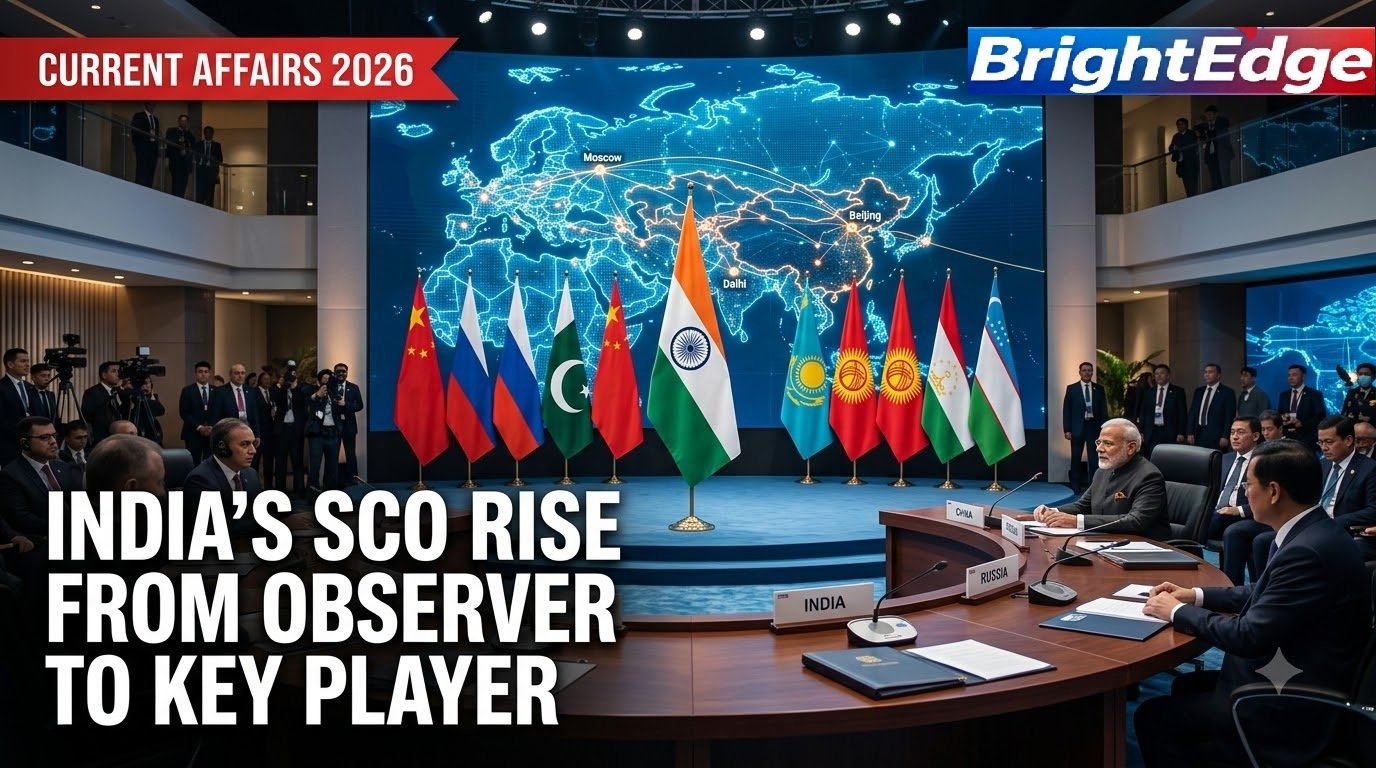
Prime Minister Narendra Modi reached Kyrgyzstan on Sunday to attend the 26th Shanghai Cooperation Organisation (SCO) Summit, being held from August 31 to September 1. During the summit, he is expected to address key regional and global challenges and hold bilateral meetings with several world leaders on the sidelines.
India’s journey with the Shanghai Cooperation Organisation (SCO) reflects the country’s expanding diplomatic and strategic footprint across Eurasia. What began with Observer status in 2005 evolved into full membership in 2017, giving New Delhi a seat at one of Eurasia’s most important multilateral platforms.
Today, India uses the SCO to engage with Russia, China, Central Asian states, Iran, and other regional partners while advancing its interests in counter-terrorism, connectivity, trade, energy, technology, and people-to-people relations.
What Is the Shanghai Cooperation Organisation?
- The Shanghai Cooperation Organisation, or SCO, was established on 15 June 2001 by China, Kazakhstan, Kyrgyzstan, Russia, Tajikistan and Uzbekistan.
- The organisation initially focused strongly on regional security, particularly terrorism, separatism and extremism. Over time, its agenda expanded to include economic cooperation, connectivity, energy, digital development, culture and humanitarian cooperation.
- As of the latest official Indian government brief, the SCO has 10 member states: India, China, Russia, Kazakhstan, Kyrgyzstan, Tajikistan, Uzbekistan, Pakistan, Iran and Belarus. Afghanistan and Mongolia hold observer status, while the organisation also has a wider group of dialogue partners.
India’s Journey: From Observer to Full Member
- India’s formal association with the SCO began in 2005, when India was granted Observer status along with Iran and Pakistan.
- For more than a decade, India participated in the organisation without full membership. A major diplomatic shift came in 2015, when the SCO decided to admit India and Pakistan as full members.
- India completed the required obligations, including accession to SCO agreements, and officially became a full member at the Astana Summit in June 2017.
- This transformation significantly expanded India’s ability to influence discussions concerning Eurasian security and regional cooperation.
Why the SCO Matters to India
The SCO is strategically important because it brings India into the same multilateral framework as several countries central to New Delhi’s foreign-policy priorities.
1. Central Asia Connectivity
- Central Asia is important to India’s trade, energy and geopolitical interests. SCO membership provides India with an institutional platform to engage Kazakhstan, Kyrgyzstan, Tajikistan and Uzbekistan.
- Connectivity remains particularly important because India’s direct land access to Central Asia is constrained by geography and Pakistan.
- India therefore sees projects and initiatives involving alternative routes, ports and multimodal connectivity as important tools for expanding its Eurasian engagement.
2. Counter-Terrorism and Security
- Security cooperation is one of the SCO’s core areas.
- India has consistently highlighted terrorism, radicalisation and extremism as major regional challenges. The organisation’s Regional Anti-Terrorist Structure (RATS) provides a mechanism for member states to cooperate on counter-terrorism issues.
- For India, this provides another multilateral platform to raise concerns about terrorism and cross-border security.
3. Balancing Relations With China and Russia
- One of the unique advantages of the SCO for India is that it provides a platform where India, China and Russia interact within the same institutional framework.
- India’s relationship with China remains complicated by the unresolved boundary question, while Russia remains an important defence and strategic partner.
- The SCO therefore gives New Delhi an opportunity to maintain dialogue even when bilateral relations with individual countries face difficulties.
India’s SCO Presidency: A Major Turning Point
India assumed the SCO presidency for the first time from September 2022 to July 2023.
During its chairmanship, India hosted around 134 SCO-related events, including 14 ministerial-level meetings, and promoted its SECURE framework:
S – Security
E – Economic development
C – Connectivity
U – Unity
R – Respect for sovereignty and territorial integrity
E – Environmental protection
India also introduced new areas of cooperation involving startups and innovation, traditional medicine, digital inclusion, youth empowerment and shared Buddhist heritage.
The presidency culminated in the SCO Heads of State Summit hosted by India on 4 July 2023, held virtually.
India’s Growing Digital and Technology Push
- India has increasingly attempted to bring its technology strengths into the SCO framework.
- During its presidency, New Delhi promoted cooperation in areas including digital transformation, startups and innovation.
- The SCO Secretary-General’s 2026 visit to India also highlighted India’s achievements in the digital economy, IT and new technologies. The organisation noted that India’s 2022–23 chairmanship had introduced several new areas of cooperation.
- This creates an opportunity for India to position itself not only as a security stakeholder but also as a technology and innovation partner for the wider Eurasian region.
India’s Role in 2026
- India’s engagement with the SCO remains active.
- In May 2026, SCO Secretary-General Nurlan Yermekbayev visited India and met External Affairs Minister S. Jaishankar in New Delhi. Discussions covered the SCO’s future development, preparations for upcoming meetings and the organisation’s modernisation.
- India reiterated its commitment to active cooperation within the organisation.
- India also participated in the SCO Council of Foreign Ministers meeting held in Cholpon-Ata, Kyrgyz Republic, on 24 July 2026, represented by Minister of State for External Affairs Kirti Vardhan Singh.
- These engagements demonstrate that India’s SCO participation is now an established component of its broader Eurasian diplomacy.
India and the SCO: What Lies Ahead?
India’s future SCO strategy is likely to focus on several interconnected priorities:
- Counter-terrorism and regional security
- Central Asian connectivity
- Energy cooperation
- Digital economy and technology
- Trade and investment
- Startups and innovation
- Traditional medicine
- Youth and education
- Environmental cooperation
- Cultural and civilisational links
For New Delhi, the SCO is not simply a security organisation. It is increasingly a platform through which India can engage a large part of the Eurasian region.
India’s Strategic Balancing Act
- India’s SCO policy also reflects its broader approach of strategic autonomy.
- New Delhi maintains partnerships with different and sometimes competing groupings. India is simultaneously involved in platforms such as the Quad, BRICS, G20 and SCO.
- The SCO is particularly significant because it allows India to remain engaged with countries such as China and Russia while strengthening its links with Central Asia and Iran.
- Rather than viewing the SCO as an alternative to India’s other partnerships, New Delhi has increasingly used it as one component of a multi-aligned foreign-policy strategy.
Conclusion
- India’s SCO journey has come a long way since it received Observer status in 2005.
- Its transformation into a full member in 2017, followed by its first SCO presidency in 2022–23, marked a significant expansion of India’s role in Eurasian diplomacy.
- With the organisation continuing to evolve around security, connectivity, trade, technology and regional cooperation, India has an opportunity to use its position to advance both its national interests and broader regional engagement.
- India is no longer merely an observer in the SCO. It has become an active participant with ambitions to shape the organisation’s future agenda.
Click Here to Read: PM Modi Arrives in Bishkek for Two-Day Kyrgyzstan Visit, SCO Summit