

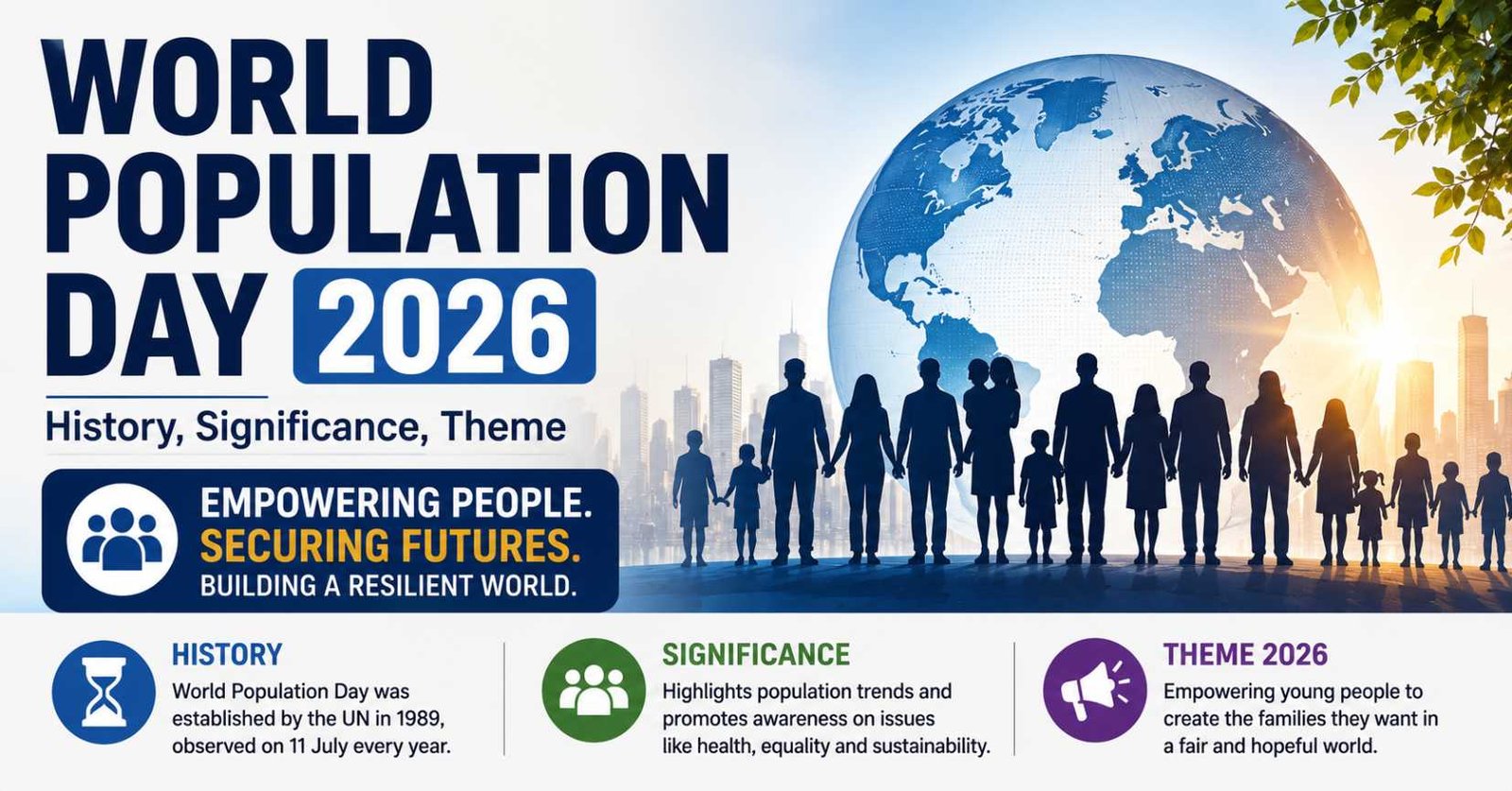
- World Population Day is observed every year on 11 July to raise awareness about global population issues, including reproductive health, family planning, gender equality, maternal and child health, and sustainable development.
- The observance encourages governments, organisations, and communities to promote informed choices that contribute to healthier families and a more sustainable future.
- Established by the United Nations Development Programme (UNDP) in 1989, World Population Day was inspired by the landmark “Five Billion Day” on 11 July 1987, when the world’s population reached approximately five billion.
History of World Population Day
The idea behind World Population Day emerged from growing concerns over rapid population growth and its impact on natural resources, healthcare, education, employment, and economic development.
Key Milestones
- 11 July 1987: World population reached approximately 5 billion (“Five Billion Day”).
- 1989: The United Nations Development Programme (UNDP) established World Population Day.
- 1990: The first official World Population Day was observed.
- 2022: The global population crossed 8 billion.
- 2026: The observance continues to focus on reproductive health, family planning, and sustainable development.
Why is World Population Day Important?
World Population Day serves as a reminder that population trends affect every aspect of society.
Its objectives include:
- Promoting voluntary family planning.
- Raising awareness about reproductive health.
- Encouraging gender equality.
- Improving maternal and child healthcare.
- Supporting sustainable development.
- Empowering young people through education and informed choices.
World Population Day 2026 Theme
At the global level, the United Nations announces the official theme each year.
In India, the Ministry of Health and Family Welfare is observing World Population Day 2026 with the campaign theme:
“Healthy Timing and Spacing of Pregnancies for the Well-being of Mother and Child and Planned Parenthood.”
Global Population Trends
Understanding population trends is essential for effective policymaking.
Some important global statistics include:
- The world’s population has grown from 1 billion in 1804 to over 8 billion today.
- It is projected to reach approximately 8.5 billion by 2030.
- Global fertility rates have declined significantly over the past five decades.
- Average life expectancy has increased due to improvements in healthcare.
- By 2050, nearly two-thirds of the world’s population is expected to live in urban areas.
India’s Focus on Family Planning
The Ministry of Health and Family Welfare uses World Population Day to strengthen awareness about:
- Healthy timing and spacing of pregnancies
- Prevention of unintended pregnancies
- Access to quality reproductive healthcare
- Counselling services
- Maternal and child health programmes
The campaign also aims to improve healthcare delivery through targeted interventions at the community level.
Key Facts About World Population Day
- Date: 11 July (every year)
- Established: 1989
- Inspired by: Five Billion Day (11 July 1987)
- Observed by: United Nations and countries worldwide
- Purpose: Raise awareness about population issues, reproductive health, family planning, and sustainable development.
Conclusion
World Population Day 2026 reminds us that sustainable development depends not only on population numbers but also on ensuring that every individual has access to quality healthcare, education, and informed reproductive choices.
By promoting voluntary family planning, healthy pregnancy spacing, gender equality, and youth empowerment, governments and communities can work together to build healthier families and a more prosperous future for all.