

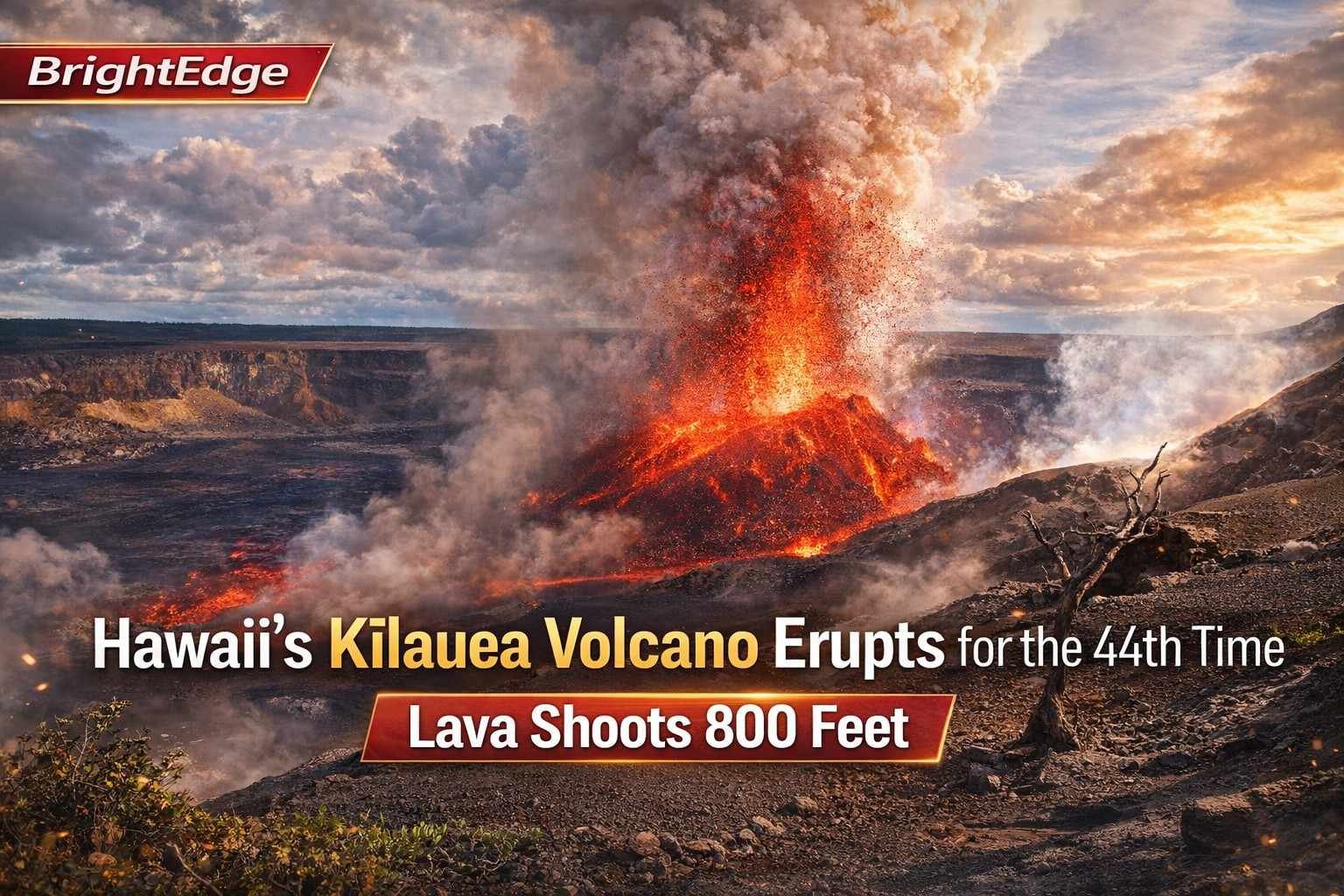
Hawaii’s Kilauea volcano roared back to life on the morning of April 9, 2026, as its 44th eruptive episode began at 11:10 a.m. HST inside the Halemaʻumaʻu crater at the volcano’s summit.
The north vent drove the show this time, with lava fountains climbing to peak heights of approximately 800 feet, before settling to a sustained 700 feet through the afternoon.
The eruption plume punched up to 16,000 feet above sea level, sending a narrow band of ash, Pele’s hair, and lightweight tephra spinning northeast toward the communities of Volcano, Mountain View, Puna, Hilo, and the Hamakua District.
The US Geological Survey’s Hawaiian Volcano Observatory immediately raised the Volcano Alert Level to RED WARNING and the Aviation Color Code to RED, the highest designations in both scales, warning of dangerous tephra fall within 3 miles of the vents and lighter ash potentially drifting tens of miles downwind.
Why Kīlauea captures the world’s attention?
- Kīlauea sits atop the southeastern flank of Mauna Loa on Hawaii’s Big Island and is widely considered one of the most continuously active volcanoes on Earth.
- The name itself means “spewing” or “much spreading” in Hawaiian, a fitting description for a mountain that has been reshaping its landscape for millennia.
- About 90% of Kīlauea’s surface is covered in lava flows less than 1,100 years old.
- In 2018, the USGS ranked it the single highest volcanic threat to lives and infrastructure in the United States.
- Unlike many explosive volcanoes, Kīlauea’s eruptions are largely contained within the Halemaʻumaʻu crater and have not threatened homes or buildings during this cycle.
- The real danger lies in the extraordinary volume of tephra, glassy volcanic ash, Pele’s hair (thin glass fibers stretched from molten lava by bursting gas bubbles), and rock fragments that the eruptions rain down on surrounding communities.
A volcano is an opening (vent) in the Earth’s crust through which molten rock (magma), gases, and ash escape from inside the Earth to the surface. When magma reaches the surface, it is called lava.
How Does a Volcano Form?
- Deep inside Earth, rocks melt due to high temperature and pressure
- This molten material (magma) rises upward
- When pressure builds, it erupts through weak zones in the crust
- Over time, repeated eruptions form a volcanic mountain
Types of Volcanoes:
1. Active Volcano:
- Currently erupting or likely to erupt
- Example: Mount Etna (Italy)
2. Dormant Volcano:
- Not active now but may erupt in future
- Example: Mount Fuji (Japan)
3. Extinct Volcano:
- No eruption for thousands of years
- Example: Mount Kenya
Don’t Miss Daily GK Updates!
Get the latest current affairs directly in your inbox
No spam. Only important updates.