

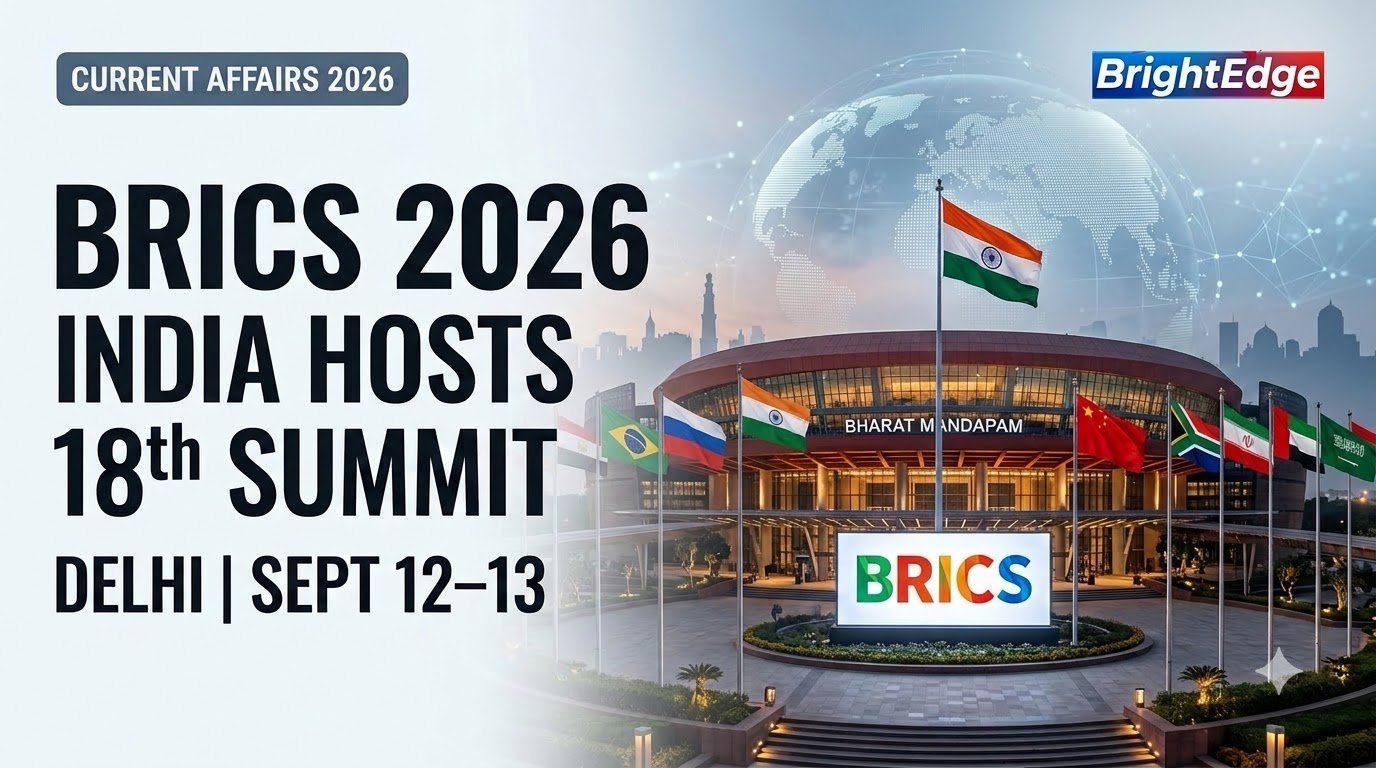
The 18th BRICS Summit 2026 is set to bring global attention to New Delhi as India hosts the annual leaders’ meeting on 12–13 September 2026 at Bharat Mandapam. India assumed the BRICS Chairship on 1 January 2026, making this the country’s fourth time leading the grouping after 2012, 2016 and 2021.
The summit comes at an important moment for BRICS. The grouping has expanded beyond its original five members, while issues such as global trade, economic resilience, artificial intelligence, digital technology, climate change, energy security and reform of international institutions are becoming increasingly important.
India’s 2026 presidency is built around a people-centric “Humanity First” approach, with the overarching theme:
“Building for Resilience, Innovation, Cooperation and Sustainability.”
Category Details Summit 18th BRICS Summit Year 2026 Host Country India Host City New Delhi Date 12–13 September 2026 Venue Bharat Mandapam BRICS Chair India Chairship began 1 January 2026 Theme Building for Resilience, Innovation, Cooperation and Sustainability Approach People-centric, “Humanity First” Major focus Trade, finance, technology, development, sustainability and global governance The Four Key Pillars of BRICS 2026
India’s BRICS presidency is organised around four major pillars.
1. Resilience
The first pillar focuses on strengthening the ability of BRICS economies and societies to deal with global disruptions.
Key areas include:
- Global supply-chain resilience
- Health security
- Climate-related risks
- Economic resilience
- Institutional capacity
- Food and energy security
The objective is to make BRICS economies better prepared for future global shocks.
2. Innovation
Technology is another major priority of India’s presidency.
The innovation agenda includes:
- Artificial intelligence
- Digital Public Infrastructure
- Fintech
- Emerging technologies
- Digital transformation
- Knowledge sharing
- Technology-led inclusive growth
India’s experience with digital public infrastructure gives it an opportunity to promote practical technology-based solutions among BRICS members.
3. Cooperation
The third pillar aims to deepen practical cooperation between BRICS countries.
Important areas include:
- Trade facilitation
- Development finance
- Economic cooperation
- Policy coordination
- Global governance reforms
- People-centric partnerships
The broader objective is to make BRICS cooperation more effective and development-oriented.
4. Sustainability
Climate change and sustainable development form the fourth pillar.
The agenda includes:
- Climate action
- Green finance
- Clean-energy transition
- Sustainable development
- Environmental cooperation
- Resilient infrastructure
Bharat Mandapam: The Venue
- The summit will take place at Bharat Mandapam in New Delhi, India’s major international convention and exhibition complex.
- The venue has already hosted major international events, including the G20 Leaders’ Summit in 2023, making it a natural choice for another major global diplomatic gathering.
What Will Be on the BRICS Summit 2026 Agenda?
While the final leaders’ declaration and outcomes will depend on negotiations at the summit, India’s chairship has established several broad areas of focus.
1. Global Economic Cooperation
Trade, investment and economic cooperation are expected to remain central to discussions.
BRICS countries are looking at ways to improve intra-group economic engagement and build more resilient supply chains.
The economic agenda is particularly significant because BRICS has become a much larger grouping following its expansion.
2. Reform of Global Institutions
Reform of global governance is another important issue.
India has consistently supported a greater voice for developing and emerging economies in international institutions.
Potential discussions include reforms involving institutions such as:
- United Nations
- International Monetary Fund
- World Bank
- Other multilateral institutions
The broader objective is to make global governance more representative of today’s economic and demographic realities.
3. Artificial Intelligence and Digital Technology
AI is becoming an increasingly important part of India’s BRICS agenda.
The focus is expected to include:
- Responsible AI
- Digital public infrastructure
- Digital inclusion
- Fintech
- Technology cooperation
- Sharing technological capabilities
India’s presidency has already featured dedicated technology and communications engagements under the BRICS framework.
4. Climate Change and Green Development
Climate change will also receive significant attention.
BRICS countries are expected to discuss:
Climate action + green finance + energy transition + sustainable development
India’s environment-related BRICS meetings during 2026 have focused on strengthening cooperation for a resilient and sustainable future.
5. Health Cooperation
Health security is another major area of cooperation.
The BRICS health agenda includes strengthening collaboration, sharing knowledge and supporting a more inclusive global health architecture.
The expanded BRICS grouping represents a substantial share of the world’s population, making cooperation on global health particularly significant.
6. Peace, Security and Global Issues
The BRICS leaders are also expected to exchange views on major international and regional developments.
India’s official announcement says leaders will discuss common priorities within BRICS and global and regional matters of mutual importance.
This makes the summit significant not only economically but also diplomatically.
Click Here to Read: 18th BRICS Summit 2026: India to Host Summit in Delhi
Bhopal to Host BRICS Culture Ministers’ Meeting and Working Group Sessions
[…] Click Here To Read: 18th BRICS Summit 2026: All Details and Significance […]