

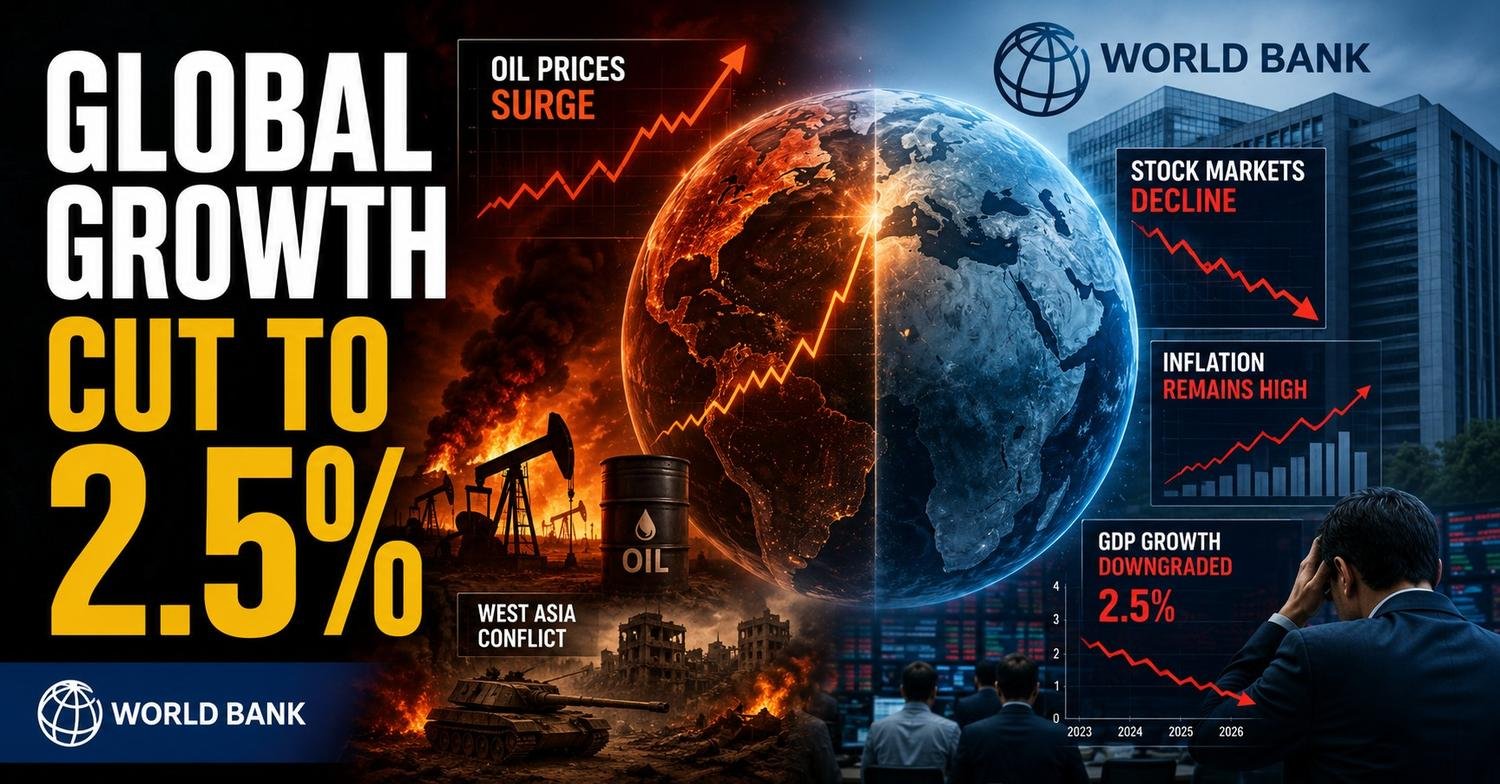
- The World Bank has lowered its global economic growth forecast for 2026 to 2.5 per cent, citing the escalating conflict in West Asia as a major factor disrupting energy markets, reigniting inflation and weakening economic prospects across the world.
- In its latest Global Economic Prospects Report, released in June 2026, the multilateral lender warned that the world economy is facing another major shock similar to previous crises, with rising oil prices and supply disruptions threatening growth in both advanced and developing economies.
- The revised forecast marks a slowdown from 2.9 per cent growth in 2025 and represents the lowest global growth rate since the COVID-19 pandemic.
West Asia Conflict Behind the Downgrade
- According to the World Bank, the ongoing conflict in West Asia has significantly altered the global economic outlook.
- The report stated that “The global economy is facing another major shock.
- The conflict in the Middle East has triggered sharp increases in energy prices, renewed inflationary pressures, and fueled expectations of tighter monetary policy.”
- The institution noted that countries dependent on imported energy and those directly affected by the conflict are expected to witness the sharpest economic slowdown.
- Approximately two-thirds of the world’s economies are now facing weaker growth prospects due to the crisis.
Commodity Prices Expected to Surge by 22%
The World Bank sharply revised its commodity price outlook.
In January 2026, commodity prices were expected to decline by 7 per cent. However, the new report projects a 22 per cent increase in commodity prices during 2026 due to disruptions in energy and commodity supplies from the Gulf region.
The report highlighted:
- Commodity prices to rise by 22% in 2026.
- Brent crude oil to average $94 per barrel.
- Oil prices expected to be 36% higher than in 2025.
- Brent crude projected to remain over 50% above January estimates.
- European natural gas prices likely to increase by around 30% due to tighter LNG supplies.
The sharp rise in energy costs is expected to have far-reaching consequences for inflation, trade and household spending across the globe.
Inflation Pressures Return
- Higher energy and commodity prices are once again fueling inflationary pressures worldwide.
- The World Bank warned that headline inflation expectations have risen in both advanced and emerging economies.
- Persistently high inflation could force central banks to maintain tight monetary policies for longer periods, which may further dampen economic activity and investment.
Global Growth Could Fall to 1.3% in Worst-Case Scenario
The report also outlined a downside scenario in which the global economy could slow even further.
If the conflict intensifies and energy supply disruptions become more severe, global growth could plunge to just 1.3 per cent in 2026.
The World Bank warned that:
- Commodity prices could rise further.
- Inflationary pressures may intensify.
- Food insecurity could worsen.
- Financial markets may experience stress.
- Global investment and trade could weaken.
Such a scenario would pose significant risks for both developed and developing economies.
Artificial Intelligence Offers Hope
- Despite the gloomy outlook, the World Bank identified Artificial Intelligence (AI) as a potential driver of future economic growth.
- The report noted that broader investment in AI technologies and their widespread adoption could improve productivity, boost innovation and support economic activity in the coming years.
- AI-led productivity gains could partially offset the negative impact of higher energy costs and slower trade growth.
Implications for India
Although the report focused on global trends, India could face indirect challenges from:
- Higher crude oil import bills.
- Increased inflationary pressures.
- Rising input costs for industries.
- Volatility in financial markets.
- Pressure on fiscal and current account balances.
However, India’s relatively strong domestic demand and expanding digital economy may help cushion some of the external shocks.
Conclusion
- The World Bank’s decision to lower the global growth forecast to 2.5 per cent highlights the growing economic risks arising from geopolitical tensions in West Asia.
- With oil prices rising, inflation returning and commodity markets under pressure, policymakers around the world face the challenge of balancing growth and price stability.
- While Artificial Intelligence offers a ray of hope for long-term growth, the near-term outlook remains uncertain as the world grapples with another major economic shock.