

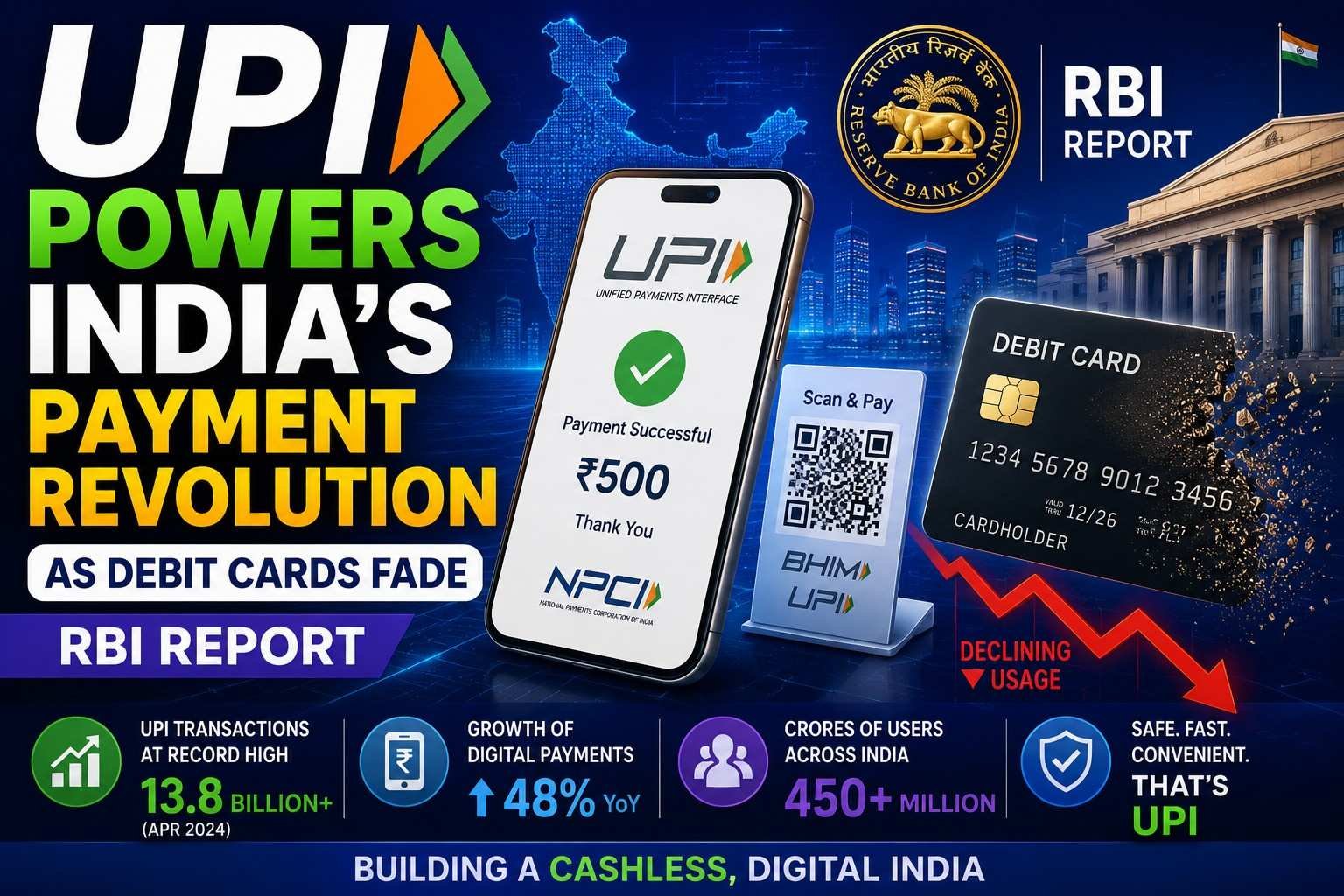
- India’s digital payments ecosystem has witnessed a dramatic transformation, with the Unified Payments Interface (UPI) emerging as the country’s most widely used payment system.
- According to the latest report released by the Reserve Bank of India, UPI accounted for nearly 85.5% of all payment transactions by volume during the second half of 2025.
- The growing popularity of UPI reflects how deeply digital payments have become embedded in the daily lives of Indians.
- From grocery shopping and food delivery to utility bill payments, transport fares, and peer-to-peer transfers, UPI is now the preferred payment method across the country.
Debit Card Usage Declines Sharply
- While UPI continues to dominate transaction volumes, the RBI report also highlights the rapid decline in debit card usage.
- Debit card transaction volumes fell sharply from 4.08 billion transactions in 2021 to just 1.33 billion transactions in 2025, marking a decline of nearly 67% over four years. The value of debit card transactions also dropped from ₹7.4 lakh crore to ₹4.5 lakh crore during the same period.
- According to the RBI, the decline is largely due to the increasing use of UPI, digital wallets, and credit cards. Although debit cards still account for the majority of cards in circulation, they are now mainly used for ATM cash withdrawals and basic banking activities rather than retail payments.
Credit Cards Continue to Grow
- In contrast to debit cards, credit cards have recorded strong growth over the past few years.
- Between 2021 and 2025, credit card transaction volumes more than doubled from 2.16 billion to 5.7 billion transactions. Transaction value also increased significantly from ₹8.9 lakh crore to ₹23.2 lakh crore.
- The report notes that credit cards are increasingly being used for online purchases, premium spending, and short-term credit access.
- Private sector banks continue to dominate the credit card market. Their market share rose from 67.7% in 2021 to 71.1% in 2025 due to aggressive digital expansion and co-branded credit card offerings. Public sector banks registered modest growth, while foreign banks witnessed a sharp decline in their market share.
RTGS Handles the “Big Money”
- Although UPI dominates transaction volumes, large-value money movement in India still takes place through the Real Time Gross Settlement (RTGS) system.
- The RBI report states that RTGS accounted for only 0.1% of total transaction volume but contributed a massive 68.6% of the overall transaction value.
- This is because RTGS is primarily used for, High-value corporate transfers, Institutional settlements, Wholesale banking transactions and Large business payments.
- Since RTGS transactions require a minimum amount of ₹2 lakh, the system naturally handles fewer but much larger transactions.
- Meanwhile, despite processing the majority of retail transactions, UPI contributed only 9.5% of the total transaction value.
India Moving Towards a Fully Digital Economy
- The RBI report clearly shows that India is rapidly becoming an almost completely digital economy.
- During the first half of 2025 the Digital payments accounted for 99.8% of total transaction volume
- Digital payments contributed 97.7% of total transaction value
- Over the past decade, digital payment growth in India has been extraordinary.
- In 2013 India recorded 222 crore digital transactions and total transaction value stood at ₹772 lakh crore
- By 2024, Digital transactions crossed 20,787 crore
- Total transaction value surged to ₹2,758 lakh crore
- This reflects the rapid expansion of digital financial infrastructure across the country.
UPI’s Explosive Growth Over the Years
- UPI’s rise has been particularly remarkable over the last five years.
- Its share in India’s digital payment volume increased from 34% in 2019 to more than 83–85% by 2025
- In the first half of 2025 alone, UPI processed over 10,637 crore transactions
- Total transaction value reached nearly ₹143 lakh crore
- Government data further reveals that during FY 2025–26, UPI handled over 24,162 crore annual transactions
- Total value exceeded ₹314 lakh crore, this makes UPI one of the world’s largest real-time payment systems.
Expansion of Digital Payment Infrastructure
- The RBI report also highlights the rapid expansion of India’s digital payment infrastructure.
- The country now has Crores of QR-code acceptance points
- Widespread merchant onboarding
- Increasing digital payment penetration in rural areas
- Apart from UPI, several other payment systems such as, IMPS, NEFT, BBPS, Prepaid Payment Instruments (PPIs) have also registered strong growth over the years.
Major Behavioural Shift in Indian Payments
- The report reflects a significant behavioural shift in the way Indians make payments.
- Consumers are increasingly moving away from physical card-based transactions and adopting instant account-to-account digital payments through UPI.
- While credit cards continue to grow as a premium spending and credit product, debit cards are steadily losing relevance in India’s fast-evolving digital payment ecosystem.
- Overall, the RBI report highlights how India has successfully built one of the world’s most advanced and rapidly expanding digital payment systems, with UPI at the centre of this transformation.