

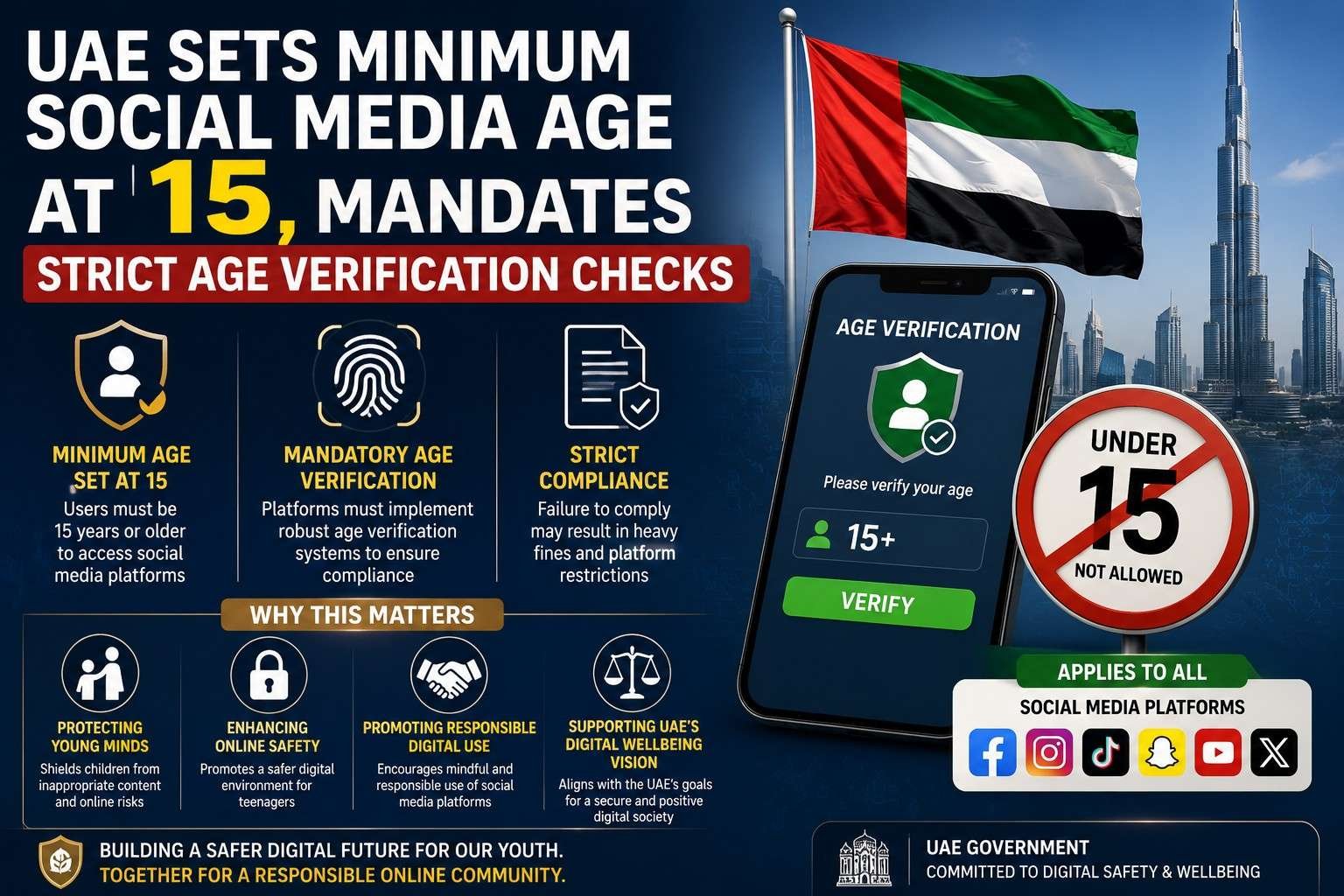
- In a landmark move aimed at strengthening online child protection, the United Arab Emirates (UAE) has announced a minimum age requirement of 15 years for social media use.
- The decision makes the UAE the first Arab nation to introduce such a restriction amid growing global concerns over children’s digital safety and mental well-being.
- The new regulations were approved by the UAE government and will apply to all social media platforms operating within the country.
What the New Rules Say
- Children below the age of 15 will not be allowed to create or operate personal social media accounts.
- They will be prohibited from posting content, commenting, sharing posts, or joining public groups.
- Social media companies must deactivate accounts belonging to users under 15.
- Platforms must prevent users from bypassing age-verification systems.
The regulations are designed to reduce children’s exposure to harmful content and unsafe online interactions.
Special Safeguards for Teenagers
Teenagers aged 15 and 16 will still be allowed to access social media platforms, but under enhanced protection measures.
These safeguards include:
- Age-appropriate content controls.
- Restrictions on interactions with unknown users.
- Screen-time management tools.
- Strong parental supervision features.
- Additional online safety protections.
The UAE government believes these measures will help balance digital access with child safety.
Mandatory Age Verification
One of the most significant aspects of the new regulation is the requirement for strict age verification.
Social media platforms will be required to use:
Digital Identity Verification
Platforms must verify a user’s age using official digital identity systems where available.
AI-Powered Verification Tools
Artificial intelligence technologies may be used to support age assessment and verification processes.
No Self-Declaration Allowed
Users will no longer be able to simply enter their date of birth without verification.
The government has clearly stated that self-declared age information will not be accepted as valid proof of age.
Protection of Children’s Data
The new rules also strengthen privacy protections for minors.
Social media companies will be prohibited from:
- Using children’s personal data for targeted advertising.
- Conducting behavioral profiling of minors.
- Exploiting children’s online activity for commercial purposes.
This aligns with growing international efforts to enhance digital privacy protections for young users.
Why the UAE Introduced These Rules
According to the government, the regulations aim to address several major concerns:
Exposure to Inappropriate Content
Children can encounter harmful, violent, or age-inappropriate material online.
Unsafe Online Interactions
The internet may expose minors to cyberbullying, scams, and contact from unknown individuals.
Excessive Screen Time
Growing concerns exist regarding the impact of prolonged social media use on mental and physical health.
Data Privacy Risks
Children’s personal information can be vulnerable to misuse and exploitation.
The government says the new framework is designed to create a safer digital environment for young users.
Social Media Companies Get 12 Months to Comply
The UAE has provided social media platforms with a transition period of up to 12 months to fully implement the new requirements.
Companies operating in the country will need to:
- Develop robust age-verification systems.
- Update safety features.
- Remove non-compliant accounts.
- Adjust advertising and data collection practices.
Failure to comply may expose platforms to regulatory action.
Part of a Global Trend
The UAE’s decision comes amid a growing international movement to regulate children’s social media usage.
Several countries have introduced or proposed stricter rules, including:
Australia, which has explored tighter restrictions on youth social media access.
Various European nations are also considering stronger online safety laws and age-verification requirements.
Governments worldwide are increasingly focusing on:
- Mental health impacts of social media.
- Child online safety.
- Data protection.
- Digital well-being.
What This Means
The UAE’s new policy represents one of the most comprehensive child online protection frameworks introduced in the region.
The rules could:
- Improve online safety for children.
- Encourage responsible social media use.
- Increase accountability for technology companies.
- Influence future regulations in other countries.
As concerns about digital well-being continue to grow globally, the UAE’s approach may serve as a model for similar initiatives elsewhere.