

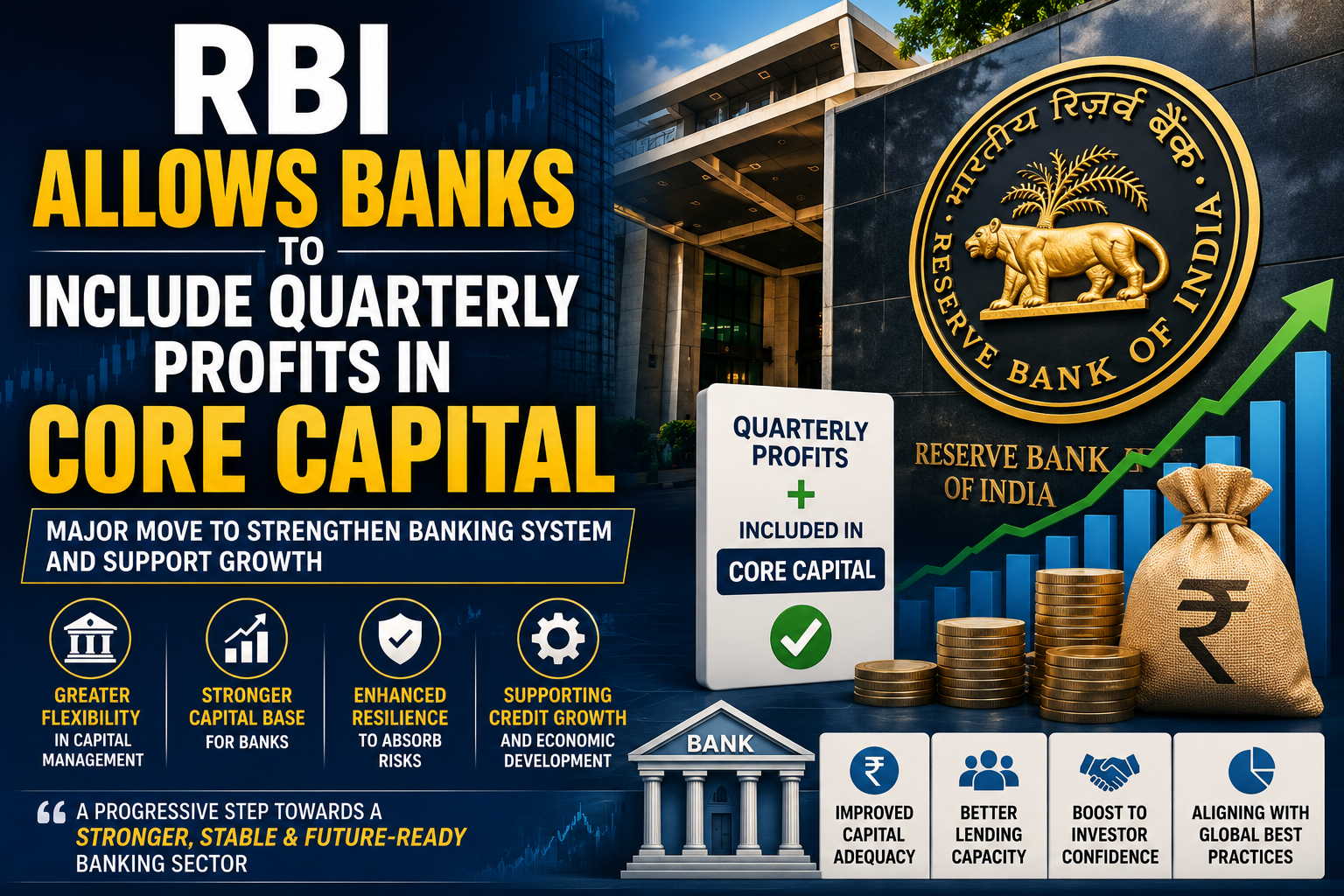
The Reserve Bank of India has allowed banks to include profits earned during a financial year in their core capital on a quarterly basis, subject to certain regulatory conditions. The move aims to align banks’ capital adequacy calculations more closely with their current financial performance while maintaining prudential safeguards.
The decision was announced through the Reserve Bank of India (Commercial Banks – Prudential Norms on Capital Adequacy) Fifth Amendment Directions, 2026.
Key Change Introduced by RBI
- Under the revised norms, banks can now recognise interim or quarterly profits as part of their Common Equity Tier 1 (CET1) capital during the financial year itself, instead of waiting until the end of the financial year.
- CET1 capital is the highest quality form of regulatory capital and mainly consists of common shares, retained earnings, and disclosed reserves. It serves as the primary buffer available to banks for absorbing losses.
Conditions for Inclusion of Quarterly Profits
The RBI has specified that banks can include quarterly profits in CET1 capital only if:
- the quarterly financial statements are fully audited, or
- they undergo a limited review by auditors.
This condition has been introduced to ensure transparency, accuracy, and prudential discipline in capital computation.
Revised Formula for “Eligible Profit”
The central bank has also prescribed a revised methodology for calculating “eligible profit” that can be recognised as part of CET1 capital.
The revised framework ensures that:
- expected dividend payouts,
- foreseeable expenses,
- and potential losses
are adequately accounted for before profits are added to regulatory capital.
This approach aims to prevent overstatement of banks’ capital position and maintain financial stability.
Impact on Banks
The amendment is expected to provide greater flexibility to banks in managing their capital adequacy ratios during the year. By allowing quarterly profits to be included earlier, banks may be able to:
- strengthen their capital position more quickly,
- improve lending capacity,
- and manage regulatory capital requirements more efficiently.
At the same time, the RBI’s safeguards are intended to ensure that capital calculations remain conservative and reliable.
Importance of CET1 Capital
- Under global banking standards such as the Basel framework, banks are required to maintain minimum capital adequacy ratios to absorb unexpected losses and protect depositors.
- Common Equity Tier 1 capital is considered the strongest form of capital because it consists mainly of permanently available funds capable of absorbing losses immediately when required.
- The RBI’s latest move is expected to help Indian banks better reflect their real-time financial strength while continuing to preserve stability in the banking system.