

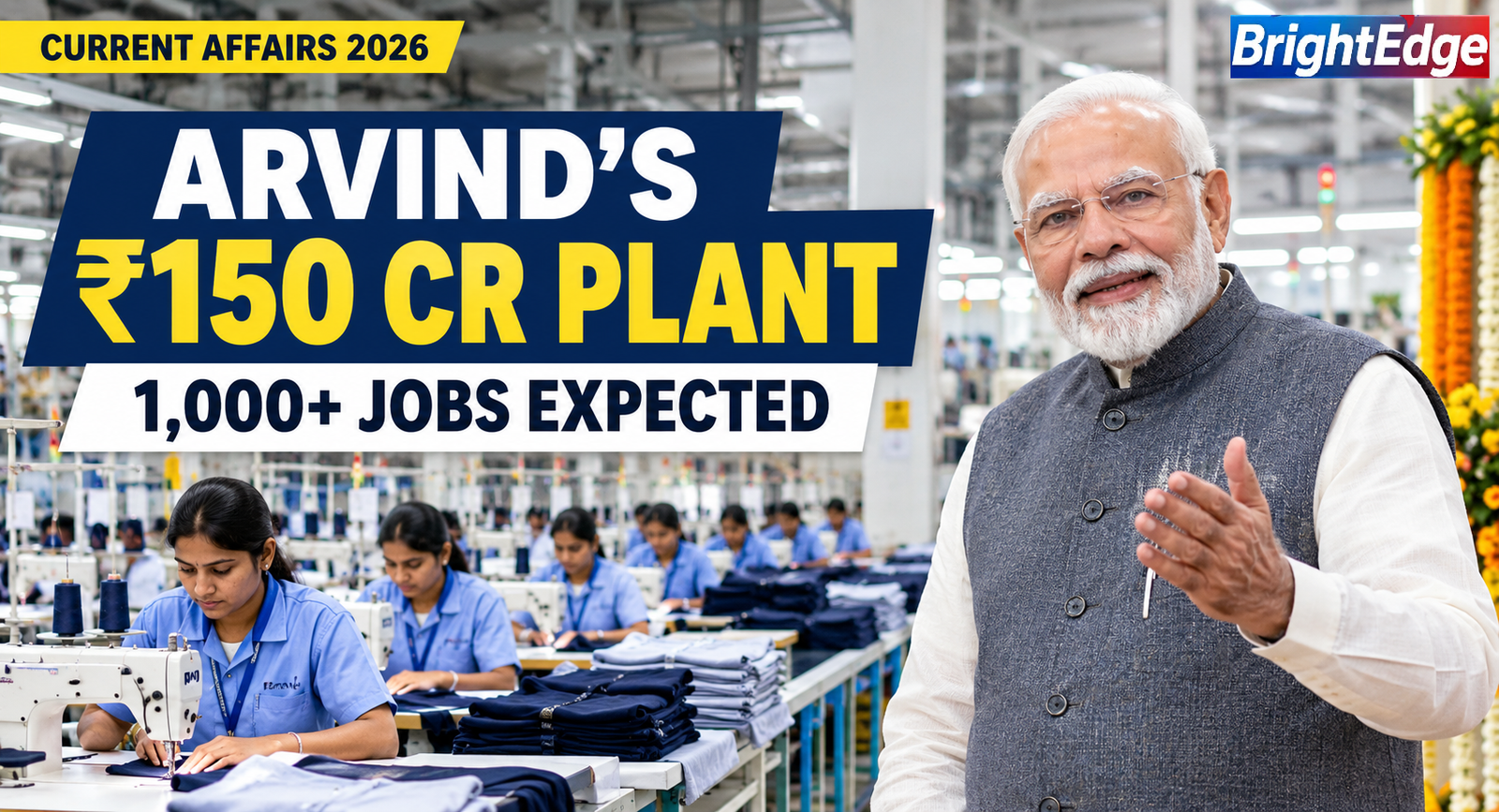
Prime Minister Narendra Modi inaugurated a new garment manufacturing facility of Arvind Limited in Varanasi, Uttar Pradesh, on October 25, 2026.
Developed with an investment of approximately ₹150 crore, the facility is expected to strengthen India’s textile and apparel manufacturing sector while creating more than 1,000 employment opportunities, predominantly for women.
The new plant is located in the Mirzamurad area of Varanasi and represents Arvind Limited’s expansion into Uttar Pradesh’s manufacturing landscape. The project aims to connect local manufacturing capabilities with domestic and international apparel markets.
The inauguration also highlighted the potential of modern garment manufacturing to support women’s employment, skill development and industrial growth in eastern Uttar Pradesh.
Key Highlights of Arvind Limited’s Varanasi Plant
- Inaugurated by: Prime Minister Narendra Modi.
- Company: Arvind Limited.
- Location: Mirzamurad, Varanasi, Uttar Pradesh.
- Investment: Approximately ₹150 crore.
- Expected employment: More than 1,000 direct jobs.
- Workforce focus: Predominantly women.
- Manufacturing focus: Garment and knitwear production.
- Main objective: Strengthen apparel manufacturing, employment and export potential.
The project is expected to support the development of a stronger textile manufacturing ecosystem in the Purvanchal region.
1. What Is the Arvind Textile Plant in Varanasi?
- The new facility is a garment manufacturing unit established by Arvind Limited, an Ahmedabad-based textile and apparel company.
- The plant has been developed as a modern manufacturing facility equipped with automated sewing technologies. It is intended to manufacture knitwear and other apparel products while improving production efficiency and quality.
- According to the company’s announcement, the facility has been developed with an investment of approximately ₹150 crore. It occupies around 5.5 acres and has a built-up area of approximately 65,000 square feet.
- The project also supports Arvind Limited’s strategy of expanding its garment manufacturing capabilities and integrating more stages of production into its existing textile business.
2. More Than 1,000 Jobs Expected
- Employment generation is one of the most significant aspects of the Varanasi manufacturing project.
- The facility is expected to create more than 1,000 direct jobs as operations develop. These opportunities are expected to benefit people in Varanasi and the wider Purvanchal region.
- The expansion of manufacturing activity can also create demand for supporting services, including transportation, logistics, packaging, maintenance and local suppliers.
- However, the figure of more than 1,000 jobs represents expected employment, not confirmation that all positions have already been filled.
- The project’s long-term employment contribution will depend on production capacity, workforce requirements and the expansion of operations.
3. Women’s Employment and Skill Development
- Women’s participation is a central feature of the new facility.
- According to reporting on the inauguration, more than 300 local women had already been recruited and were undergoing training at the plant.
- The initiative is intended to provide women with opportunities to acquire manufacturing skills and participate in the formal workforce.
- During his visit, Prime Minister Narendra Modi interacted with women workers and discussed their work and experiences. Reports also highlighted the importance of earning opportunities during training and the potential for employment to support further education and personal aspirations.
- The project illustrates how garment manufacturing can create employment pathways for women, particularly in regions where expanding local industrial opportunities may reduce the need to migrate for work.
4. How the Plant Could Strengthen Varanasi’s Textile Industry
Varanasi is widely known for its traditional Banarasi silk sarees and handloom heritage. The establishment of a modern garment manufacturing facility adds another dimension to the city’s textile economy.
Traditional handloom production and industrial garment manufacturing involve different production methods, skills and markets. However, both contribute to the wider textile and apparel ecosystem.
The Arvind facility could strengthen the region’s industrial base through:
- Modern garment manufacturing capabilities.
- Employment and technical skill development.
- Greater demand for local services and logistics.
- Opportunities for supporting businesses and suppliers.
- Connections with national and international apparel markets.
The project’s impact will depend on how successfully these opportunities translate into sustained production, employment and local economic activity.
5. Will Garments Manufactured in Varanasi Reach International Markets?
- Arvind Limited has an established customer base across global markets. The company expects the new facility to contribute to its apparel manufacturing operations and support the supply of garments to international customers.
- The inauguration therefore carries significance beyond local employment.
- Manufacturing garments in Varanasi for domestic and international markets could help connect the region with wider apparel supply chains.
- The facility is expected to manufacture knitwear products, while reports on the project have also referred to sportswear and undergarments.
- Actual export volumes and the contribution of the Varanasi unit to international sales will depend on production, customer demand and the company’s commercial operations.
6. What Is Arvind Limited?
- Arvind Limited is an Indian textile and apparel company headquartered in Ahmedabad, Gujarat.
- The company operates across textile manufacturing and apparel-related businesses. Its activities include fabrics, garments and other textile products serving domestic and international customers.
- The Varanasi facility represents an expansion of its garment manufacturing capabilities and strengthens its presence in Uttar Pradesh.
- For the company, the project is intended to support garment production capacity, operational integration and access to manufacturing opportunities in a new regional market.
7. Why Is the Varanasi Plant Important for Uttar Pradesh?
- The inauguration is relevant to Uttar Pradesh’s broader efforts to attract industrial investment and expand manufacturing-led economic activity.
- Large manufacturing facilities can contribute to regional development through direct employment, workforce training and demand for supporting services.
- For eastern Uttar Pradesh, the project could help broaden employment opportunities beyond traditional occupations and encourage the growth of an industrial support network.
The potential benefits include:
- Employment generation: More local manufacturing jobs as the facility expands.
- Skill development: Training in garment production and modern manufacturing practices.
- Women’s workforce participation: Greater access to industrial employment for local women.
- Industrial diversification: Expansion of garment manufacturing alongside the region’s established economic activities.
- Market connectivity: Opportunities to supply apparel to domestic and international customers.
These are potential benefits rather than guaranteed outcomes. Their scale will depend on the facility’s operating performance and future expansion.
Click Here to Read: PM Modi Inaugurates SEMICON India 2026 in New Delhi
Click Here to Read: PM Modi and Japanese PM Inaugurate Maruti Suzuki’s Kharkhoda Plant
Click Here to Read: PM Narendra Modi inaugurates projects worth around ₹9,400 crore in Telangana