

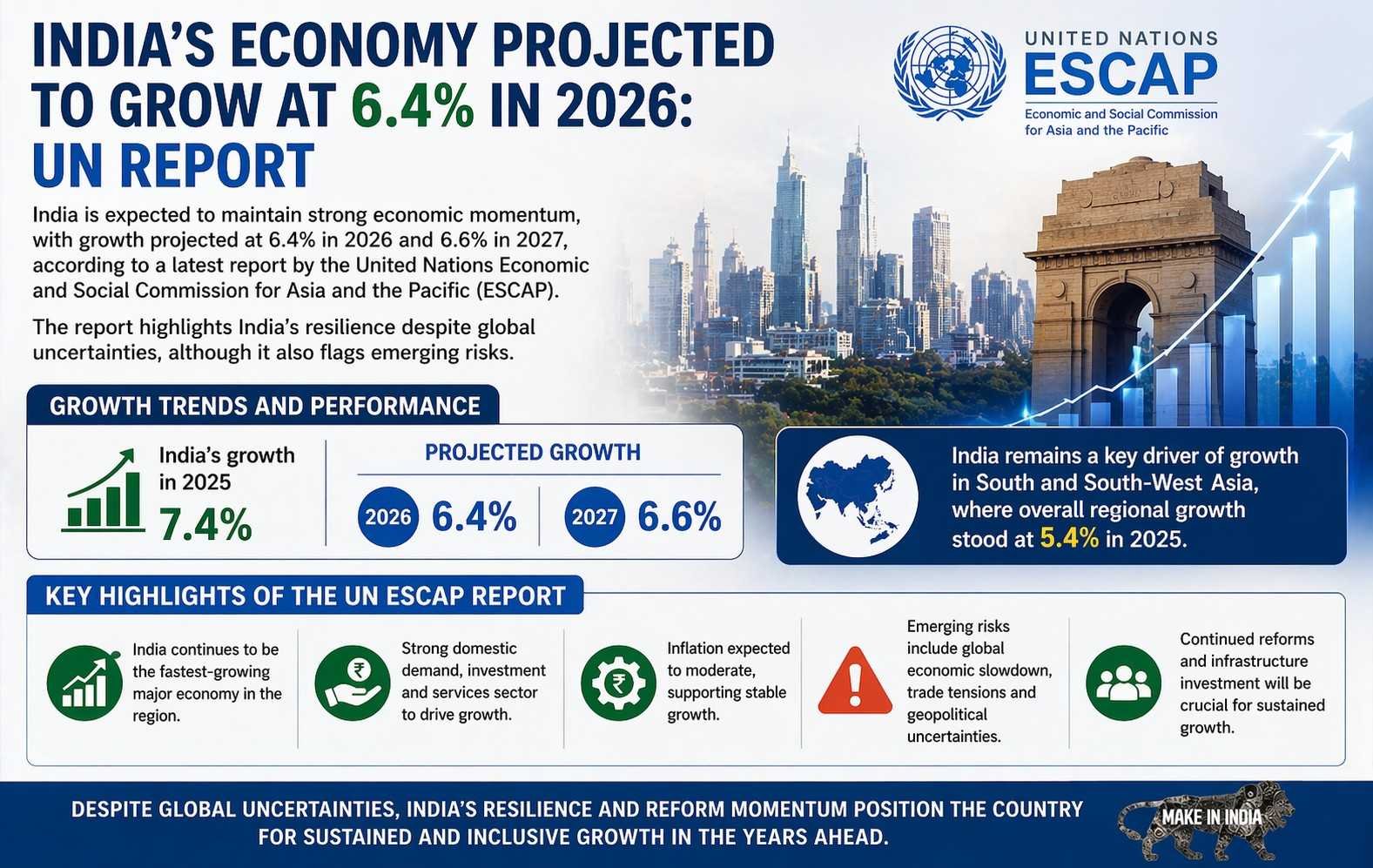
India’s economy is projected to grow at 6.4% in 2026 and 6.6% in 2027, according to a report released by the United Nations.
The estimates are part of the “Economic and Social Survey of Asia and the Pacific 2026”, published by the United Nations Economic and Social Commission for Asia and the Pacific (ESCAP).
Growth Trends and Key Drivers
- India recorded a strong 7.4% growth in 2025
- Growth was supported by:
- Robust domestic consumption, especially in rural areas
- GST rate cuts
- Export frontloading ahead of US tariff hikes
The report also noted that the services sector continues to be a major driver of economic growth.
Impact of Global Trade Tensions
Economic momentum slowed in the second half of 2025 due to:
- A 25% decline in exports to the United States
- Triggered by 50% tariffs imposed in August 2025
This highlights India’s vulnerability to global trade disruptions.
Inflation Outlook
- 2026: 4.4%
- 2027: 4.3%
Inflation is expected to remain stable and within manageable levels.
FDI and Regional Trends
- Foreign Direct Investment (FDI) to Asia-Pacific:
- Declined by 2% in 2025
- Despite a 14% rise in global FDI flows
India remained a key destination for greenfield investments, alongside:
- Australia
- Republic of Korea
- Kazakhstan
Remittances and Challenges
India continues to be the world’s largest remittance recipient, with:
- $137 billion in 2024
However, challenges include:
- A 1% US tax on remittances (from January 2026)
- Potential impact on household consumption
Remittances remain crucial, with ~40% used for essential expenses like healthcare.
Green Jobs and Energy Transition
- Global green jobs: 16.6 million
- India’s share: 1.3 million jobs
The report highlights India’s focus on sustainable development, supported by initiatives like:
- Production Linked Incentive (PLI) schemes
- Promotion of:
- Solar manufacturing
- Battery production
- Green hydrogen
Policy Significance
The report emphasises that:
- Public investment and industrial policy can accelerate growth
- Clean energy transition can:
- Create jobs
- Reduce import dependence
- Build new industries
India’s policy approach is cited as a model for green industrial development.
Conclusion
Despite global uncertainties and trade challenges, India remains one of the fastest-growing major economies. With strong domestic demand, policy support, and a push towards green growth, the country is well-positioned to maintain stable and sustainable economic expansion in the coming years.