

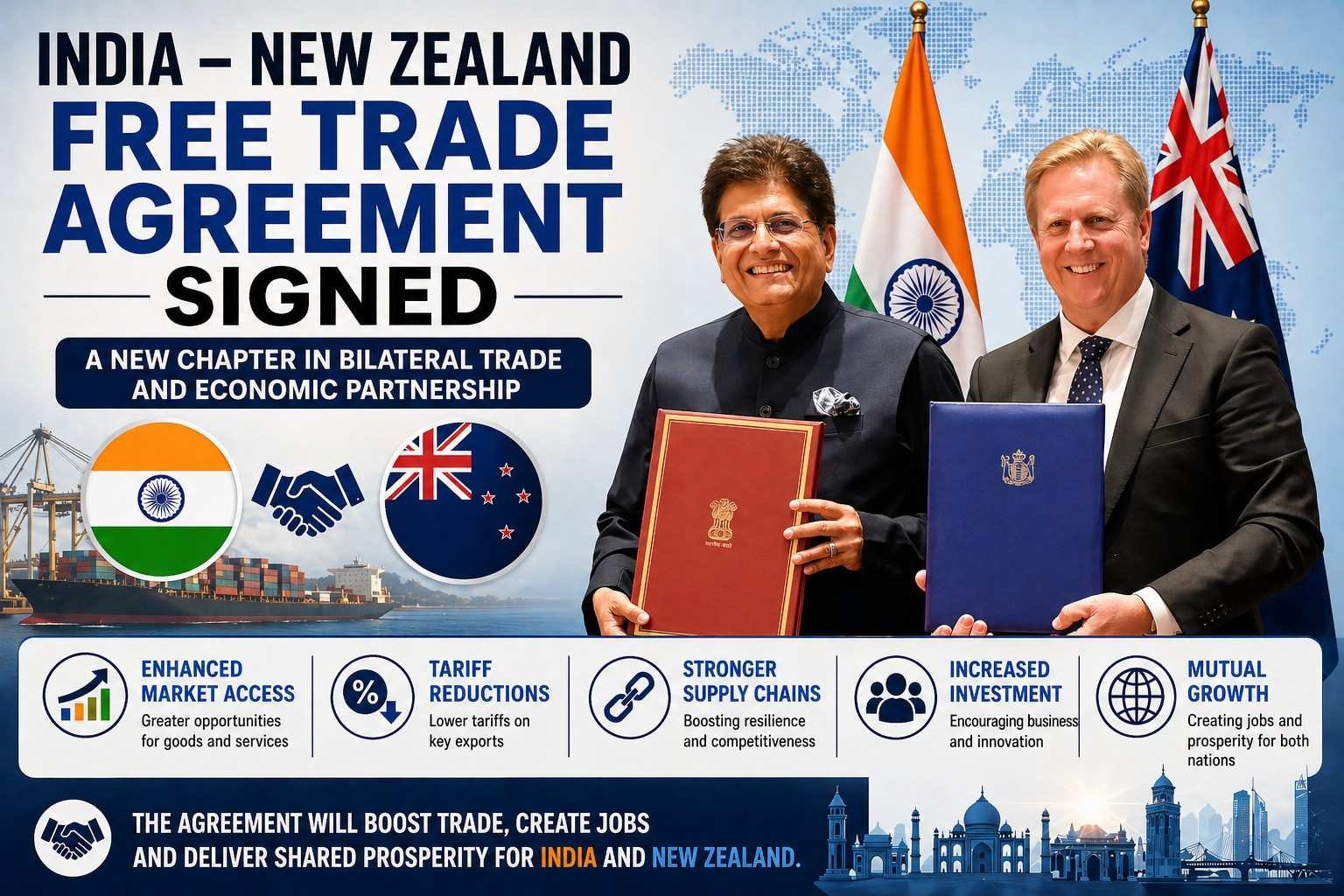
In a historic boost to bilateral economic and strategic ties, India and New Zealand have signed a landmark Free Trade Agreement (FTA), concluding negotiations in a record 9 months, making it one of India’s fastest-concluded FTAs.
The agreement is expected to significantly boost trade, investment, jobs, mobility, and cooperation across sectors such as agriculture, services, education, tourism, and culture.
Key Highlights of India–New Zealand FTA
1. 100% Duty-Free Access for Indian Exports
The FTA eliminates duties on 100% of Indian exports to New Zealand.
Major beneficiary sectors include:
- Textiles & apparel
- Leather & footwear
- Gems & jewellery
- Engineering goods
- Processed foods
This is a huge boost for India’s labour-intensive sectors and MSMEs.
2. New Zealand’s $20 Billion Investment Commitment
New Zealand has committed USD 20 billion investment in India over 15 years.
This will strengthen:
- Infrastructure
- Renewable energy
- Digital services
- Skill development
- Research & innovation
3. Protection for India’s Sensitive Sectors
India has protected key domestic sectors by excluding several items from market access:
- Dairy products
- Sugar
- Certain animal products
- Vegetable products
- Arms & ammunition
- Selected metals and articles
This safeguards Indian farmers and industries.
Big Gains for Agriculture
The FTA includes an Agricultural Productivity Partnership.
Focus areas include:
- Kiwifruit
- Apples
- Honey
- Forestry
- Fisheries
- Livestock
- Wine sector
India will also establish Centres of Excellence and improve:
- Planting material
- Supply chains
- Food safety
- Orchard management
Services Sector Gains
New Zealand has opened access across 118 services sectors and offered MFN treatment in 139 sectors.
For the first time, New Zealand has facilitated trade in:
- Ayurveda
- Yoga
- Traditional medicine services
This boosts India’s AYUSH ecosystem globally.
Trade & Economic Impact
Bilateral Trade Growth
- Merchandise trade rose from USD 873 million (2023–24) to USD 1.3 billion (2024–25)
- India’s exports to New Zealand reached USD 711 million
- Services exports rose 13% to USD 634 million
Strong Indian Diaspora
Around 300,000 persons of Indian origin and NRIs live in New Zealand, nearly 5% of its population.
Other Important Provisions
The FTA also includes:
- GI protection commitments
- Faster customs clearance (24–48 hours)
- SPS & TBT simplification
- Rules of Origin framework
- Cooperation in tourism, sports, audiovisual industries, and traditional knowledge.
What is FTA?
A Free Trade Agreement (FTA) is a pact between two or more countries to reduce or eliminate trade barriers such as tariffs, import quotas, and restrictions, thereby promoting smoother trade flows. As of April 2026, India has signed 9 major FTAs covering 38 countries, reflecting its growing integration into global markets.
India’s Current FTAs (as of 2026)
India has 9 FTAs covering 38 countries, including both bilateral and regional agreements.
Key Agreements:
- India–Mauritius CECPA (2021) – First of the new-generation FTAs.
- India–UAE CEPA (2022) – Boosts trade in textiles, gems, pharma, and creates ~1 million jobs.
- India–Australia ECTA (2022) – Improves access for Indian exports like textiles and pharma.
- India–EFTA TEPA (2024, effective 2025) – With Switzerland, Norway, Iceland, Liechtenstein.
- India–UK CETA (2025) – Expands trade in services, mobility pathways for professionals.
- India–Oman CEPA (2025) – Strengthens Gulf trade relations.
- India–New Zealand FTA (2025) – Opens Oceania markets for Indian goods.
- India–EU FTA (2026) – Major deal with 27 EU countries, enhancing access for agriculture, IT, and services.
- Framework with USA (2026) – Interim trade agreement strengthening bilateral engagement.
Conclusion
The India–New Zealand Free Trade Agreement marks a transformative step in India’s trade diplomacy. It promises stronger exports, higher investment, better mobility for students and professionals, and wider opportunities for MSMEs, farmers, and entrepreneurs.