

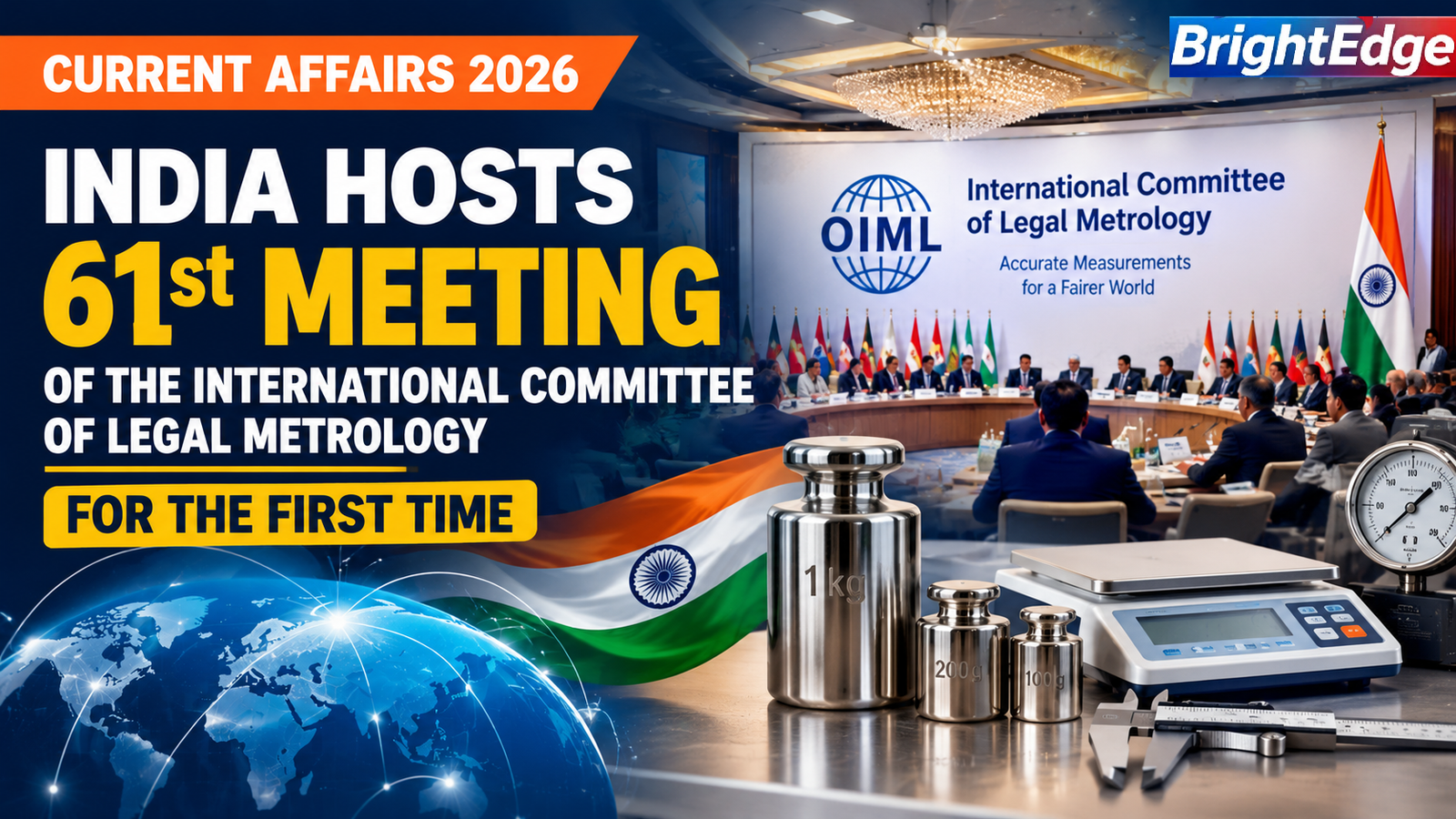
India hosted the 61st Meeting of the International Committee of Legal Metrology (CIML) in New Delhi for the first time from October 26 to 28, 2026. Organised by the Department of Consumer Affairs, Government of India, in association with the International Organization of Legal Metrology (OIML), the meeting brings together international delegates, senior officials and technical experts to discuss measurement standards, digitalisation, consumer protection and international trade.
The three-day programme includes an international seminar on “Evolutions in Legal Metrology”, an OIML Strategy Workshop and discussions on emerging technologies and the future of global measurement systems.
The event highlights India’s efforts to modernise its legal metrology framework and strengthen international cooperation on reliable and harmonised measurement standards.
What Is the 61st CIML Meeting 2026?
- The 61st CIML Meeting is an international gathering of the International Committee of Legal Metrology, the committee responsible for guiding the technical and administrative activities of the International Organization of Legal Metrology.
- The meeting provides a platform for participating countries and experts to discuss international measurement standards, regulatory developments, conformity assessment and cooperation in legal metrology.
- India is hosting this meeting for the first time in New Delhi from October 26 to 28, 2026.
- The programme also addresses the impact of digital technologies, changing industrial requirements and the need for internationally harmonised measurement systems.
- According to the Ministry of Consumer Affairs, Food and Public Distribution, the event provides an opportunity to showcase India’s regulatory reforms and exchange international best practices.
Who Is Organising the 61st CIML Meeting?
The meeting is being organised by the Department of Consumer Affairs, Government of India, in association with the International Organization of Legal Metrology.
What Is Legal Metrology?
- Legal metrology refers to the application of legal and regulatory requirements to measurements and measuring instruments.
- It helps ensure that measurements used in commercial transactions and other regulated activities are accurate, reliable and consistent with applicable standards.
- For example, legal metrology is relevant when consumers purchase one kilogram of rice, buy petrol by the litre, or receive a product whose declared net quantity must match the quantity supplied.
- It also covers regulated measuring instruments used in areas such as industry, healthcare, safety and environmental monitoring.
- Reliable measurement systems help protect consumers against incorrect quantities, support fair competition among businesses and strengthen confidence in commercial transactions.
- International cooperation in legal metrology helps countries develop compatible requirements and reduces unnecessary technical obstacles to trade.
What Is the International Organization of Legal Metrology (OIML)?
- The International Organization of Legal Metrology, commonly known as OIML, is an intergovernmental organisation established in 1955.
- Its principal objective is to promote the global harmonisation of legal metrology procedures and requirements.
- OIML develops international recommendations, standards and related documents for measuring instruments and measurement systems used in trade, industry, healthcare, safety and environmental protection.
- Its work supports cooperation among national authorities and helps manufacturers and regulators work towards internationally compatible technical requirements.
- The organisation also operates the OIML Certification System, which facilitates the international acceptance of relevant test results and certificates under its applicable arrangements.
- Headquarters: Paris, France
- Membership: Includes 64 Member States and 63 Corresponding Members.
- India’s Role: India joined the OIML in 1956 and acts as an authorized country to issue international OIML certificates.
Key Objectives of the 61st CIML Meeting
1. Harmonisation of International Measurement Standards
One of the major objectives is to strengthen cooperation on internationally harmonised measurement requirements.
Common technical approaches can improve consistency between countries and support the development, testing and verification of measuring instruments.
2. Digital Transformation of Legal Metrology
The programme explores how digital technologies can modernise regulatory services and measurement systems.
Discussions include digitalisation, innovative administrative practices, e-learning and the development of machine-readable technical standards.
3. Consumer Protection and Fair Trade
Accurate measurements are essential for protecting consumers and ensuring that businesses compete under fair conditions.
Reliable measurement requirements help promote correct quantity declarations, transparent transactions and confidence in products and services.
4. International Recognition of Testing and Certification
International cooperation can help reduce duplication in testing and certification where applicable arrangements allow results to be recognised across borders.
This can support manufacturers seeking to enter international markets while maintaining appropriate technical and regulatory safeguards.
5. Cooperation on Emerging Technologies
The meeting provides an opportunity to examine how measurement standards and regulatory systems should respond to technological developments.
Topics include digital transformation, machine-readable recommendations and potential applications of artificial intelligence in measurement and verification systems.
Major Legal Metrology Reforms Highlighted by India
During the meeting, the Department of Consumer Affairs highlighted several initiatives intended to improve regulatory services, strengthen verification capacity and support consumer protection.
1. e-Maap National Portal
The e-Maap National Portal is intended to provide integrated digital services in legal metrology.
Digital regulatory platforms can simplify access to services, improve administrative efficiency and make relevant processes more convenient for businesses and other users.
The initiative forms part of India’s broader efforts to modernise legal metrology administration.
2. Government Approved Test Centres (GATCs)
Government Approved Test Centres help augment the capacity available for verification and testing of eligible measuring instruments.
Expanding this infrastructure can support more accessible verification services and improve the administration of measurement-related requirements.
3. Jan Vishwas Reforms
The Jan Vishwas reforms of 2023 and 2026 were highlighted in the official account of the meeting.
The reforms include measures relating to the decriminalisation of specified offences, improvement notices and graded penalties.
Their stated objective is to support a more proportionate regulatory framework and improve ease of doing business while retaining essential consumer safeguards.
4. OIML Certification System Issuing Authority Recognition
India’s recognition as an OIML Certification System (OIML-CS) Issuing Authority is an important development in international measurement cooperation.
The OIML-CS facilitates the international acceptance of relevant test results and certificates under its rules and arrangements.
This recognition can help Indian manufacturers navigate applicable conformity assessment requirements and improve opportunities for international market access.
It does not mean that every Indian measuring instrument automatically receives approval in every foreign market.
5. One Nation, One Time
The National Time Dissemination Project, known as “One Nation, One Time”, aims to provide accurate, reliable and traceable Indian Standard Time across the country.
Reliable time synchronisation is important for sectors such as banking, telecommunications, digital infrastructure, power systems and navigation.
The project highlights the wider role of precision measurement and national measurement standards in supporting modern infrastructure.
How Will the CIML Meeting Benefit India?
Hosting the 61st CIML Meeting provides India with an opportunity to exchange expertise, present regulatory developments and participate in international discussions on measurement standards.
Its potential benefits include the following.
- Improved consumer confidence: Reliable measurement systems help consumers receive the quantities and measurements declared in commercial transactions.
- Support for Indian manufacturers: Greater familiarity with international standards and conformity assessment requirements can help businesses prepare products for export markets.
- Reduced technical barriers to trade: Harmonised requirements and appropriate mutual recognition arrangements can reduce unnecessary duplication in testing and certification.
- Better regulatory practices: International knowledge-sharing can help authorities evaluate modern regulatory approaches and improve administrative processes.
- Technology-enabled governance: Discussions on digitalisation and machine-readable standards can inform future improvements in measurement administration.
These benefits depend on the implementation of relevant standards, effective regulatory cooperation and the specific requirements of each market.
Click Here to Read: India’s ‘One Nation, One Time’ Rules 2026 Notified