

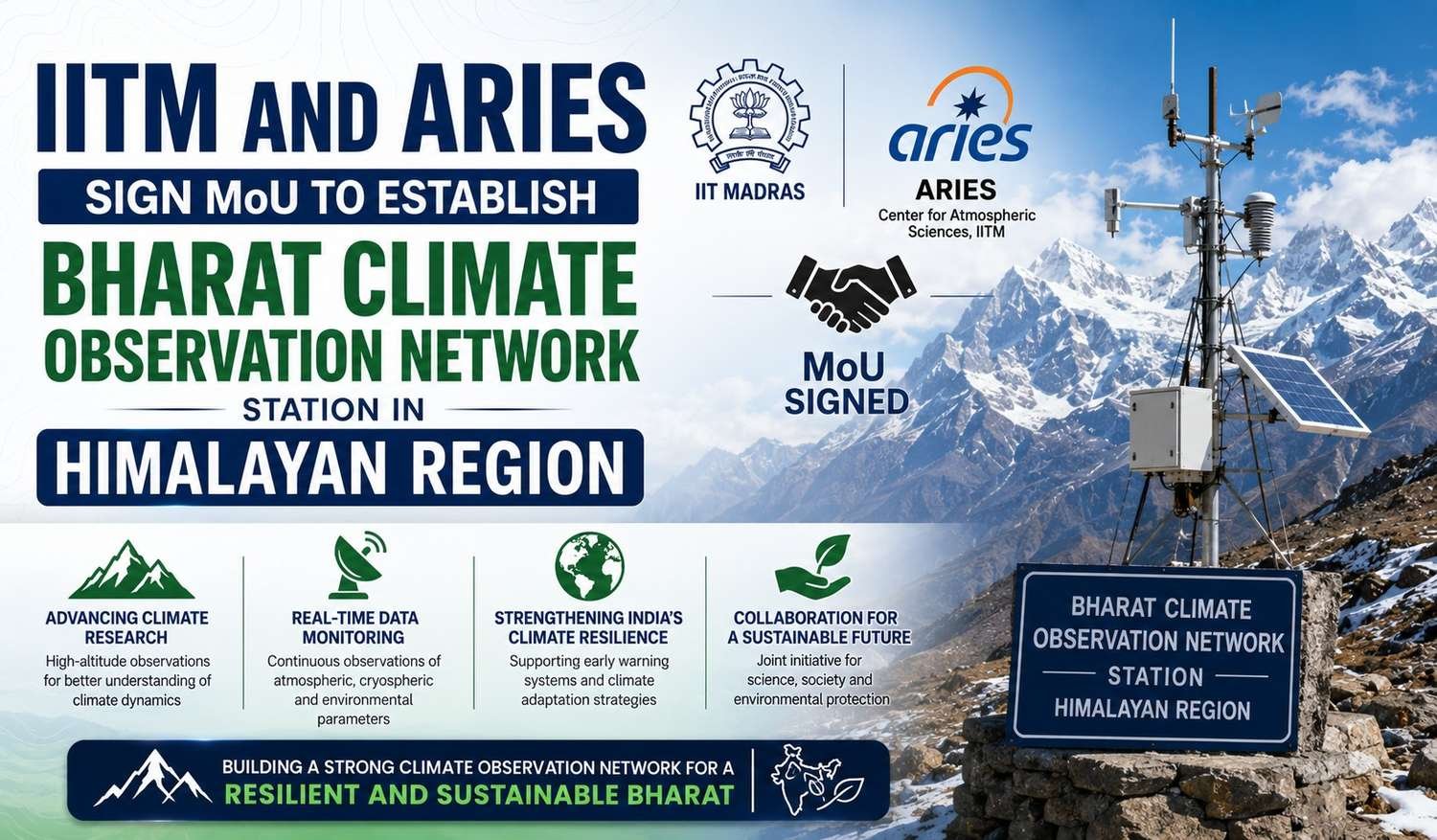
- In a significant step towards strengthening India’s climate monitoring and climate research infrastructure, the Indian Institute of Tropical Meteorology (IITM), Pune, and the Aryabhatta Research Institute of Observational Sciences (ARIES), Nainital, have signed a long-term Memorandum of Understanding (MoU) for the establishment of a climate observation station under the Bharat Climate Observation Network (BCON).
- The agreement will remain effective for more than 50 years and is expected to play a crucial role in advancing climate science and atmospheric research in India.
Major Boost to Mission Mausam
- The collaboration aligns with the objectives of Mission Mausam, a flagship initiative of the Ministry of Earth Sciences (MoES) aimed at improving weather forecasting, climate monitoring, and atmospheric research capabilities across India.
- Under this initiative, a dedicated Climate Observation Station will be established at ARIES, Devasthal, a high-altitude research site in Uttarakhand’s Himalayan region.
- The station will become an important component of the Bharat Climate Observation Network (BCON), a national climate monitoring framework developed by IITM.
What is Bharat Climate Observation Network (BCON)?
BCON is a nationwide observational programme conceptualized and implemented by IITM under the Ministry of Earth Sciences.
Its primary objective is to create a long-term, high-precision climate monitoring network capable of collecting accurate climate-related data from different geographical regions of India.
The network aims to generate high-quality climate datasets that can support:
- Climate change research
- Weather and climate forecasting
- Environmental monitoring
- Climate policy formulation
- Earth System Model development
- Scientific assessment of long-term climate trends
BCON is expected to become one of India’s most comprehensive climate observation systems.
Why Devasthal Was Chosen
ARIES’ observatory at Devasthal provides an ideal location for climate monitoring.
Located in the Himalayan region at a high altitude, the site offers relatively pristine atmospheric conditions that are less affected by urban pollution.
This unique environment allows scientists to accurately measure:
- Greenhouse gases
- Climate-active trace gases
- Short-lived climate pollutants
- Atmospheric chemistry
- Meteorological parameters
- Soil moisture levels
The location is particularly important for understanding climate processes occurring in the ecologically sensitive Himalayan ecosystem.
Key Observations Under the New Station
The BCON station at Devasthal will continuously monitor several critical climate variables.
Meteorological Parameters
Scientists will collect data on temperature, humidity, rainfall, wind speed, atmospheric pressure, and other weather-related variables.
Greenhouse Gases
The station will monitor gases such as carbon dioxide (CO₂), methane (CH₄), and other greenhouse gases that contribute to global warming.
Short-Lived Climate Forcers
Researchers will study pollutants such as black carbon and aerosols that influence regional climate patterns.
Atmospheric Chemistry
The project will help scientists understand chemical processes occurring in the atmosphere and their impact on climate.
Soil Moisture Monitoring
Soil moisture data will assist in studying land-atmosphere interactions and hydrological processes.
Importance for Climate Change Research
The long-term climate data generated through BCON will significantly strengthen India’s climate science capabilities.
Scientists will be able to:
- Detect long-term climate trends
- Assess the impact of global warming
- Study atmospheric pollution transport
- Improve climate risk assessments
- Develop evidence-based climate policies
The project will provide critical information needed to understand how climate change is affecting India’s environment and economy.
Supporting India’s Earth System Models
One of the most important contributions of BCON will be its support for climate modelling.
The high-accuracy datasets collected through the network will help validate and improve Earth System Models (ESMs), including India’s first indigenous Earth System Model developed by IITM.
Better climate models will enable:
- More accurate climate projections
- Improved monsoon forecasts
- Enhanced extreme weather predictions
- Better adaptation planning
These improvements are essential for climate resilience and disaster preparedness.
Why This Matters for India
India is among the countries most vulnerable to climate change impacts, including extreme weather events, changing rainfall patterns, glacier retreat, and rising temperatures.
Developing a robust climate observation network is essential for:
- Climate adaptation planning
- Sustainable development
- Disaster risk reduction
- Water resource management
- Agricultural planning
- Environmental conservation
The IITM-ARIES partnership represents a major step toward building the scientific infrastructure needed to address these challenges.
Conclusion
The long-term collaboration between IITM Pune and ARIES Nainital marks an important milestone in India’s climate research journey. By establishing a Climate Observation Station under the Bharat Climate Observation Network in the Himalayan region, the partnership will generate critical climate data, strengthen research capabilities, and support evidence-based climate action.
As climate change continues to pose global challenges, initiatives such as BCON will help India improve its scientific understanding of climate processes and enhance its ability to respond effectively to future environmental risks.