

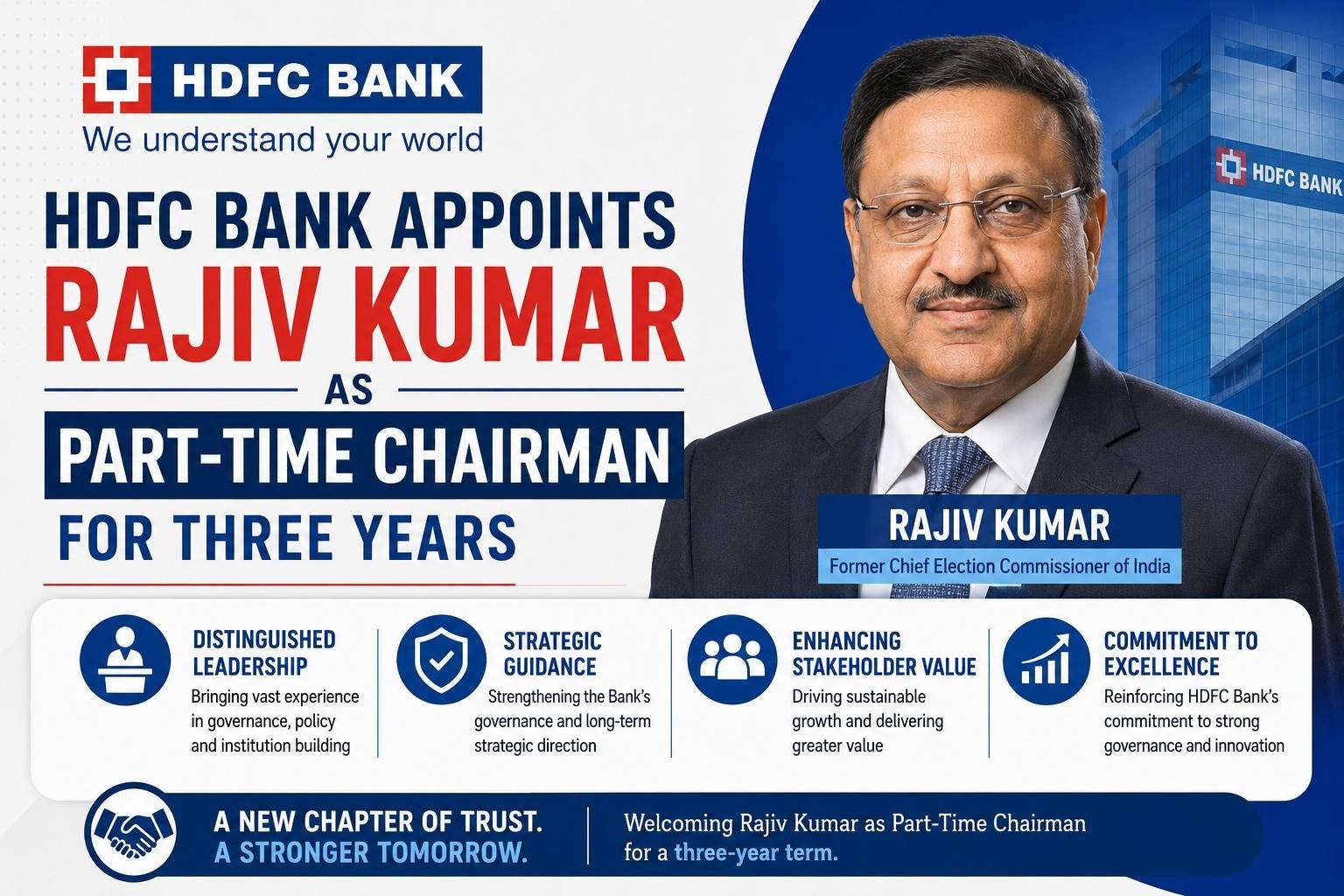
- India’s largest private sector lender, HDFC Bank, has announced a major leadership change by appointing former Chief Election Commissioner (CEC) Rajiv Kumar as its Part-Time Chairman for a period of three years.
- The appointment, approved by the bank’s Board of Directors, is subject to approval from the Reserve Bank of India (RBI).
- The board has also approved Rajiv Kumar’s appointment as an Additional Director (Independent Director) for a four-year term beginning June 30, 2026, subject to shareholders’ approval.
A Significant Leadership Transition
- Rajiv Kumar’s appointment comes at a crucial time for HDFC Bank as the lender prepares for another important governance decision—the reappointment of Managing Director and CEO Sashidhar Jagdishan, whose second term is scheduled to conclude in October 2026.
- Once RBI grants approval, Kumar will formally assume charge as Part-Time Chairman, strengthening the bank’s governance framework ahead of this leadership transition.
Filling the Chairman’s Vacancy
- The position became vacant after former Part-Time Chairman Atanu Chakraborty resigned in March 2026, citing differences regarding certain practices within the bank that he believed were inconsistent with his personal values and ethics.
- Following his resignation, veteran banker Keki Mistry was appointed as Interim Part-Time Chairman for an initial three-month period.
- His tenure was later extended until September 18, 2026, ensuring continuity until a permanent appointment could be made.
- Rajiv Kumar’s appointment is expected to bring stability and experienced leadership to the bank’s Board.
Legal Review Cleared Governance Concerns
- The appointment also follows HDFC Bank’s recent disclosure that an independent legal review commissioned by the bank found that the allegations made by former Chairman Atanu Chakraborty in his resignation letter were “not substantiated.”
- The development is viewed as an important step in restoring confidence in the bank’s governance processes.
Rajiv Kumar’s Distinguished Career
- Rajiv Kumar is a 1984-batch IAS officer with extensive experience in public administration, finance and governance.
- Before becoming the 25th Chief Election Commissioner of India, he served as Secretary, Department of Financial Services, from 2017 to 2020.
- During his tenure, he played a central role in several landmark banking reforms, including:
- Implementation of the Government’s 4R Strategy—Recognition, Resolution, Recapitalisation and Reforms—to address stressed assets in public sector banks.
- Consolidation of 27 public sector banks into 12 larger entities.
- Capital infusion of more than ₹3 lakh crore into public sector banks.
- Strengthening governance, compliance and risk management systems.
- Increasing deposit insurance coverage from ₹1 lakh to ₹5 lakh, providing greater protection to bank depositors.
As Chief Election Commissioner, Rajiv Kumar successfully supervised the 2024 Lok Sabha Elections, one of the world’s largest democratic exercises.
What This Means for HDFC Bank
- The appointment signals HDFC Bank’s continued emphasis on strong corporate governance, regulatory compliance and experienced leadership.
- With Rajiv Kumar’s background in financial sector reforms and public administration, analysts believe his experience will help the bank navigate future regulatory and strategic challenges while supporting long-term growth.
- His appointment also comes at a time when India’s banking sector is witnessing rapid digital transformation, increasing regulatory oversight and evolving customer expectations.
Looking Ahead
- Following RBI approval, Rajiv Kumar will officially assume office as Part-Time Chairman for a three-year term.
- The bank’s next major governance milestone will be the Board’s decision on the extension of Managing Director and CEO Sashidhar Jagdishan’s tenure, making the coming months particularly significant for HDFC Bank’s leadership.
Conclusion
By appointing former Chief Election Commissioner Rajiv Kumar as Part-Time Chairman, HDFC Bank has reinforced its commitment to strong governance and experienced leadership. With decades of experience in banking reforms, financial administration and public service, Kumar is expected to play a key role in guiding India’s largest private lender through its next phase of growth and strategic transformation.