

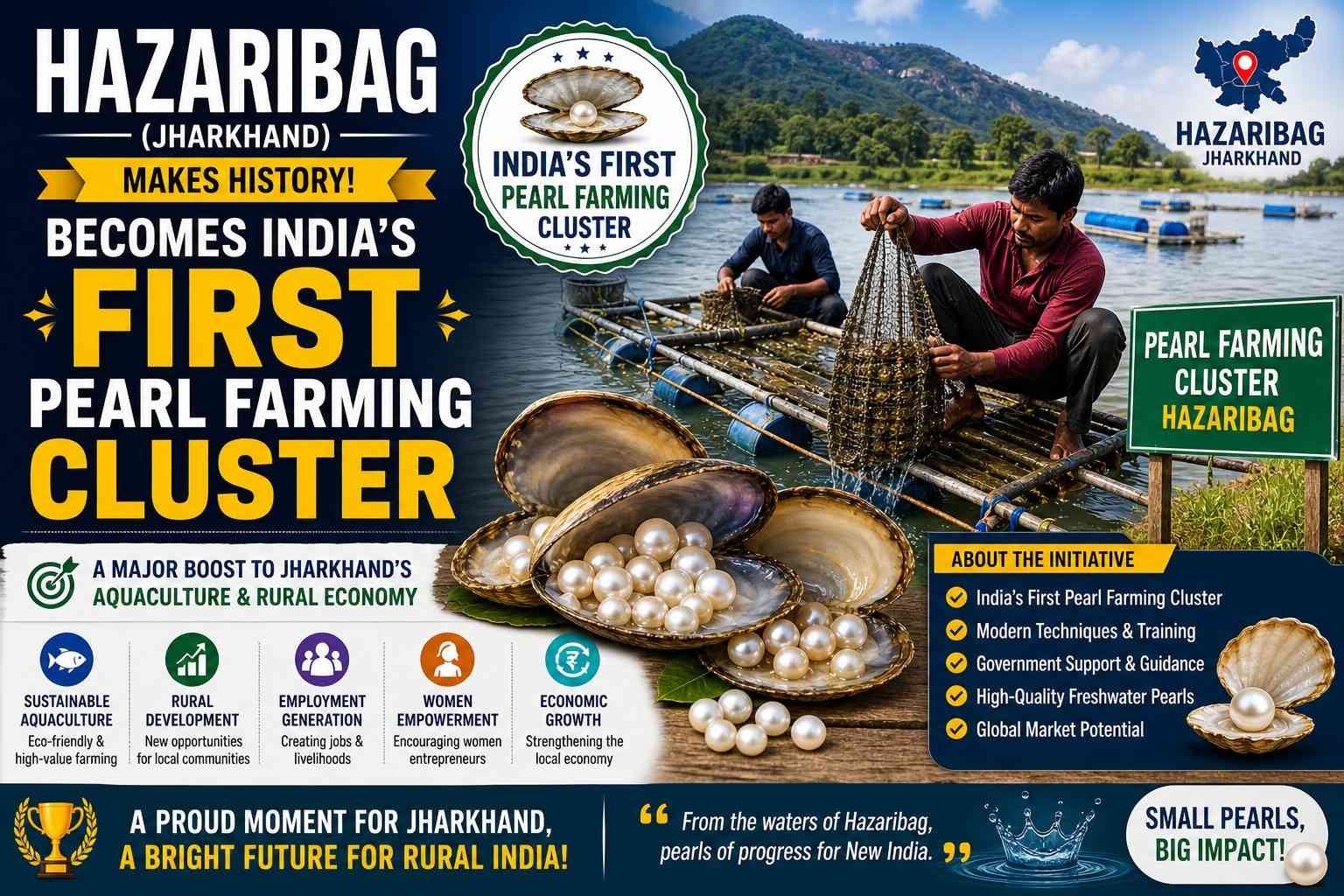
Hazaribag has been identified as India’s first pearl farming (moti) cluster. The initiative is being driven by the government to transform the district into a model hub for pearl cultivation and allied activities.
Key Highlights of the Initiative
- First Pearl Cluster in India:
The Government of India has officially selected Hazaribag as the country’s only dedicated pearl farming cluster. - Focus on Rural Livelihoods:
The programme aims to:- Generate employment
- Increase farmers’ income
- Promote sustainable use of water resources
- Women-Centric Approach:
- Strong push for Self-Help Groups (SHGs)
- Plan to create an all-women Farmer Producer Organisation (FPO)
- Enhances women’s participation in the rural economy
What is Pearl Farming?
Pearl farming involves cultivating pearls inside freshwater mussels by inserting a nucleus (foreign object) into the mollusc.
Process:
- Selection of healthy mussels
- Surgical implantation of nucleus
- Cultivation in ponds/reservoirs
- Harvesting pearls after 12–24 months
It is a high-value, low-land activity, ideal for small and marginal farmers.
Key Locations & Activities
- Daurwa–Kundwa Area (Hazaribag):
Developed as a pond-based pearl farming cluster with training support. - Tilaiya Reservoir (Barhi subdivision):
- Integration of cage fish farming + pearl culture
- Promotes income diversification
Government Strategy
Officials are working on a phased development plan:
- Expansion of pearl farming to more farmers
- Use of modern aquaculture techniques
- Establishing direct market linkages
- Capacity building through training & demonstrations
Why This Initiative Matters
- Promotes blue economy in inland regions
- Reduces dependence on traditional agriculture
- Encourages women-led entrepreneurship
- Positions India in the global pearl market
Exam-Oriented Takeaways
- First Pearl Farming Cluster in India: Hazaribag (Jharkhand)
- Focus: Rural employment + women empowerment
- Technique: Freshwater pearl cultivation
- Model: Cluster-based aquaculture development