

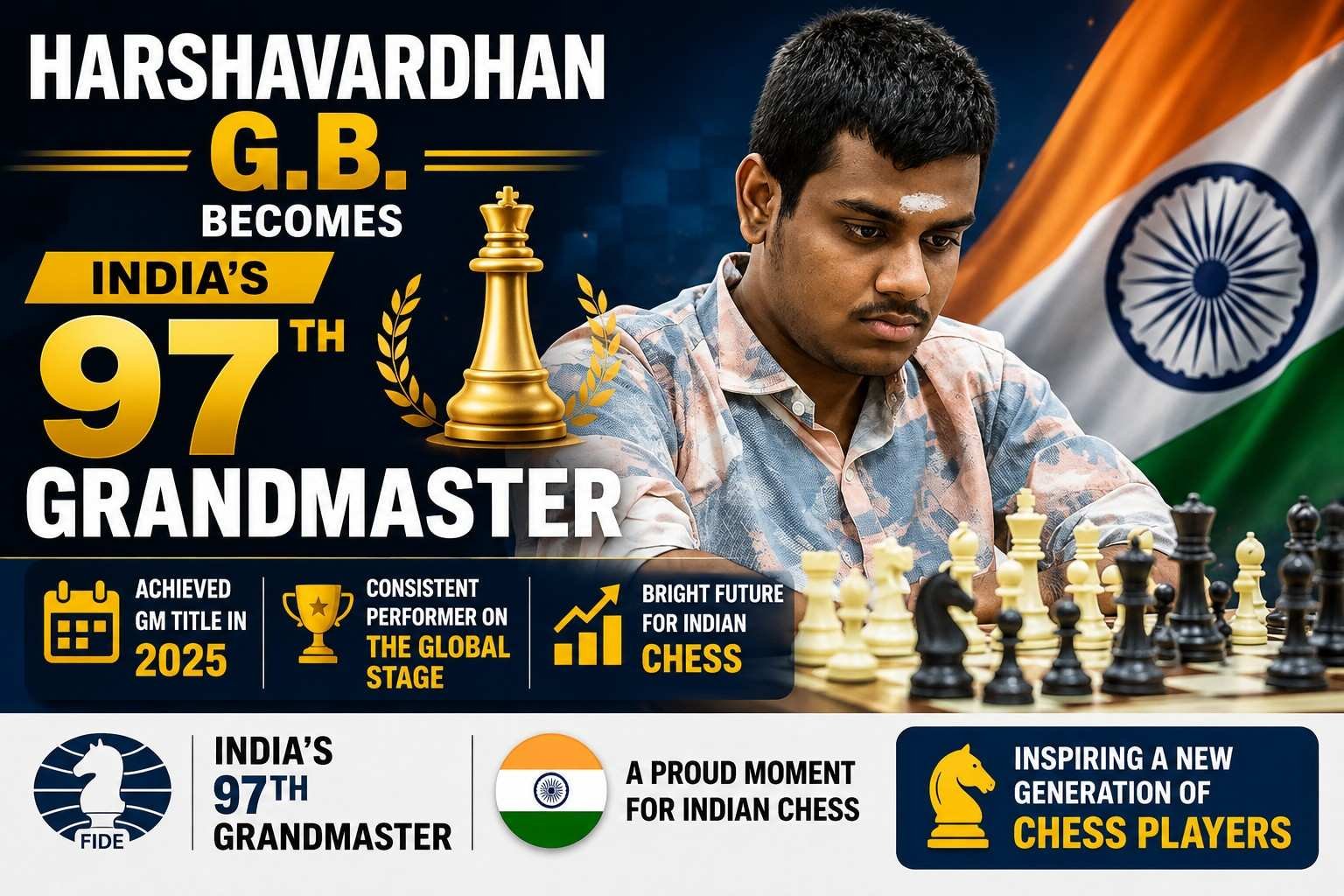
- Indian chess celebrated another historic milestone as International Master (IM) G.B. Harshavardhan officially became India’s 97th Grandmaster (GM) after achieving his third and final Grandmaster norm at the Second Chola Chess GM Norm Round-Robin Tournament held in Chennai.
- The landmark achievement further strengthens India’s growing reputation as one of the world’s leading chess nations.
- While Harshavardhan made history by earning the prestigious Grandmaster title, Grandmaster Michał Krasenkow of Poland emerged champion of the GM Norm tournament, and Grandmaster Aleksej Aleksandrov of Belarus won the IM Norm event.
Harshavardhan Becomes India’s 97th Grandmaster
Harshavardhan entered the tournament needing one final Grandmaster norm to secure the coveted title.
He delivered an outstanding performance by:
- Scoring 6.5 points from 9 rounds.
- Achieving his third and final GM norm.
- Crossing the mandatory 2500 Elo rating required for the Grandmaster title.
With these accomplishments, Harshavardhan officially became India’s 97th Grandmaster, joining the elite club of Indian chess legends.
His achievement reflects India’s remarkable rise as a global chess powerhouse.
Michał Krasenkow Wins GM Norm Tournament
Although Harshavardhan achieved the Grandmaster title, the tournament championship went to Grandmaster Michał Krasenkow of Poland.
Final Standings – GM Norm Tournament
| Rank | Player | Points |
|---|---|---|
| 1 | GM Michał Krasenkow (Poland) | 7.0 |
| 2 | IM G.B. Harshavardhan (India) | 6.5 |
| 3 | IM Harsh Suresh (India) | 6.0 |
Krasenkow’s consistent performance across nine rounds helped him clinch the championship.
Aleksej Aleksandrov Wins IM Norm Event
In the First Chola Chess IM Norm Round-Robin Tournament, Grandmaster Aleksej Aleksandrov of Belarus secured the title.
Final Standings – IM Norm Tournament
| Rank | Player | Points |
| 1 | GM Aleksej Aleksandrov (Belarus) | 6.5 |
| 2 | FM Daakshin Arun (India) | 6.0 |
| 3 | IM L.M.S.T. De Silva | 5.5 |
Indian player Daakshin Arun also achieved a significant milestone by earning his second International Master (IM) norm.
India’s Chess Revolution Continues
Harshavardhan’s achievement highlights the rapid growth of Indian chess over the past decade.
India has consistently produced world-class players thanks to:
- Strong grassroots development.
- World-class coaching.
- Growing international tournament exposure.
- Inspiration from legends like Viswanathan Anand.
- Increased support from academies and federations.
The country now boasts one of the youngest and strongest pools of chess talent in the world.
Significance of Becoming a Grandmaster
The Grandmaster (GM) title is the highest lifetime title awarded by the International Chess Federation (FIDE).
To become a Grandmaster, a player must:
- Achieve three GM norms in internationally rated tournaments.
- Cross the 2500 Elo rating at any point during their career.
- Meet FIDE’s performance requirements against strong international opposition.
Only a select group of players worldwide achieve this prestigious title.
A Bright Future for Indian Chess
- With Harshavardhan becoming India’s 97th Grandmaster and several young players earning international norms, India’s dominance in global chess continues to grow.
- The emergence of new Grandmasters strengthens India’s chances in future Chess Olympiads, World Championships and elite international tournaments.
Conclusion
- G.B. Harshavardhan’s historic achievement marks another proud moment for Indian chess. Becoming India’s 97th Grandmaster reflects years of dedication, consistent performance and exceptional talent.
- Alongside tournament winners Michał Krasenkow and Aleksej Aleksandrov, the Chola Chess tournaments showcased the growing strength of international chess while highlighting India’s continued rise as a global chess powerhouse.