

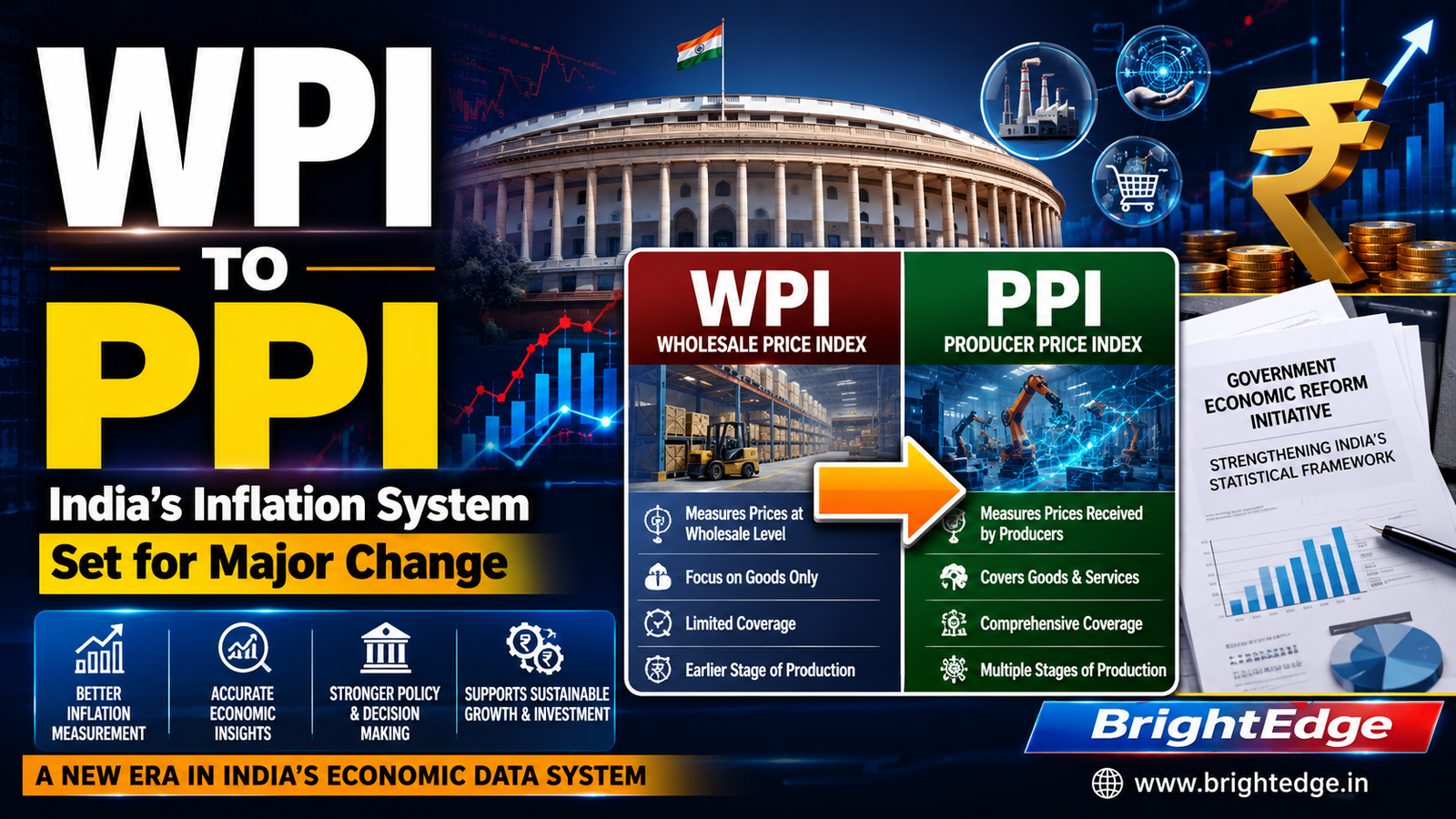
- The government has decided to gradually phase out the Wholesale Price Index (WPI) and replace it with a comprehensive Producer Price Index (PPI) system.
- The decision was taken to modernise the country’s inflation and pricing data framework and align it with global best practices.
- The government has approved the revision of the base year of the Wholesale Price Index (WPI) from 2011-12 to 2022-23.
- Considering the wide usage of WPI in price escalation clauses, this index will be released for five years from the date of release of the revised series, along with PPI, and will be discontinued thereafter.
- This will give sufficient time to users to switch from WPI to PPI.
- The revised Wholesale Price Index and New Producer Price Indices are scheduled to be released on the 15th of this month.
- The Ministry added that the number of items covered under the new series of WPI has increased from 697 to 957, providing a broader representation of economic activity.
What is the Wholesale Price Index (WPI)?
The Wholesale Price Index measures changes in the prices of goods sold in bulk at the wholesale level. It tracks price movements before products reach consumers and has been one of India’s key inflation indicators for decades.
However, WPI primarily focuses on goods and does not adequately capture services, which now form a major part of the Indian economy.
What is the Producer Price Index (PPI)?
The Producer Price Index measures the average change in prices received by producers for their goods and services over time. Unlike WPI, PPI tracks prices from the producer’s perspective and is widely used by advanced economies around the world.
PPI covers multiple stages of production and provides a more comprehensive view of inflationary trends.
Why is India Moving to PPI?
Several factors have driven the government’s decision:
1. Global Best Practices
Most developed economies use Producer Price Index systems to measure producer-level inflation.
2. Better Inflation Tracking
PPI captures price movements more accurately throughout the production process.
3. Inclusion of Services
Unlike WPI, the PPI framework can incorporate service-sector activities.
4. Improved Policy Decisions
More accurate inflation data can help policymakers make better decisions regarding interest rates, industrial policy, and economic planning.
WPI vs PPI: Key Differences
| Feature | WPI | PPI |
|---|---|---|
| Measures | Wholesale prices | Producer prices |
| Coverage | Mainly goods | Goods and services |
| Global Usage | Limited | Widely adopted |
| Inflation Analysis | Basic | More comprehensive |
| Production Stages | Limited | Multiple stages |
Impact on the Indian Economy
The introduction of PPI could strengthen India’s statistical framework and provide businesses, investors, and policymakers with better economic insights. Experts believe the transition will enhance transparency, improve inflation forecasting, and bring India’s economic indicators closer to international standards.
Conclusion:
The proposed replacement of WPI with the Producer Price Index marks an important modernization of India’s economic data system. As the economy becomes increasingly diversified and service-driven, adopting PPI could offer a more realistic picture of inflation and production costs across sectors.