

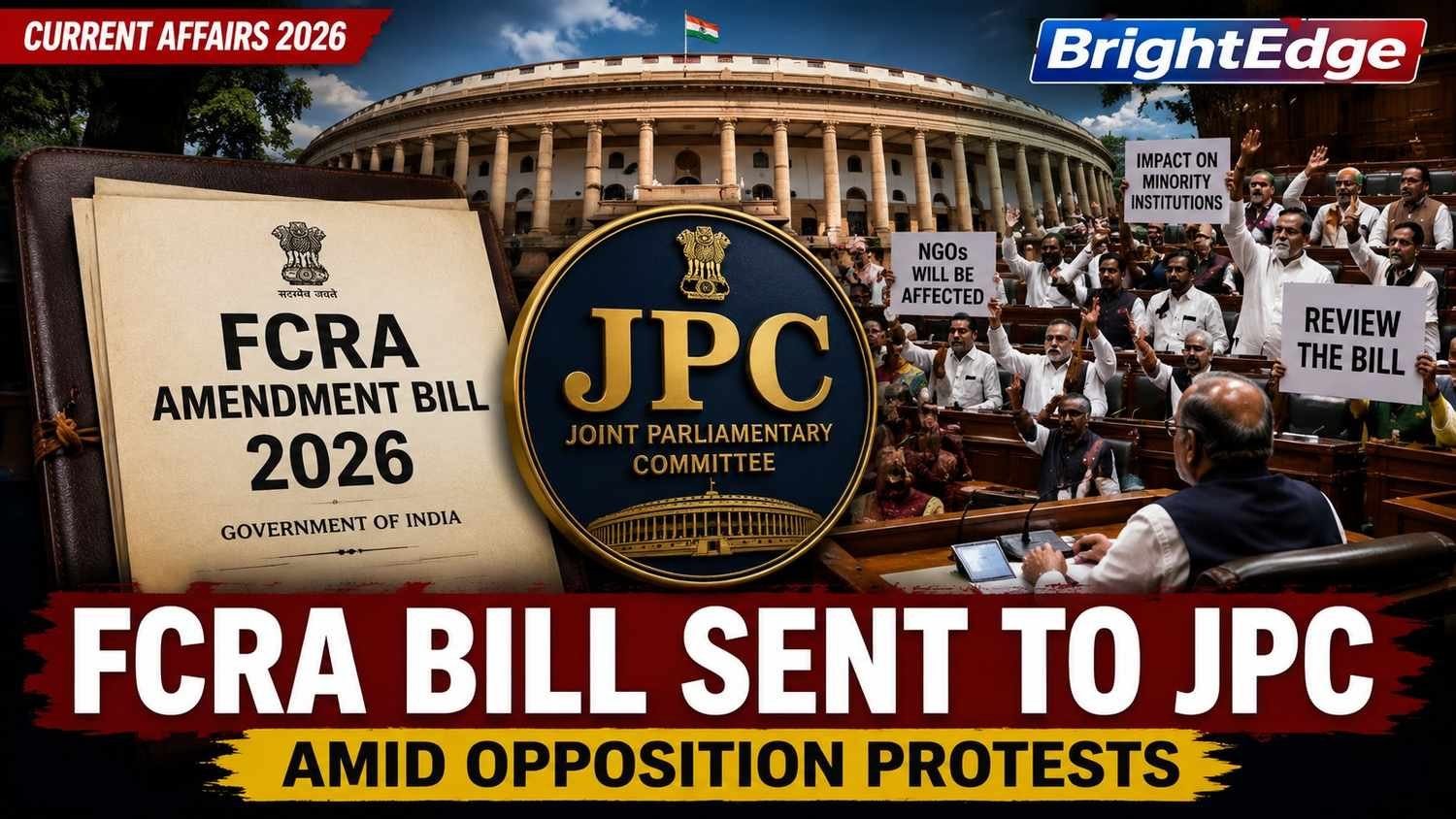
The Foreign Contribution (Regulation) Amendment Bill, 2026 has been referred to a 31-member Joint Parliamentary Committee (JPC) for detailed scrutiny amid strong Opposition protests in the Lok Sabha. The development has put the proposed changes to India’s foreign-funding regulatory framework under renewed public and parliamentary focus.
The FCRA Amendment Bill 2026 seeks to amend the Foreign Contribution (Regulation) Act, 2010, which regulates the acceptance and utilisation of foreign contributions in India.
The Bill proposes significant changes relating to FCRA registration, renewal, foreign contributions, assets created from foreign funds and the powers of a proposed Designated Authority.
The Lok Sabha referred the legislation to the JPC on August 12, 2026, following an uproar by Opposition MPs. The committee will comprise 21 Lok Sabha members and 10 Rajya Sabha members and is expected to submit its report by the last day of the first week of the Winter Session of Parliament in 2026.
What Is the FCRA Amendment Bill 2026?
- The Foreign Contribution (Regulation) Amendment Bill, 2026 was introduced in the Lok Sabha on March 25, 2026.
- The proposed legislation seeks to replace parts of the existing framework governing the management of foreign contributions and assets created from foreign contributions.
- According to the Bill’s stated objectives, the amendments are intended to establish a comprehensive statutory framework for the vesting, supervision, management and disposal of foreign contributions and assets when an organisation’s FCRA registration is cancelled, surrendered or ceases.
- The Bill also proposes changes concerning prior permission for receiving foreign contributions, penalties and investigation procedures.
CLICK HERE TO READ IN DETAIL ABOUT FCRA 2026
Why Was the FCRA Bill Sent to a JPC?
- The decision to send the Bill to a Joint Parliamentary Committee came amid strong Opposition objections in the Lok Sabha.
- Opposition parties have alleged that some of the proposed provisions could adversely affect NGOs, minority institutions, religious organisations and civil society groups.
- The government has rejected the allegation that the proposed legislation specifically targets minorities or particular organisations. Parliamentary Affairs Minister Kiren Rijiju challenged the Opposition to identify provisions that specifically target minorities.
- The JPC referral means that the Bill will now undergo additional parliamentary examination before the legislative process moves ahead.
Joint Parliamentary Committee (JPC):
A Joint Parliamentary Committee (JPC) is a temporary committee of the Indian Parliament consisting of members from both the Lok Sabha and Rajya Sabha.
Key points:
- Purpose: To conduct a detailed examination of a Bill, issue, policy, or matter of public importance.
- Composition: Members are drawn from both Houses of Parliament.
- Formation: A JPC is constituted when both Houses agree to a motion or when one House adopts a motion that is subsequently agreed to by the other.
- Functions: It can examine documents, hear evidence, seek expert opinions and consult stakeholders.
- Report: After its investigation, the committee submits a report with observations and recommendations to Parliament.
- Important: A JPC’s recommendations are not automatically binding on the government.
What Happens Next?
- The Bill will now be examined by the 31-member Joint Parliamentary Committee.
- The JPC is expected to study the provisions, hear views and examine concerns before submitting its report to Parliament.
- The committee’s report is expected by the last day of the first week of the Winter Session of Parliament in 2026.
- The JPC process could therefore become a crucial stage for proposed changes to India’s foreign-funding regulatory regime.
- The Bill is not yet law. Its referral to the JPC means that the proposed provisions remain subject to parliamentary scrutiny and possible changes.
Why the FCRA Bill Matters
- Foreign contributions play an important role in the work of many non-profit organisations, charitable institutions and civil society bodies.
- According to PRS Legislative Research, 13,520 organisations received ₹55,741 crore in foreign contribution between 2019 and 2022. As of July 15, 2026, the FCRA portal showed 14,449 active FCRA certificates, 22,498 cancelled certificates and 15,212 certificates deemed expired.
- These numbers underline why changes to the FCRA framework could have a significant impact on organisations receiving foreign funding.
- The debate is therefore not limited to foreign donations. It also involves questions surrounding regulatory oversight, asset ownership, compliance, government powers, civil society operations and parliamentary scrutiny.
Conclusion
- The FCRA Amendment Bill 2026 has entered a significant new phase after the Lok Sabha referred it to a 31-member Joint Parliamentary Committee amid Opposition protests.
- The proposed legislation could substantially change how foreign-funded organisations manage their assets when their FCRA registration is cancelled, surrendered or ceases. At the same time, the Bill proposes changes to penalties, prior permission, registration procedures and investigation requirements.
- The JPC’s examination will be crucial in determining whether the controversial provisions are retained, modified or removed before Parliament considers the legislation further.
- For now, the most important point is that the FCRA Amendment Bill 2026 has not become law. It remains a proposed piece of legislation undergoing parliamentary scrutiny.