

1. TRAI Revamps MyCall App to Improve Voice Call Quality

The Telecom Regulatory Authority of India (TRAI) has launched a revamped version of the TRAI MyCall mobile application to improve the quality of voice calls across telecom networks. The app enables users to rate calls using a 1–5 star system, report issues such as call drops, echo, audio delays, cross-connections, and poor voice quality, and automatically submits anonymized feedback along with network parameters. The data is shared with telecom service providers (TSPs) and TRAI to help identify network deficiencies and improve Quality of Experience (QoE).
Key Highlights
- Instant 1–5 star call rating system.
- Report call drops, echo, voice breaking, delayed connection, and other issues.
- Automatic post-call feedback prompts.
- Interactive map showing feedback history.
- Coverage test feature to assess signal strength.
- Feedback is anonymized and used to improve network quality.
Why It Matters
- The app strengthens consumer participation in improving telecom services and supports evidence-based regulation.
- TRAI MyCall application can be installed on Android devices from Google Play at following link: https://play.google.com/store/apps/details?id=com.trai.mycall
- Shri Anil Kumar Lahoti is the Chairman of TRAI.
- The Telecom Regulatory Authority of India (TRAI) was established with effect from 20th February 1997 by an Act of Parliament, called the Telecom Regulatory Authority of India Act, 1997, to regulate telecom services, including fixation/revision of tariffs for telecom services which were earlier vested in the Central Government.
2. Tamil Nadu Leads in Deceased Organ Donation, Ranks Second in Transplants
According to the National Organ and Tissue Transplant Organisation (NOTTO), Tamil Nadu recorded the highest number of deceased organ donors in 2025 and ranked second nationally in total organ transplants, performing 2,796 transplants. The state also has the country’s largest network of transplant centres and has received repeated national recognition for its organ donation programme.
Key Highlights
- Highest deceased organ donors in India in 2025.
- 2,796 organ transplants performed.
- Ranked second after Delhi in total transplants.
- 172 transplant centres in the state.
- Recognized as the best-performing state in organ donation.
Why It Matters
- Tamil Nadu’s model demonstrates how coordinated healthcare systems and public awareness can improve organ donation rates.
- Delhi was honoured as the Best Union Territory.
- Assam received the award for the Best State in the North Eastern Region.
- Indian Organ Donation Day, is organized to commemorate the first successful heart transplant in India performed on 3rd August 1994 at AIIMS, New Delhi after the promulgation of the Transplantation of Human Organs Act (THOA) 1994.
3. Operation Trishul Brings Back 274 Fugitives
The Government of India has intensified efforts against transnational crime through Operation Trishul, under which 274 fugitives wanted for serious offences have been brought back from different countries through extradition, deportation, and international cooperation.
Key Highlights
- 274 fugitives returned to India.
- Coordinated by Indian investigative agencies.
- Strengthens international cooperation.
- Targets organized crime and economic offenders.
Why It Matters
- Demonstrates India’s growing success in international law enforcement cooperation.
- Government launched BHARATPOL, connecting more than 1,400 agencies with INTERPOL, thereby reducing the time required for information sharing to 3 -10 days
- Government enacted National Investigation Agency (NIA) Amendment Act and Unlawful Activities (Prevention) Amendment (UAPA) Act in 2019
- Three new criminal laws introduced special provisions relating to fugitive criminals, for first time, Sections 355 and 356 of BNSS provide provision for trials in absentia
- Through stringent enforcement of PMLA, Modi Govt attached assets worth ₹17,874 crore belonging to fugitive criminals between 2019 and 2026
- Between 2019 and 2026, successful restitution amounting to ₹18,762 crore was carried out, including funds recovered from economic offenders who had fled country.
4. Supreme Court Extends Third-Party Insurance for New Vehicles
The Supreme Court has extended the requirement for long-term third-party motor insurance for newly purchased vehicles. The decision is intended to ensure that accident victims receive timely compensation while improving compliance with compulsory motor insurance laws.
Key Highlights
- Applies to newly registered vehicles.
- The new term of third-party motor vehicle insurance for new cars will be four years.
- For new two-wheelers, it will be six years.
- Protects accident victims.
- Encourages continuous insurance coverage.
- Reduces uninsured vehicles.
Key Enforcement Measures Proposed:
- No Insurance, No Fuel: A pilot project to test denying fuel at petrol pumps to vehicles lacking valid third-party insurance.
- ANPR Camera Integration: Connecting Automatic Number Plate Recognition cameras with the VAHAN Portal and the Insurance Information Bureau (IIB) database for automated detection and e-challans.
- Handheld Police Tools: Equipping traffic police with mobile apps and devices for on-the-spot insurance verification.
- Extended Tenure: Directing the IRDAI to increase mandatory third-party insurance for new private cars from 3 to 4 years, and for two-wheelers from 5 to 6 years.
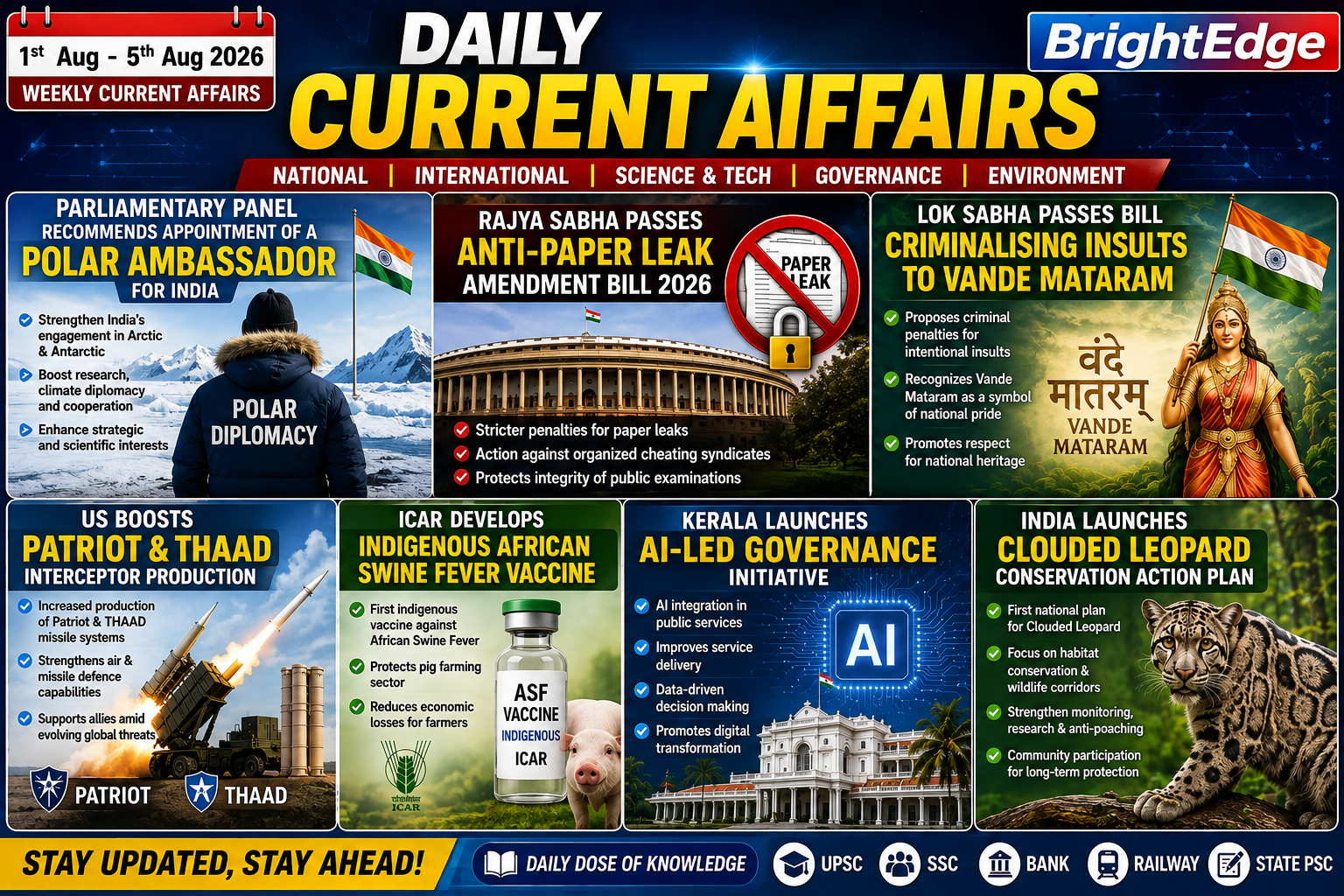
5. Parliamentary Panel Recommends Appointment of a Polar Ambassador
A Parliamentary Standing Committee has recommended that India appoint a Polar Ambassador to strengthen engagement in Arctic and Antarctic affairs. The proposal is aimed at supporting scientific research, climate diplomacy, and strategic cooperation.
Key Highlights
- Dedicated representative for polar affairs.
- Supports Arctic and Antarctic research.
- Strengthens climate diplomacy.
- Enhances India’s global scientific engagement.
Also,
- The panel has further observed that there are two Indian research stations — ‘Maitri’ and ‘Bharati’ — in Antarctica.
- While ‘Maitri’ was built on a stable ice-free land at Schirmacher Oasis and is operational since 1989, another very modern research station, ‘Bharati’ was established at Princess Elisabeth Land situated at about 2,500 km east of the ‘Maitri’ station in 2012.
6. Rajya Sabha Passes Anti-Paper Leak Amendment Bill, 2026
The Rajya Sabha has passed the Anti-Paper Leak Amendment Bill, 2026, which seeks to strengthen legal measures against examination paper leaks and organized cheating by prescribing stricter penalties and improving investigative powers.
Key Highlights
- Tougher punishment for paper leaks.
- Targets organized cheating syndicates.
- Protects recruitment and competitive exams.
- Improves examination integrity.
Key Provisions and Penalties
- Organized Crimes: Raises minimum prison terms to 7–10 years and increases maximum fines to ₹10 crore.
- Service Providers: Increases maximum fines to ₹5 crore and extends debarment for conducting exams to eight years.
- General Fines: Enhances the general maximum fine to ₹50 lakh
Investigation and Fast-Track Trials
- Special Task Force: Empowers the central government to establish a Special Task Force (STF) for investigations.
- Time-Bound Probes: Mandates investigation completion within two months, per the new Section 12A.
- Special Courts: Designates Courts of Session for day-to-day, fast-track trials, requiring case resolution within three months of the chargesheet.
7. Lok Sabha Passes Bill Criminalising Insults to Vande Mataram
The Lok Sabha has passed a bill proposing criminal penalties for intentional insults to Vande Mataram, recognizing it as a symbol of national heritage and pride.
Key Highlights
- Provides legal protection for Vande Mataram.
- Applies to intentional acts of insult.
- Promotes respect for national symbols.
- Passed by the Lok Sabha.
Why It Matters
- The bill has generated debate around constitutional values, freedom of expression, and national symbols.
- The amendment seeks to extend the same legal protection to Vande Mataram that is currently available to the National Anthem, Jana Gana Mana, under the Prevention of Insults to National Honour Act, 1971.
Under the amended legislation, any deliberate insult to or intentional obstruction of the singing of Vande Mataram will become a punishable offence, attracting legal action.
8. US Boosts Patriot and THAAD Interceptor Production
The United States has announced increased production of Patriot and THAAD (Terminal High Altitude Area Defense) interceptor missiles to strengthen missile defence capabilities and support allied nations amid evolving security challenges.
Key Highlights
- Increased Patriot missile production.
- Expansion of THAAD interceptor manufacturing.
- Enhances missile defence.
- Supports allies and strategic deterrence.
Why It Matters
- The U.S. has signed a more than $3 billion deal with Lockheed Martin, opens new tab and Northrop Grumman, opens new tab to ramp up production of Patriot and THAAD interceptor missile parts, as conflicts in Iran and Ukraine strain stockpiles.
- Terminal High Altitude Area Defense (THAAD): Provides upper-tier, long-range defense. It intercepts ballistic missiles at high altitudes (up to 150 km) and ranges (up to 200 km) using hit-to-kill kinetic energy.
- Patriot: Acts as a lower-tier shield. It intercepts short- and medium-range ballistic missiles, cruise missiles, and aircraft.
9. ICAR Develops Indigenous African Swine Fever Vaccine
The Indian Council of Agricultural Research (ICAR) has developed India’s first indigenous vaccine against African Swine Fever (ASF), a viral disease that causes severe losses in pig populations.
Key Highlights
- First indigenous ASF vaccine.
- MA-104_Cell_Line-Based Live Attenuated African Swine Fever (ASF) Vaccine.
- Developed by ICAR.
- Protects pig farming sector.
- Expected to reduce economic losses.
Why It Matters
- ICAR–National Institute of High Security Animal Diseases (ICAR-NIHSAD), Bhopal, have developed India’s first indigenous MA-104_Cell_Line-Based Live Attenuated African Swine Fever (ASF) Vaccine for pigs.
- African Swine Fever (ASF), caused by the African Swine Fever Virus (ASFV), is one of the most devastating trans-boundary animal disease affecting domestic and wild pigs worldwide.
- The economic impact of ASF outbreaks in India has been significant. During the initial outbreaks in Assam in 2020 and 2021, pig mortality and culling resulted in estimated losses of approximately ₹276 crore. In Mizoram, ASF outbreaks have reportedly affected more than 11,382 households up to 2025, resulting in an estimated financial loss of approximately ₹982 crore.
10. Kerala Launches AI-Led Governance Initiative
Kerala has introduced an AI-led governance initiative to integrate artificial intelligence into public administration, improving service delivery, decision-making, and citizen-centric governance.
Key Highlights
- AI integration in government services.
- Improved public service delivery.
- Data-driven governance.
- Promotes digital transformation.
- Enhances administrative efficiency.
Also,
- A Business Policy and Process Re-engineering (BPPR) Cell has also been established to comprehensively revise the Secretariat Office Manual and the Rules of Business using AI-assisted tools and global best practices to simplify government procedures.
- The SAMPATH portal will serve as a GIS-based digital register of state-owned land, buildings and other public assets, using AI-based analytics to support maintenance planning.
- PLANSPACE 2.0 will create an integrated digital register of development projects to prevent duplication and improve resource allocation. The platform has been designed in line with the PM Gati Shakti National Master Plan.
- The VEGAM framework seeks to accelerate land acquisition by reducing the pre-notification process from 18-24 months to an estimated three to four months through technology-enabled workflows.
11. India Launches Clouded Leopard Conservation Action Plan

The Government of India has launched the Clouded Leopard Conservation Action Plan, the country’s first dedicated strategy for protecting the elusive Clouded Leopard (Neofelis nebulosa). Found mainly in the forests of Northeast India, the species faces threats from habitat loss, poaching, and fragmentation. The action plan emphasizes habitat restoration, scientific monitoring, anti-poaching measures, and community participation.
Key Highlights
- First national conservation plan for Clouded Leopard.
- Focus on habitat restoration and wildlife corridors.
- Scientific monitoring using camera traps and GPS.
- Community participation in conservation.
- Anti-poaching measures strengthened.
Why It Matters
- The Clouded Leopard is a flagship species for conserving Northeast India’s rich biodiversity.
- This species has been included in the Species Recovery Programme of the Integrated Development of Wildlife Habitats (IDWH).
- The Indian Wildlife (Protection) Act protects the clouded leopard.
- It is vulnerable according to the International Union for Conservation of Nature (IUCN) Red List.
12. Telangana Seeks Higher Tummidihatti Barrage
The Telangana Government Chief Minister Revanth Reddy has urged the Centre to approve an increased height for the Tummidihatti Barrage on the Pranahita River. The project is expected to enhance irrigation, drinking water supply, and agricultural development across northern Telangana.
Key Highlights
- Proposed increase in barrage height.
- Part of the Pranahita-Chevella project.
- Improves irrigation potential.
- Supports drinking water supply.
- Requires inter-state coordination.
Why It Matters
- Telangana and Maharashtra had earlier agreed to construct the barrage at a height of 148 metres. However, the studies conducted by the Central Water and Power Research Station (CWPRS), Pune, examined the feasibility of increasing the height to between 150 to 152 metres.
- According to the CWPRS study, the difference in submergence between a 148 metre and a 152 metre barrage would be negligible. Around 50 percent of the affected area would remain within the riverbed itself.
- Constructing the barrage at 148 metres would not allow gravity based water supply, making costly pumping systems unavoidable.
- A barrage between 150 and 152 metres would enable gravity flow, significantly reducing electricity consumption and lowering long term operational costs. He urged the Union Minister to persuade Maharashtra to agree to the revised height and requested that a meeting between Telangana and Maharashtra be convened at the earliest.
13. Himalayan Serow Sighted in Himachal Pradesh After Two Decades
The rare Himalayan Serow, a protected mountain mammal listed as Vulnerable by the IUCN, has been sighted in Himachal Pradesh after nearly 20 years. The sighting indicates improving forest health and successful conservation efforts.

Key Highlights
- Rare species rediscovered after two decades.
- Found in Himachal Pradesh.
- IUCN Status: Vulnerable.
- Indicator of healthy ecosystems.
- Protected under Indian wildlife laws.
Why It Matters
- The discovery highlights the importance of habitat conservation in the Himalayas.
- The Himalayan serow (Capricornis thar) is among the least-seen large mammals of the Himalayas. Solitary and highly secretive, it inhabits steep, densely forested mountain slopes, making sightings extremely rare.
- The International Union for Conservation of Nature (IUCN) has classified the species as Near Threatened due to habitat degradation, fragmentation and hunting pressure in parts of the Himalayas.
- It is the state animal of Mizoram.
- A 2021 study indicated that the Himalayan serow was last seen in the Kalatop Wildlife Sanctuary in 2005-06.
14. India Targets 874 GW Power Capacity by 2031–32
India has announced an ambitious target of 874 GW installed electricity generation capacity by 2031–32 under the National Electricity Plan. A large share of this capacity is expected to come from renewable energy sources such as solar, wind, hydro, and nuclear power.
Key Highlights
- Target: 874 GW by 2031–32.
- Focus on renewable energy expansion.
- Supports net-zero goals.
- Enhances energy security.
- Meets growing electricity demand.
Why It Matters
- The plan is central to India’s clean energy transition and sustainable development goals.
- As of June 30, 2026, India had a total installed power generation capacity of 5,48,858 MW, with non-fossil fuel sources accounting for 54.18 per cent of the total. Renewable energy sources, including hydro, accounted for 52.58 per cent, while fossil fuel-based capacity stood at 45.82 per cent.
- Coal remained the largest individual source, with 2,24,158 MW of installed capacity, while solar capacity stood at 1,62,152 MW.
- Around 21,080 MW of thermal capacity has been commissioned since April 2023 through June 2026, while 47,545 MW is under construction and contracts for another 16,000 MW have been awarded. The projected thermal capacity requirement by 2035-36 is around 3,15,000 MW.
- Around 1,47,720 MW of renewable capacity is under construction, including 1,19,580 MW of solar and 27,720 MW of wind capacity.
- Pumped storage projects totalling 15,870 MW/95,220 MWh and battery energy storage systems of 15,754 MW/42,530 MWh are also under construction.
15. Nauru’s Climate-Funded ‘Golden Passport’ Scheme
The Pacific island nation of Nauru has introduced a Golden Passport Scheme, offering citizenship to foreign investors. Revenue generated through the scheme will fund climate adaptation, coastal protection, and infrastructure projects to address rising sea levels.
Key Highlights
- Citizenship by investment.
- Climate adaptation funding.
- Supports coastal resilience.
- Addresses climate change impacts.
- Innovative financing model.
Note:
- Nauru is among the world’s most climate-vulnerable nations.
- Recently, Nauru was renamed the Republic of Naoero.
- Nauru gained independence on 31 January 1968.
16. Tamil Nadu Allocates ₹44,527 Crore for School Education
The Tamil Nadu Government has allocated ₹44,527 crore for the School Education Department, one of the largest education budgets among Indian states. The allocation aims to improve infrastructure, digital classrooms, teacher recruitment, and learning outcomes.
Key Highlights
- ₹44,527 crore allocation.
- Infrastructure modernization.
- Teacher recruitment.
- Digital learning initiatives.
- Student welfare schemes.
17. Parliament Passes Appropriation (No. 3) Bill, 2026
Parliament has passed the Appropriation (No. 3) Bill, 2026, authorizing the withdrawal of funds from the Consolidated Fund of India to meet government expenditure approved by Parliament.
Key Highlights
- Passed by Parliament.
- Authorizes government spending.
- Funds withdrawn from Consolidated Fund.
- Essential for budget implementation.
- Constitutional financial procedure.
18. Supreme Court Extends 10-km Mining Buffer to Wetlands
The Supreme Court has extended the 10-km eco-sensitive mining buffer to wetlands, aiming to protect fragile ecosystems from environmental degradation caused by mining activities.
Key Highlights
- 10-km protection zone.
- Covers notified wetlands.
- Restricts mining activities.
- Supports biodiversity conservation.
- Strengthens environmental safeguards.
19. Centre Proposes Rules for Two-Wheeled Ambulances
The Ministry of Road Transport and Highways has proposed regulations for two-wheeled ambulances, designed to provide rapid emergency medical response in congested urban areas where larger ambulances face delays.
Key Highlights
- Faster emergency response.
- Ideal for congested cities.
- Equipped with first-aid facilities.
- Supports ambulance network.
- Improves survival during emergencies.
20. IIT Hyderabad Launches ANUGYAN Nuclear Training Programme
IIT Hyderabad has launched the ANUGYAN Nuclear Training Programme, aimed at developing skilled professionals in nuclear science, engineering, and technology. The programme supports India’s expanding nuclear energy and research ecosystem.
Key Highlights
- Advanced nuclear training programme.
- Focus on nuclear engineering.
- Industry-academia collaboration.
- Supports India’s clean energy goals.
- Skill development for future workforce.
21. India Crosses 20,000 Organ Transplants in 2025
India achieved a major healthcare milestone by recording over 20,000 organ transplants in 2025, the highest ever in a single year. The achievement reflects improved public awareness, better transplant infrastructure, stronger organ-sharing networks, and effective implementation of the National Organ Transplant Programme (NOTP). Kidney transplants accounted for the largest share, followed by liver, heart, and lung transplants.
Key Highlights
- Over 20,000 organ transplants in 2025.
- Highest annual transplant figure in India.
- Kidney transplants accounted for the majority.
- Growth in deceased organ donation.
- Expansion of National Organ and Tissue Transplant Organization (NOTTO) and state transplant networks.
22. India Achieves Near-Universal Banking Coverage of Inhabited Villages
India has achieved near-universal banking coverage across inhabited villages through initiatives like Pradhan Mantri Jan Dhan Yojana (PMJDY), Banking Correspondents (BCs), India Post Payments Bank, and digital banking services. Nearly every village now has access to formal banking services within a reasonable distance.
Key Highlights
- Near-universal banking access.
- Driven by PM Jan Dhan Yojana.
- Expansion of Banking Correspondents.
- Growth of digital payments and financial inclusion.
- Supports Direct Benefit Transfer (DBT).
23. Vice Admiral Manish Chadha Assumes Charge as DGNO
Vice Admiral Manish Chadha has taken charge as the Director General of Naval Operations (DGNO) of the Indian Navy. The DGNO is responsible for planning, monitoring, and executing naval operations while ensuring maritime security and operational preparedness.
Key Highlights
- New Director General of Naval Operations.
- Oversees maritime operations.
- Responsible for naval preparedness.
- Supports India’s Indo-Pacific strategy.
- Senior operational appointment in the Navy.
24. Government Proposes Mandatory Vehicle-to-Vehicle Communication from 2028
The Ministry of Road Transport and Highways has proposed making Vehicle-to-Vehicle (V2V) communication technology mandatory in new vehicles from 2028. The technology enables vehicles to exchange real-time information about speed, location, braking, and road hazards.
Key Highlights
- Proposed implementation from 2028.
- Improves collision avoidance.
- Supports intelligent transport systems.
- Enhances road safety.
- Enables connected vehicle ecosystem.
25. Willie Walsh Assumes Charge as IndiGo CEO

Aviation industry veteran Willie Walsh has assumed charge as the Chief Executive Officer (CEO) of IndiGo, India’s largest airline. His appointment is expected to strengthen IndiGo’s international expansion strategy, fleet modernization, and customer service initiatives.
Key Highlights
- New CEO of IndiGo.
- Focus on international expansion.
- Fleet modernization.
- Customer experience enhancement.
- Strengthening operational efficiency.
26. Russia Launches Ulyanovsk Project 885M Yasen-M Submarine
Russia has launched the Ulyanovsk, an advanced Project 885M Yasen-M nuclear-powered attack submarine. It is equipped with advanced stealth technology, long-range cruise missiles, and modern underwater warfare systems.
Key Highlights
- Project 885M Yasen-M class.
- Nuclear-powered attack submarine.
- Advanced stealth capabilities.
- Long-range missile systems.
- Strengthens Russian Navy.
27. Vishwesh Negi Appointed India’s Next Ambassador to Iran

Senior Indian diplomat Vishwesh Negi has been appointed as India’s next Ambassador to Iran. His appointment comes at a strategically important time as both countries continue cooperation in energy, trade, and connectivity projects like the Chabahar Port.
Key Highlights
- New Ambassador to Iran.
- Focus on bilateral relations.
- Supports Chabahar Port cooperation.
- Strengthens energy partnerships.
- Promotes regional connectivity.
28. Maharashtra Anti-Conversion Law Comes into Force
The Maharashtra Government has officially enforced its Anti-Conversion Law, which seeks to prevent religious conversions carried out through force, fraud, coercion, or allurement while protecting voluntary conversions carried out according to law.
Key Highlights
- Law officially implemented.
- Targets forced religious conversions.
- Provides legal safeguards.
- Prescribes penalties for violations.
- Requires procedural compliance.
Key Rules and Penalties
- Prior Notice: People who want to change their religion must tell the district magistrate at least 60 days before doing so.
- Post-Conversion Steps: A formal declaration must be submitted after the ceremony following set rules.
- First-Time Offense: Jail time up to 7 years and fines.
- Repeat Offense: Jail time up to 10 years and higher fines.Who Can Complain: Parents, brothers, sisters, and close blood relatives can file a police complaint.
29. Centre Releases ₹1.09 Lakh Crore Tax Devolution
The Union Government has released ₹1.09 lakh crore as tax devolution to states under the recommendations of the Finance Commission. The funds will help states finance development projects, welfare schemes, and infrastructure works.
Key Highlights
- ₹1.09 lakh crore released.
- Shared with all states.
- Supports state finances.
- Based on Finance Commission formula.
- Promotes cooperative federalism.
30. Self-Enumeration Begins for India’s 16th Census in West Bengal
The self-enumeration process for India’s 16th Census has begun in West Bengal. Citizens can submit household information online before physical verification by census officials.
Key Highlights
- Part of India’s 16th Census.
- Digital self-enumeration facility.
- Faster and more accurate data collection.
- Reduces paperwork.
- Supports Digital India.
31. New Catfish Species Discovered in Odisha Named After Legendary Tigress Khairi

Scientists have discovered a new species of catfish in Odisha and named it after the legendary tigress Khairi, which became a symbol of wildlife conservation in India.
Key Highlights
- New freshwater catfish discovered.
- Named after tigress Khairi.
- Discovery made in Odisha.
- Highlights biodiversity research.
- Adds to India’s rich aquatic fauna.
32. Italy Suspends Schengen Free-Movement Rules After Ceuta Migrant Influx
Italy has temporarily suspended certain Schengen free-movement provisions following a surge in irregular migration linked to the Ceuta route. The move aims to strengthen border security while managing migration pressures.
Key Highlights
- Temporary border controls.
- Response to migrant influx.
- Schengen rules partially suspended.
- Focus on national security.
- European migration policy.
33. Bhogapuram International Airport Inaugurated in Andhra Pradesh
The Bhogapuram International Airport has been inaugurated in Andhra Pradesh, becoming a major infrastructure project aimed at boosting tourism, trade, cargo movement, and regional economic development.
Key Highlights
- New international airport.
- Improves regional connectivity.
- Boosts tourism and investment.
- Supports cargo transportation.
- Strengthens Andhra Pradesh’s infrastructure.
34. Cabinet Approves ₹36,441-Crore Sports Push Under Khelo India
The Union Cabinet has approved a ₹36,441-crore investment under the Khelo India programme to transform India’s sports ecosystem. The package focuses on sports infrastructure, grassroots talent identification, athlete training, coaching, sports science, and preparation for international competitions.
Key Highlights
- ₹36,441 crore approved.
- Major expansion of Khelo India.
- Development of sports infrastructure.
- Athlete scholarships and coaching.
- Promotion of grassroots talent.
- Strengthens India’s Olympic ambitions.