

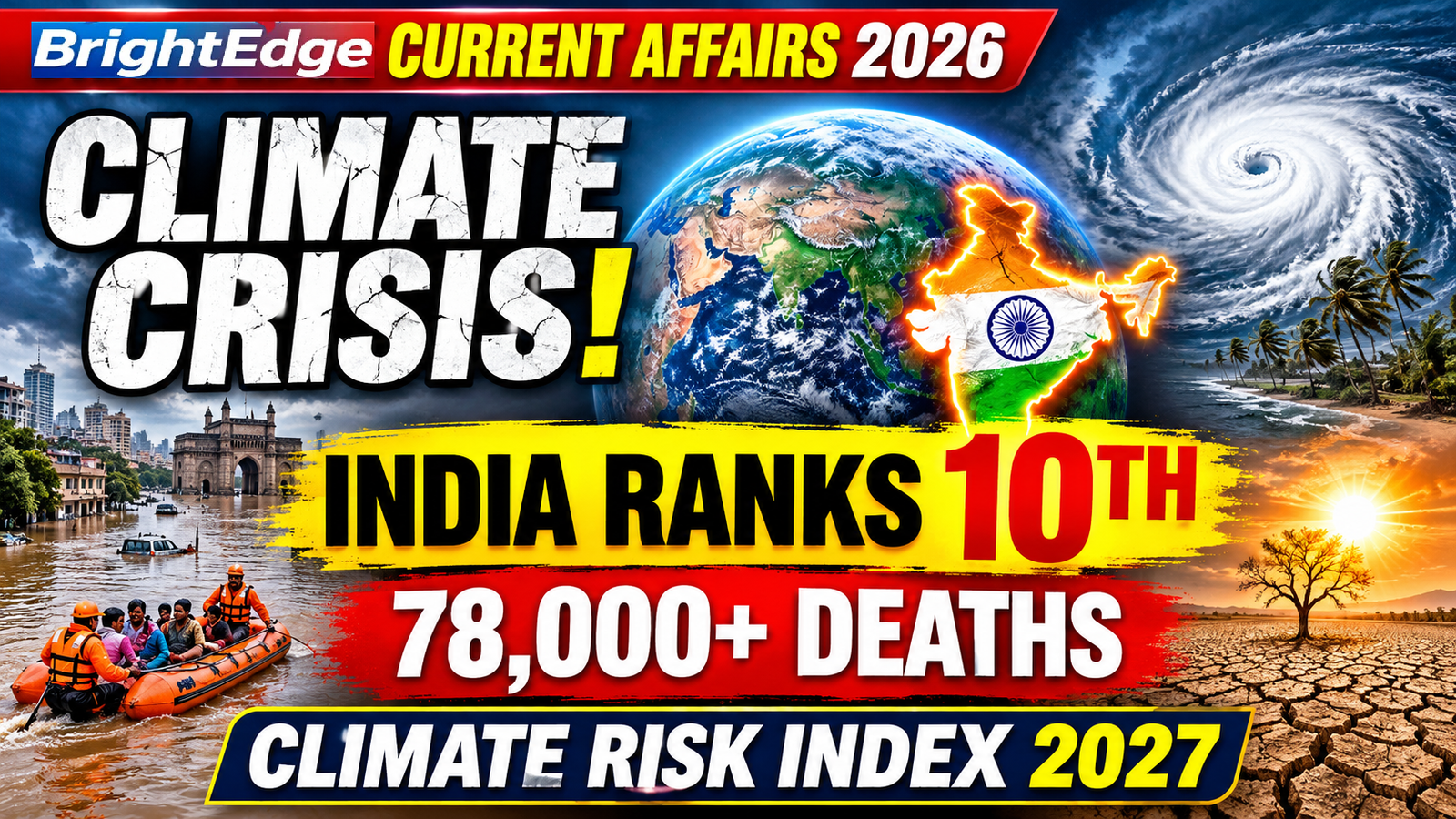
The Climate Risk Index 2027, released by Germanwatch on November 17, 2026, has placed India among the world’s ten most affected countries by extreme weather events over the past three decades.
According to the latest report, India secured the 10th position globally for the period 1996–2025, highlighting its growing exposure to floods, cyclones, heatwaves and other climate-related disasters.
The report also reveals an alarming global picture: nearly 10,000 extreme weather events between 1996 and 2025 resulted in more than 916,000 deaths, affected approximately 5.5 billion people and caused direct economic losses exceeding USD 4.7 trillion.
The report was released by Germanwatch during the 31st United Nations Climate Change Conference (COP31) in Antalya, Türkiye.
What Is the Climate Risk Index 2027?
The Climate Risk Index (CRI) is an annual report published by Germanwatch, a Germany-based environmental and development organisation.
First introduced in 2006, the index examines how severely countries are affected by extreme weather events.
It evaluates the human and economic consequences of climate-related disasters, including:
- Floods
- Storms and cyclones
- Heatwaves
- Droughts
- Wildfires
- Other extreme weather events
The index uses historical disaster data to identify countries that have experienced the greatest impacts.
Importantly, the Climate Risk Index is a retrospective assessment of actual disaster impacts. It is not a forecast of future climate risks.
Climate Risk Index 2027: Key Global Findings
The latest edition presents several alarming findings about the worldwide impact of extreme weather events.
Major highlights:
- More than 916,000 people lost their lives due to extreme weather events between 1996 and 2025.
- Approximately 5.5 billion people were affected worldwide.
- Nearly 10,000 extreme weather events were recorded over three decades.
- Direct economic losses exceeded USD 4.7 trillion.
- In 2025 alone, 367 extreme weather events were recorded.
- These events caused nearly 35,000 deaths and affected more than 100 million people.
- Economic losses during 2025 exceeded USD 158 billion.
These figures demonstrate the enormous human and economic consequences of climate-related disasters.
Top 10 Countries in Climate Risk Index 2027 (1996–2025)
According to the long-term assessment of Germanwatch, the following countries experienced the greatest impacts from extreme weather events between 1996 and 2025.
| Rank | Country |
|---|---|
| 1 | Dominica |
| 2 | Myanmar |
| 3 | Honduras |
| 4 | Libya |
| 5 | Haiti |
| 6 | Grenada |
| 7 | Philippines |
| 8 | Nicaragua |
| 9 | The Bahamas |
| 10 | India |
India’s 10th position highlights its significant exposure to recurring climate-related disasters.
Nine of the ten countries in the long-term ranking belong to lower-middle-income or upper-middle-income groups. The Bahamas is the only high-income country in the top ten.
India Ranks 10th in Climate Risk Index 2027
India remains one of the countries most severely affected by extreme weather events.
The report identifies the following statistics for India during 1996–2025:
| Indicator | India’s Data |
|---|---|
| Global Ranking | 10th |
| Extreme Weather Events | 436 |
| Deaths | More than 78,000 |
| People Affected | More than 1.2 billion |
| Economic Losses | Over USD 170 billion |
- India experienced 436 extreme weather events during the assessment period.
- These disasters resulted in more than 78,000 fatalities and economic losses exceeding USD 170 billion.
- The report identifies several important climate-related challenges facing India:
1. Floods and Landslides
Heavy monsoon rainfall frequently causes devastating floods and landslides across several Indian states. These disasters damage infrastructure, disrupt transportation and displace millions of people.
2. Cyclones
India’s coastal regions remain vulnerable to powerful tropical cyclones, which cause extensive damage to homes, agriculture, infrastructure and livelihoods.
3. Heatwaves
Recurring and unusually intense heatwaves have emerged as a major threat to human health. The report highlights severe heatwave episodes in 1998, 2002, 2003 and 2015.
India’s geographical diversity and large population make climate-related disasters particularly challenging to manage.
Climate Risk Index 2027: Top 10 Most Affected Countries in 2025
The report also provides a separate ranking for countries most affected by extreme weather events during 2025.
The top ten countries are:
| Rank | Country |
|---|---|
| 1 | Jamaica |
| 2 | Sri Lanka |
| 3 | Spain |
| 4 | Thailand |
| 5 | Philippines |
| 6 | Pakistan |
| 7 | Indonesia |
| 8 | Bolivia |
| 9 | Mozambique |
| 10 | Vietnam |
India secured the 12th position in the 2025 annual assessment.
This is an improvement compared with its 15th position in the previous annual assessment for 2024.
The long-term and annual rankings measure different periods and should not be confused.
Heatwaves: The Deadliest Climate Hazard
One of the most important findings of the Climate Risk Index 2027 concerns the growing impact of extreme heat.
According to the report:
- Heatwaves accounted for approximately 40% of reported fatalities over the 1996–2025 period.
- In 2025 alone, heatwaves caused nearly 70% of reported disaster fatalities.
- More than 24,000 deaths were attributed to heatwaves in 2025.
The report also warns that heat-related deaths are systematically underreported in several regions, particularly in the Global South.
This makes heatwaves one of the most serious climate-related threats to public health.
Storms Account for the Highest Economic Losses
While heatwaves were the deadliest hazard, storms were responsible for the largest share of economic losses.
Key findings include:
- Storms accounted for approximately 58% of total economic losses between 1996 and 2025.
- In 2025, storms generated economic losses of approximately USD 64.8 billion.
- Storms represented around 41% of total disaster-related economic losses during 2025.
These findings highlight the vulnerability of coastal communities, infrastructure and national economies to extreme weather events.
How Is the Climate Risk Index Calculated?
Germanwatch uses data from the Emergency Events Database (EM-DAT), the World Bank and the International Monetary Fund (IMF).
The index examines six indicators:
- Absolute number of fatalities.
- Fatalities per 100,000 inhabitants.
- Absolute number of people affected.
- People affected per 100,000 inhabitants.
- Absolute economic losses.
- Economic losses as a percentage of Gross Domestic Product (GDP).
The indicators combine human and economic impacts to calculate the overall ranking.
The index considers both absolute and relative impacts, allowing comparisons between countries of different population sizes and economic capacities.
However, Germanwatch also highlights limitations arising from incomplete disaster reporting and data availability.
Why Is the Climate Risk Index 2027 Important?
The report highlights the unequal distribution of climate-related disaster impacts across the world.
Countries that have historically contributed relatively little to global greenhouse gas emissions are often among those experiencing the most severe consequences.
The findings emphasise the importance of:
- Climate adaptation strategies.
- Disaster preparedness and early warning systems.
- Climate-resilient infrastructure.
- Sustainable agriculture.
- International climate finance.
- Loss and damage support for vulnerable countries.
- Faster reduction of greenhouse gas emissions.
For India, strengthening disaster management, improving urban infrastructure and developing effective heatwave action plans are particularly important.