

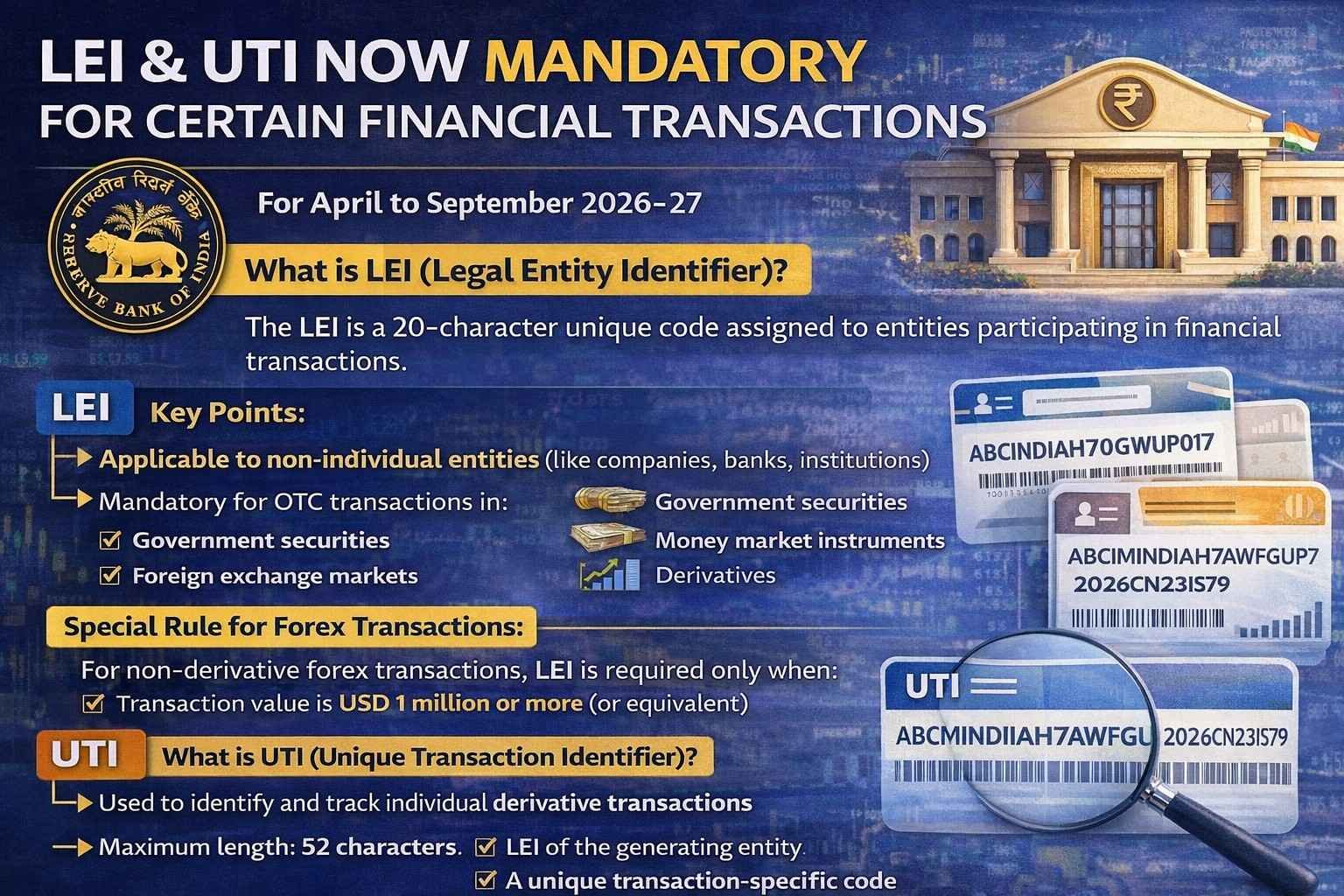
In a major step towards improving transparency in financial markets, the Reserve Bank of India (RBI) has made it mandatory to use Legal Entity Identifier (LEI) and Unique Transaction Identifier (UTI) for certain financial transactions.
These identifiers are globally recognised standards that help track and monitor financial activities more effectively.
What is LEI (Legal Entity Identifier)?
The LEI is a 20-character unique code assigned to entities participating in financial transactions.
Key Points:
- Applicable to non-individual entities (like companies, banks, institutions)
- Mandatory for OTC (Over-the-Counter) transactions in:
- Government securities
- Money market instruments
- Foreign exchange markets
- Derivatives
Special Rule for Forex Transactions:
For non-derivative forex transactions, LEI is required only when:
- Transaction value is USD 1 million or more (or equivalent)
What is UTI (Unique Transaction Identifier)?
The UTI is a unique code assigned to each OTC derivative transaction.
Key Features:
- Used to identify and track individual derivative transactions
- Must be generated as per global standards set by CPMI-IOSCO (2017 guidelines)
- Maximum length: 52 characters
- Includes:
- LEI of the generating entity
- A unique transaction-specific code
This ensures that each transaction remains identifiable throughout its lifecycle.
Applicability and Timeline
- LEI Requirement → लागू (Effective) immediately
- UTI Requirement → लागू from 1 January 2027
UTI rules will apply to all OTC derivative transactions executed after the implementation date.
Why is This Important?
The RBI’s move is aimed at:
- Improving transparency in financial markets
- Strengthening risk monitoring and reporting
- Aligning India with global financial standards
- Reducing chances of fraud and systemic risks
By uniquely identifying both entities (LEI) and transactions (UTI), regulators can better track market activity and ensure financial stability.
Conclusion
The introduction of mandatory LEI and UTI marks an important reform in India’s financial system. It not only enhances transparency and accountability but also brings India’s financial markets closer to global best practices.
This move will play a crucial role in building a more robust, secure, and well-regulated financial ecosystem.