

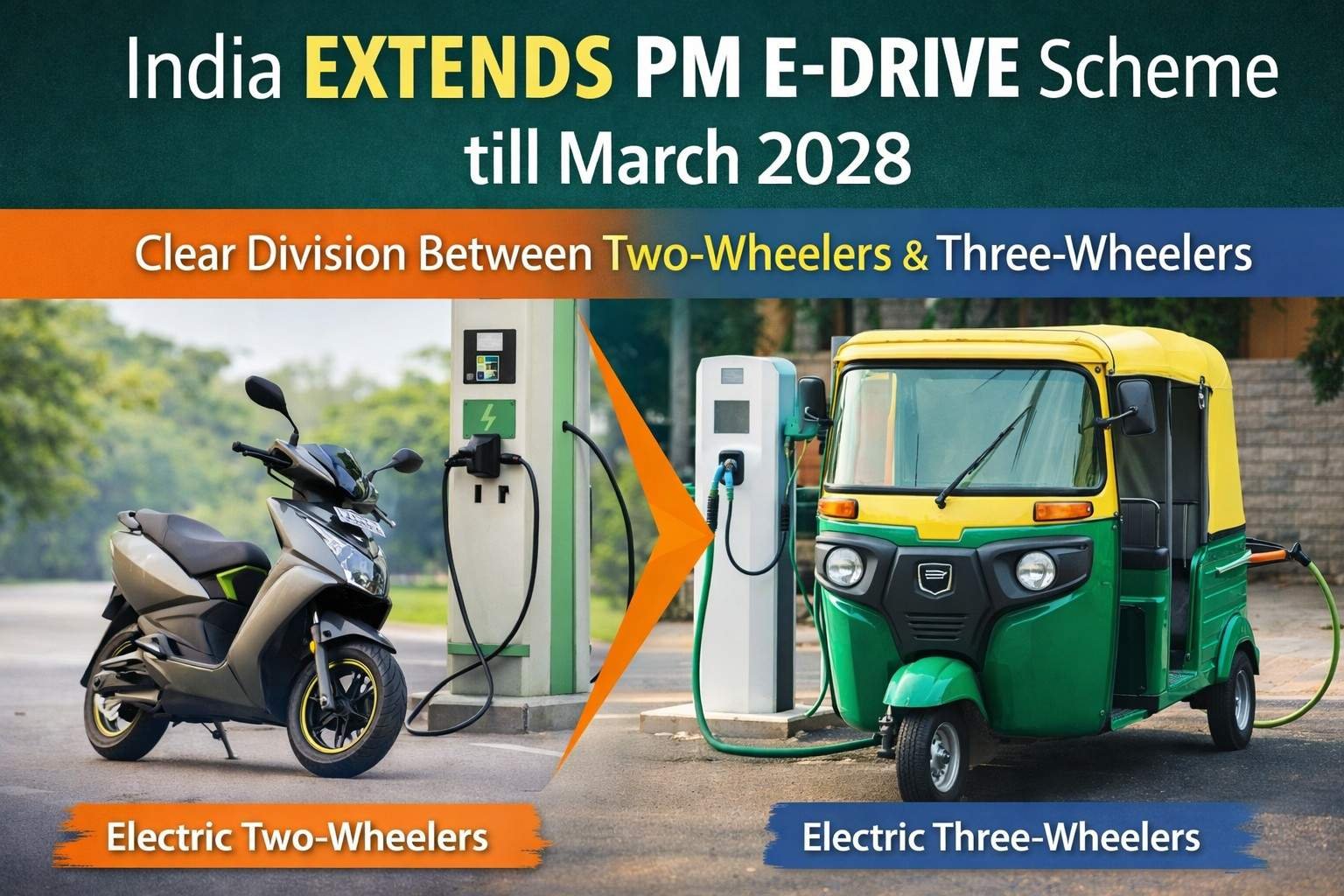
India’s electric vehicle industry has welcomed the Centre’s decision to extend the PM E-DRIVE Scheme till March 2028. However, the revised policy introduces a clear distinction between electric two-wheelers and three-wheelers, signalling a strategic shift in the country’s EV roadmap.
Policy Reset: Clear Division Between Segments
According to a notification issued by the Ministry of Heavy Industries on March 27, 2026, the scheme—capped at ₹10,900 crore—will remain operational till March 31, 2028, or until funds are exhausted.
Key highlights:
- Incentives for electric two-wheelers (E2Ws) are available only till July 31, 2026
- Subsidy remains ₹2,500 per kWh, capped at ₹5,000 per vehicle
- Incentives for electric three-wheelers (E3Ws), including e-rickshaws and e-carts, will continue till 2028
This marks a significant policy shift, prioritising certain EV segments over others.
‘Registration Cliff’ for Two-Wheelers
The limited window for electric two-wheelers has created what industry players call a “registration cliff”—a surge in demand before the subsidy deadline.
Hemant Kabra noted that the move brings clarity as the sector transitions away from subsidy-driven demand. He emphasised that manufacturers will now focus on:
- Pricing strategies
- Localisation
- Scaling production
Longer Runway for Three-Wheelers
In contrast, the three-wheeler segment has received a longer policy runway, boosting industry sentiment.
Uday Narang highlighted that extended incentives will strengthen last-mile connectivity and logistics, especially in:
- E-commerce deliveries
- Urban transport
- Fleet-based operations
Shift Towards Fleet-Led Electrification
Experts believe the revised scheme signals a larger transition in India’s EV policy:
- From retail-driven adoption
- To fleet and commercial electrification
The government appears to be focusing on segments where:
- Vehicle utilisation is high
- Cost economics are already favourable
Conclusion
The extension of the PM E-DRIVE scheme ensures policy continuity, but the differentiated approach reflects a maturing EV ecosystem. While electric two-wheelers are expected to move towards self-sustainability, electric three-wheelers will continue to receive strong policy support, driving India’s next phase of electrification.