

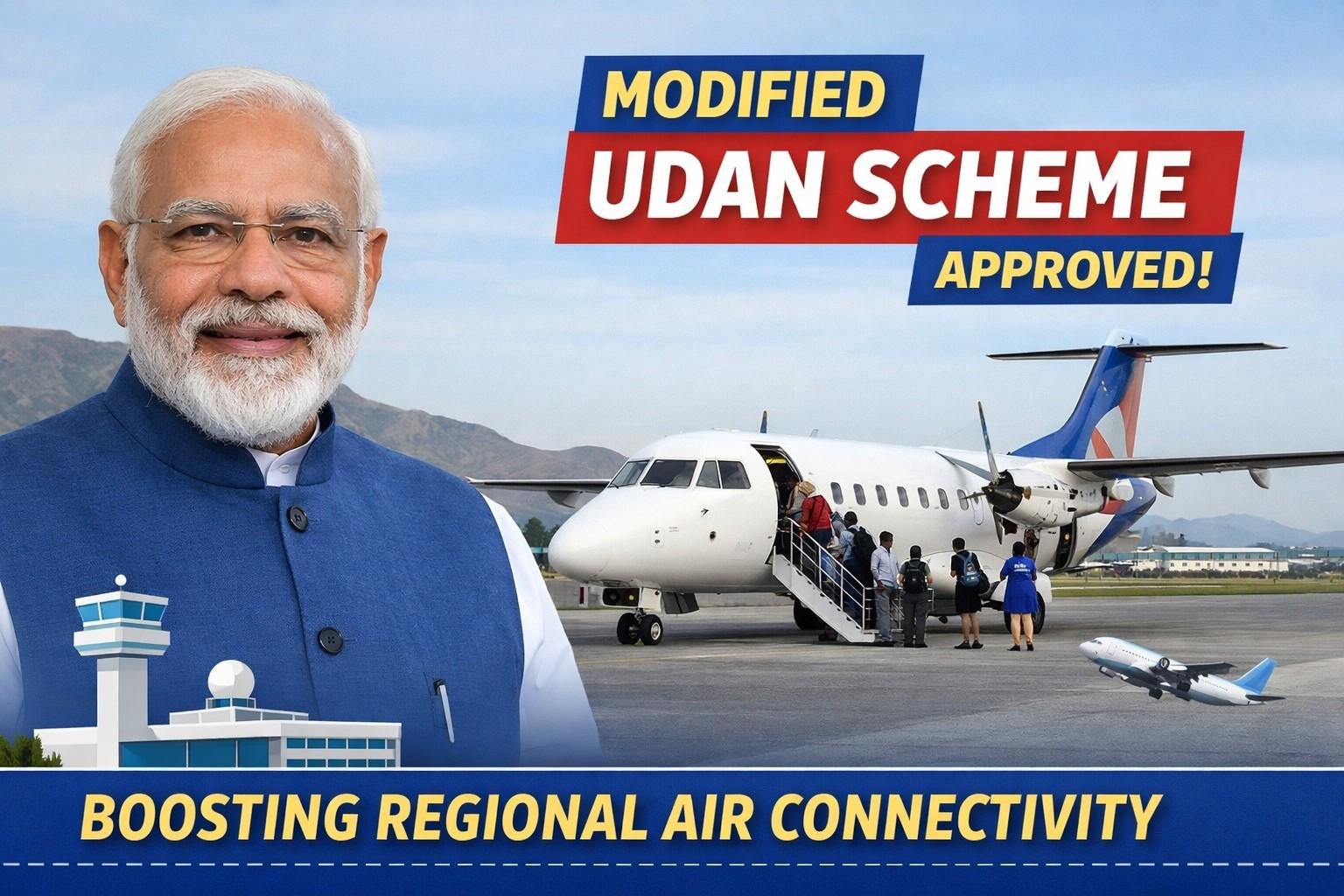
In a major step towards strengthening India’s aviation infrastructure, the Union Cabinet chaired by Prime Minister Narendra Modi has approved the Modified Regional Connectivity Scheme (UDAN). The scheme will be implemented for 10 years from FY 2026-27 to FY 2035-36, with a total outlay of ₹28,840 crore.
The revamped scheme aims to enhance regional air connectivity, making air travel more accessible and affordable, especially in underserved and remote areas.
Key Objectives of the Scheme
The Modified UDAN Scheme focuses on:
- Expanding air connectivity to unserved and underserved regions
- Boosting economic growth, trade, and tourism in Tier-2 and Tier-3 cities
- Making air travel affordable for common citizens
- Improving emergency services and healthcare access in remote areas
- Supporting the vision of Atmanirbhar Bharat and Viksit Bharat 2047
Major Components of the Modified UDAN Scheme
1. Development of Airports
Under the scheme, the government plans to develop 100 new airports by upgrading existing airstrips. This initiative will be implemented with an investment of ₹12,159 crore over the next eight years.
2. Operation & Maintenance Support
To ensure sustainability, the government will provide Operation & Maintenance (O&M) support for regional airports:
- Up to ₹3.06 crore per airport annually
- Up to ₹0.90 crore per heliport or water aerodrome
This support is estimated at ₹2,577 crore for around 441 aerodromes.
3. Development of Helipads
The scheme also includes the construction of 200 modern helipads, particularly in hilly, remote, and island regions. With a total investment of ₹3,661 crore, this will improve last-mile connectivity and emergency response capabilities.
4. Viability Gap Funding (VGF)
To encourage airline operators, the government will provide Viability Gap Funding (VGF) worth ₹10,043 crore over 10 years. This financial support will help airlines operate routes that may not be immediately profitable.
5. Boost to Indigenous Aviation
In line with the Atmanirbhar Bharat initiative, the scheme proposes the procurement of:
- HAL Dhruv helicopters for Pawan Hans
- HAL Dornier aircraft for Alliance Air
This move will strengthen India’s domestic aerospace manufacturing ecosystem.
Achievements of the Original UDAN Scheme
Launched in 2016, the UDAN scheme has already made significant progress:
- 663 routes operational across 95 airports
- Over 3.41 lakh flights operated
- Around 162 lakh passengers benefited
The scheme has successfully improved connectivity in remote, hilly, and island regions, boosting tourism and access to essential services.
Why This Matters
The Modified UDAN Scheme is expected to:
- Bridge the gap between major cities and remote regions
- Create new economic opportunities
- Strengthen regional infrastructure
- Promote inclusive and sustainable growth
Conclusion
With a strong financial outlay and a comprehensive roadmap, the Modified UDAN Scheme marks a major step towards transforming India’s aviation landscape. By enhancing connectivity and promoting self-reliance, the initiative is set to play a key role in achieving the vision of a Viksit Bharat by 2047.