

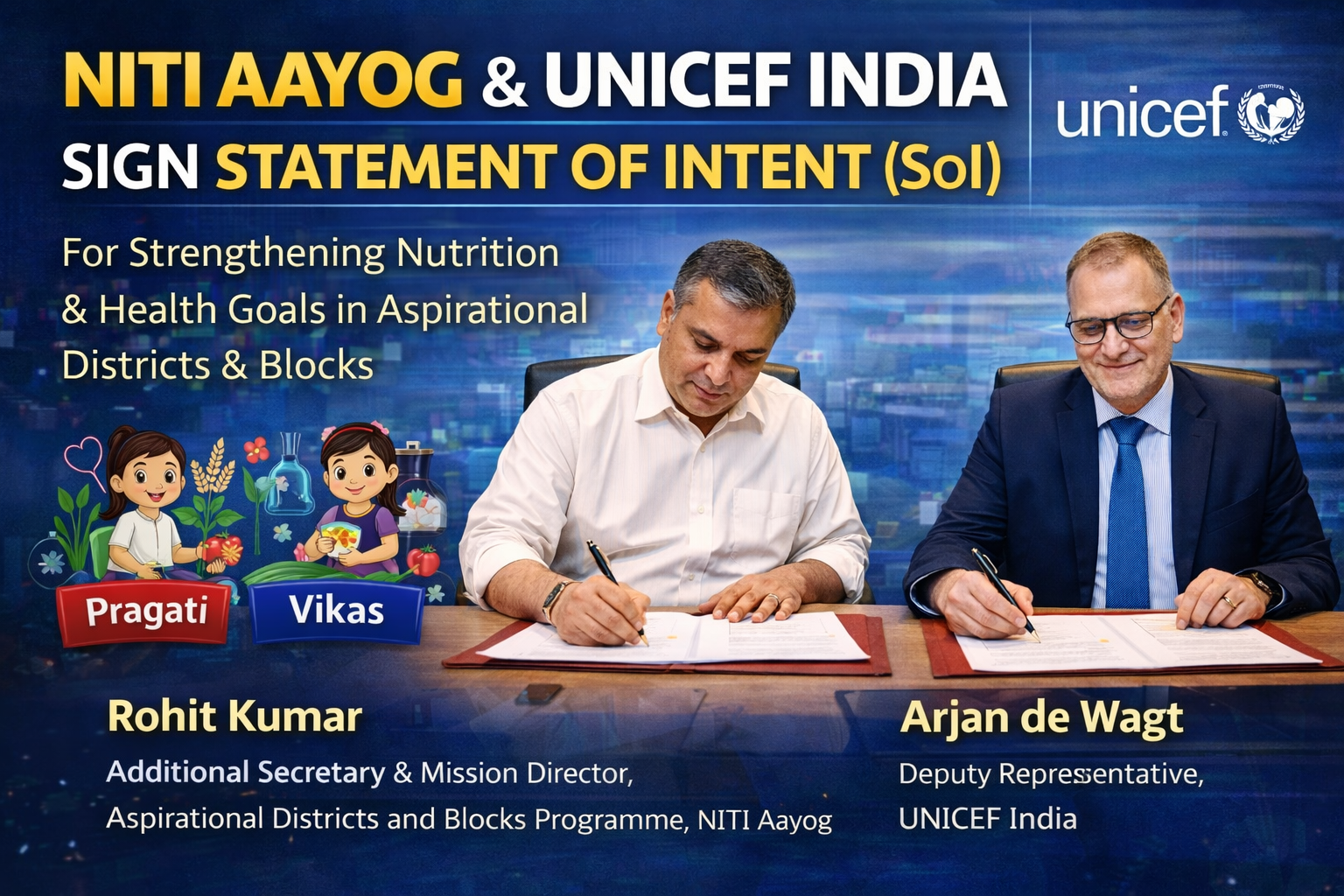
In a significant move to strengthen nutrition and health outcomes in underserved regions, NITI Aayog and UNICEF India signed a Statement of Intent (SoI) to collaborate on strategic interventions in Aspirational Districts Programme and Aspirational Blocks.
The agreement was signed by Rohit Kumar, Additional Secretary and Mission Director of the Aspirational Districts and Blocks Programme at NITI Aayog, and Arjan de Wagt, Deputy Representative of UNICEF India.
The partnership aims to accelerate progress in maternal and child nutrition, particularly in regions that face significant development challenges.

Focus on Nutrition and Health Outcomes
The collaboration between NITI Aayog and UNICEF India seeks to improve nutrition outcomes by strengthening implementation systems at the block level.
Key objectives of the partnership include:
- Improving maternal and child nutrition
- Strengthening local implementation mechanisms
- Promoting collaboration among government, private sector, and community stakeholders
- Enhancing delivery of health and nutrition services in underserved areas
The initiative is expected to support data-driven and collaborative governance, which has been a central feature of the Aspirational Districts Programme.
Role of the Aspirational Districts and Blocks Programme
The Aspirational Districts Programme focuses on accelerating development in districts that lag behind in key indicators such as health, nutrition, education, and infrastructure.
According to Rohit Kumar, the programme has demonstrated how convergence, collaboration, and evidence-based governance can drive faster development outcomes.
He noted that partnerships with international organisations like UNICEF India will help address critical health and nutrition challenges while improving last-mile service delivery.
UNICEF’s Role Through IMPAct4Nutrition
As part of the collaboration, UNICEF India will use its IMPAct4Nutrition (I4N) platform to mobilise resources and expertise.
Through this platform, UNICEF will:
- Provide technical support for nutrition initiatives
- Engage businesses, public sector enterprises, and industry associations
- Encourage CSR investments in nutrition-related programmes
The goal is to strengthen interventions that directly improve nutrition outcomes in vulnerable communities.
Key Areas of Collaboration
The partnership will focus on several important areas to strengthen nutrition and health services.
1. Strengthening Anganwadi Infrastructure
The collaboration will support improvements in infrastructure at Integrated Child Development Services centres, which play a key role in delivering nutrition and health services to women and children.
2. Improving Nutrition Literacy
Efforts will be made to raise awareness about healthy nutrition practices among communities.
3. Increasing Uptake of ICDS Services
The initiative will promote greater utilisation of services offered under Integrated Child Development Services.
4. Capacity Building of Frontline Workers
Training and capacity development programmes will be organised for frontline workers involved in health and nutrition services.
Promoting CSR and Community Participation
Another major component of the partnership is mobilising Corporate Social Responsibility (CSR) support for nutrition programmes.
The collaboration will:
- Encourage CSR partners to fund health and nutrition initiatives
- Promote community participation in local programmes
- Facilitate knowledge-sharing platforms to spread successful practices across districts and blocks
This approach aims to scale up effective nutrition interventions across multiple regions.
The Statement of Intent between NITI Aayog and UNICEF India represents a significant step toward strengthening partnerships to improve nutrition and health outcomes in India’s underserved regions.
By combining technical expertise, CSR engagement, and data-driven governance, the collaboration aims to accelerate progress in maternal and child nutrition, enhance frontline service delivery, and promote sustainable development in Aspirational Districts Programme and Aspirational Blocks.