

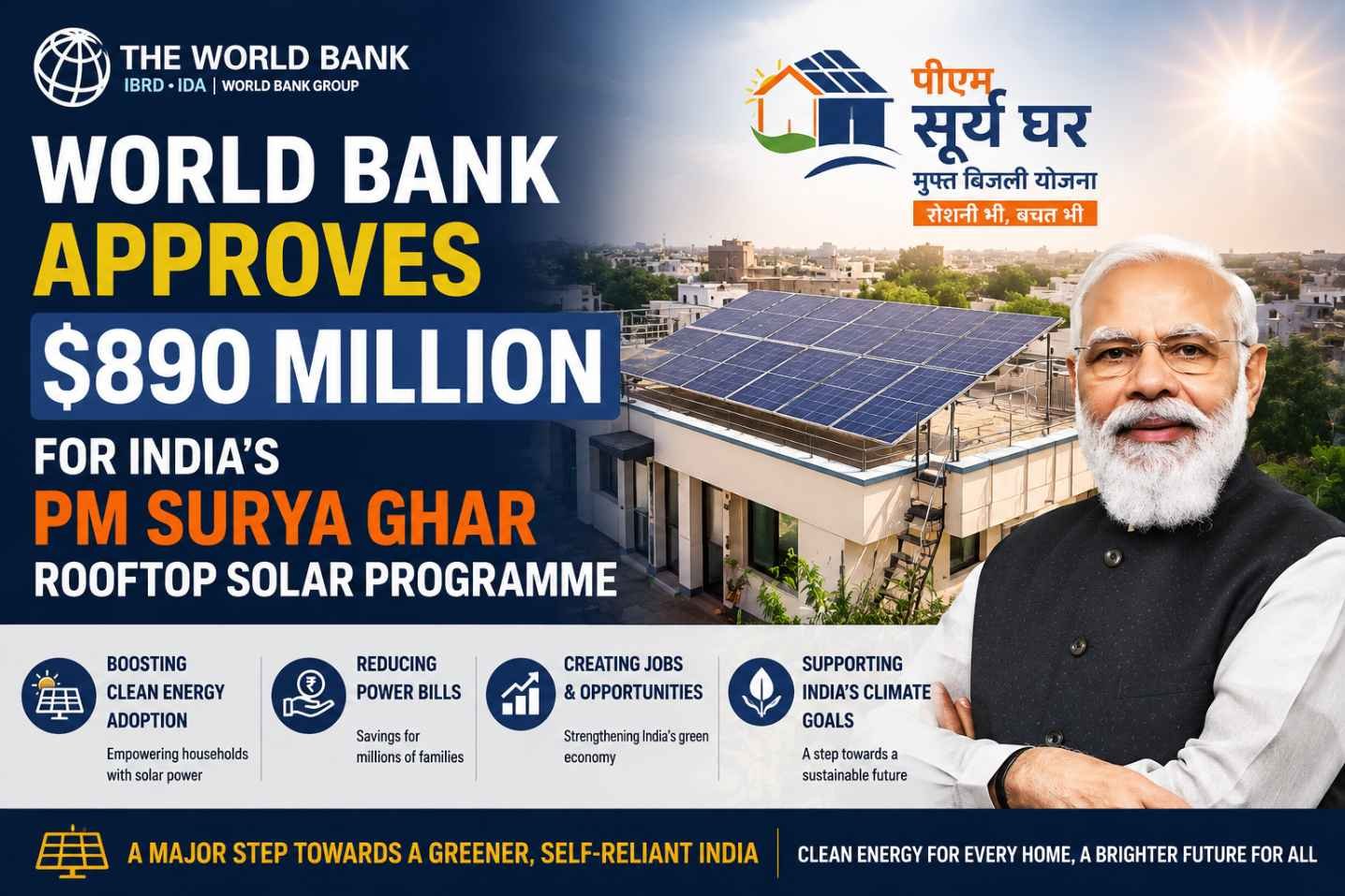
- India’s clean energy transition has received a significant boost as the World Bank approved a $890 million financing package to support the PM Surya Ghar: Muft Bijli Yojana, the Government of India’s flagship rooftop solar programme.
- The funding is expected to accelerate the installation of rooftop solar systems across 10 million (1 crore) households, while mobilising an additional $4.2 billion in private investment through commercial lending.
- The initiative aims to reduce electricity bills, strengthen domestic solar manufacturing, create employment, and support India’s long-term climate commitments.
World Bank Approves $890 Million Financing Package
The World Bank’s Board of Executive Directors approved a comprehensive financing package comprising:
- $820 million loan from the International Bank for Reconstruction and Development (IBRD).
- $60 million concessional financing from the Clean Technology Fund (CTF).
- $10 million grant from the IBRD’s Livable Planet Fund.
Beyond direct financing, the World Bank will facilitate approximately $4.2 billion in private financing, enabling households to access commercial loans for rooftop solar installations.
Support for PM Surya Ghar: Muft Bijli Yojana
The financing will strengthen the implementation of the PM Surya Ghar: Muft Bijli Yojana, which aims to provide affordable rooftop solar systems to 1 crore rural and urban households across India.
The scheme seeks to:
- Reduce household electricity bills.
- Increase clean energy adoption.
- Improve energy security.
- Encourage domestic production of rooftop solar equipment.
- Expand access to affordable financing.
Employment Generation
According to the World Bank, the programme is expected to generate nearly 1.7 million jobs across multiple sectors, including:
- Solar module manufacturing
- Equipment production
- Installation services
- Maintenance and repair
- Supply chain and logistics
- Renewable energy support services
The initiative is expected to significantly boost employment in India’s growing green energy ecosystem.
Strengthening India’s Renewable Energy Goals
India has committed to achieving:
- Net-zero carbon emissions by 2070
- 60% of electricity generation from non-fossil fuel sources by 2035
Although utility-scale solar parks have expanded rapidly over the past decade, residential rooftop solar adoption has remained comparatively low.
The latest World Bank financing is intended to bridge this gap and accelerate rooftop solar deployment nationwide.
Removing Financial Barriers
A major objective of the programme is to make rooftop solar more affordable for households.
The financing framework includes:
- Collateral-free financing options.
- Easier access to bank credit.
- Capacity building for electricity distribution companies (DISCOMs).
- Support for banks and financial institutions.
- Improved vendor ecosystems for faster installations.
These measures are expected to simplify the adoption process for millions of households.
Building on a Decade of Partnership
The World Bank has supported India’s rooftop solar sector for more than ten years.
Its previous assistance includes:
- 2016: $648 million Grid-Connected Rooftop Solar Programme.
- 2022: Additional $165 million financing to expand support for residential rooftop solar.
According to the World Bank, its cumulative support has helped India’s installed rooftop solar capacity increase from approximately 500 MW to over 27 GW.
Why This Matters
The latest World Bank package represents one of the largest international financial commitments toward India’s residential rooftop solar sector.
The programme is expected to:
- Expand clean energy access.
- Lower household electricity costs.
- Reduce carbon emissions.
- Strengthen India’s renewable energy manufacturing ecosystem.
- Create large-scale green employment.
- Mobilise substantial private investment alongside public financing.
The initiative also reinforces India’s position as one of the world’s fastest-growing renewable energy markets while supporting its long-term climate and energy security objectives.