

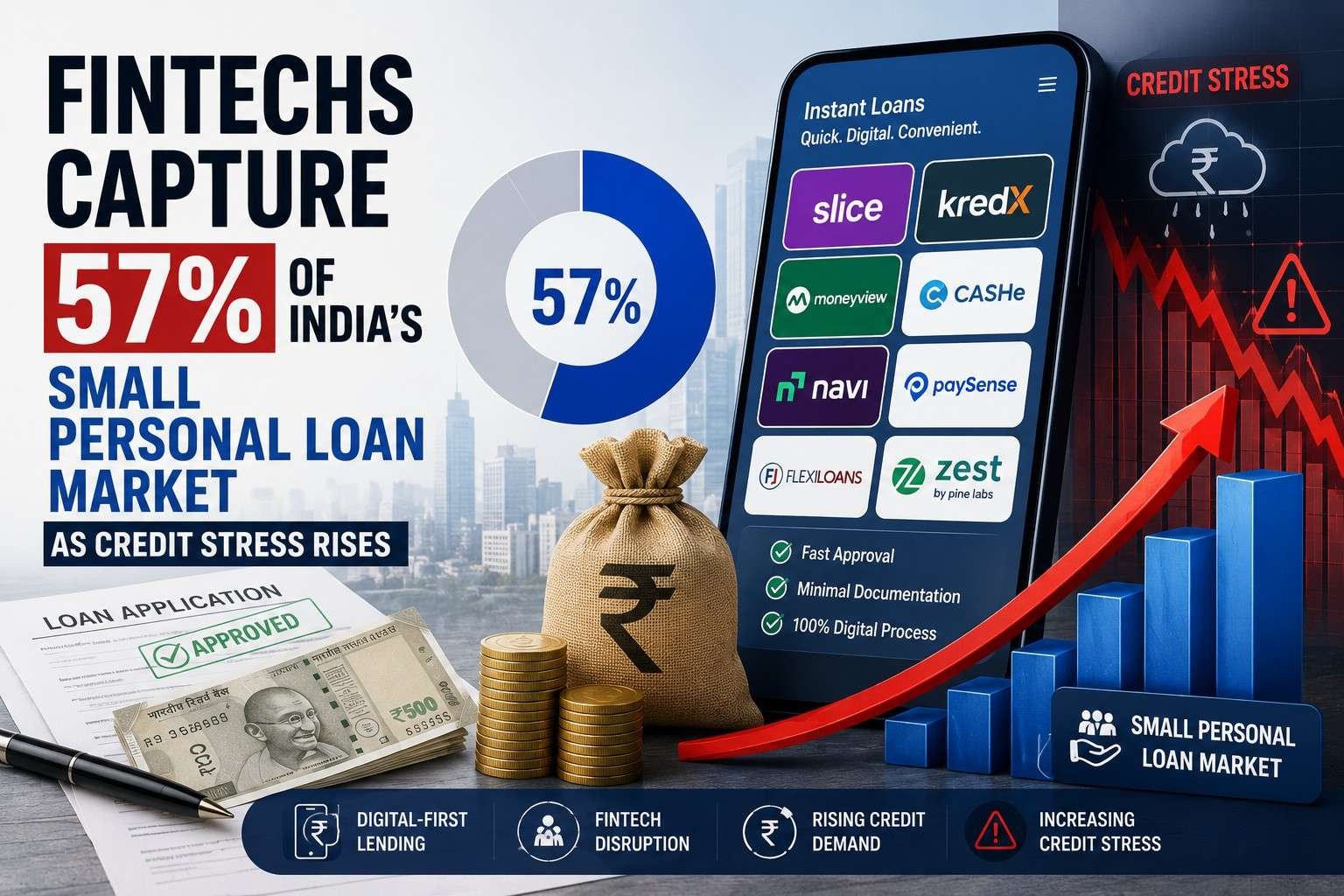
- India’s digital lending landscape is undergoing a major transformation, with fintech companies emerging as the dominant players in the small-ticket personal loan segment.
- According to the Reserve Bank of India’s latest report, fintech lenders accounted for 56.8% of all personal loans below ₹50,000 by March 2026, highlighting the rapid expansion of technology-driven lending.
- However, while fintechs are driving financial inclusion and faster credit access, the RBI has cautioned that rising delinquencies and higher exposure to unsecured lending warrant close monitoring.
Fintechs Lead the Small Loan Market
The RBI report shows that fintech companies have significantly expanded their presence in India’s consumer lending market.
By March 2026:
- Fintech lenders held a 56.8% market share in personal loans below ₹50,000.
- Non-Banking Financial Companies (NBFCs), including Housing Finance Companies (HFCs), accounted for 30.7%.
- Banks’ share declined to 10.1%.
- Other lenders held the remaining 2.3%.
The data highlights the growing preference among borrowers for digital lending platforms that offer quick approvals, paperless documentation and instant disbursement.
Credit Growth Outpaces the Market
- The fintech segment recorded an impressive 41.6% year-on-year growth in credit, more than double the overall growth rate of the small-ticket personal loan segment, which stood at 20.1%.
- The rapid expansion reflects increasing consumer demand for instant credit, especially among young borrowers and digitally active customers.
RBI Flags Rising Credit Stress
Despite the strong growth, the RBI noted that fintech lenders are experiencing higher levels of loan stress compared to banks and NBFCs.
The report found that:
- Fintech loan delinquencies stood at 6.4%.
- NBFCs reported delinquencies of 5.7%.
- Banks recorded the lowest delinquency rate at 4.1%.
The higher default rate among fintech lenders indicates that aggressive expansion in unsecured lending carries elevated credit risks.
Young Borrowers Drive Digital Lending
- The report highlighted that 70.5% of fintech loan portfolios consist of unsecured loans, with a substantial proportion of lending directed toward borrowers below the age of 35.
- While this demographic represents the future of digital finance, younger borrowers often have limited credit histories and lower financial buffers, increasing the probability of repayment stress.
- The RBI emphasised the importance of responsible lending practices, robust underwriting standards and effective risk management.
Overall Consumer Credit Shows Improvement
Despite concerns in the fintech segment, the broader consumer lending market has shown encouraging signs.
The report noted:
- Business loan delinquency declined to 1.8%.
- Credit card delinquency fell to 1.4%.
- Overall personal loan delinquency eased to 0.9%.
These trends indicate improving credit quality across several lending categories.
Microfinance Sector Shows Signs of Recovery
The RBI also highlighted improvements in the microfinance sector after a prolonged slowdown.
Key developments include:
- Credit expansion resumed following seven consecutive quarters of decline.
- Asset quality improved for the fifth straight quarter.
- Loans overdue between 31 and 180 days declined.
- Borrowers with loans from three or more lenders reduced to 9.7% in March 2026.
However, the borrower base declined by 22.7 lakh during the latest quarter, suggesting cautious lending and reduced multiple borrowing.
What the Report Means
- The RBI’s findings underscore the dual nature of India’s digital lending boom. On one hand, fintech companies are expanding financial inclusion by offering quick and convenient access to credit.
- On the other hand, the concentration of unsecured lending and higher delinquency levels highlight the need for prudent risk management.
- As digital lending continues to grow, regulators are expected to maintain close oversight to ensure that rapid credit expansion does not compromise financial stability.
Conclusion
- Fintech companies have firmly established themselves as the leading providers of small-ticket personal loans in India.
- Their ability to leverage technology has transformed consumer lending, particularly among younger borrowers.
- While the sector’s rapid growth is a positive development for financial inclusion, the RBI’s report serves as a reminder that sustainable expansion must be supported by responsible lending practices, strong underwriting standards and effective risk controls to safeguard the financial system.