

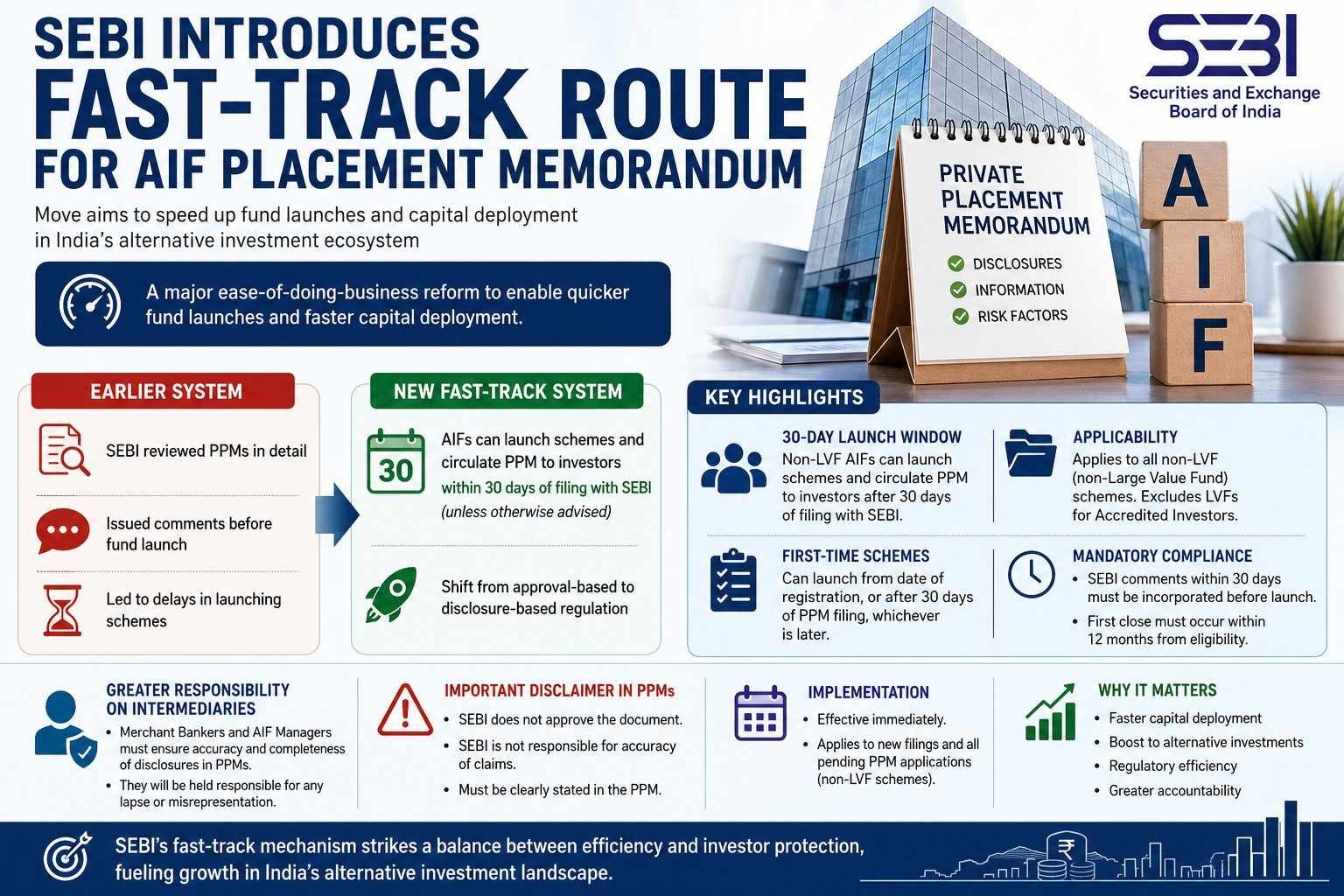
In a major ease-of-doing-business reform, Securities and Exchange Board of India (SEBI) has introduced a fast-track mechanism for processing Private Placement Memoranda (PPMs) of Alternative Investment Funds (AIF).
This move is aimed at speeding up fund launches and capital deployment in India’s alternative investment ecosystem.
What Has Changed?
Under the new framework:
- Non-LVF AIF schemes can now launch within 30 days of filing the PPM with SEBI
- They can also approach investors and raise funds after this 30-day period
- For first-time schemes, launch can happen:
- After registration OR
- After 30 days from filing (whichever is later)
Earlier, AIFs had to wait for SEBI’s detailed review and comments before launching, often causing delays.
Who Is Excluded?
- The fast-track route does NOT apply to LVFs (Large Value Funds for Accredited Investors)
- These funds will continue under the existing regulatory process
Key Process Shift
This reform marks a transition from:
Old System:
- SEBI review → Comments → Approval → Launch
New System:
- File PPM → Wait 30 days → Launch (with responsibility on intermediaries)
The change addresses the “time-consuming nature” of earlier procedures and promotes efficient capital formation.
Important Conditions & Timelines
- Any SEBI comments during the 30-day period must be incorporated before launch
- The first close of the scheme must be declared within 12 months from eligibility to launch
- Filing continues through SEBI’s intermediary portal
Increased Responsibility on Intermediaries
SEBI has shifted accountability to:
- Merchant Bankers
- AIF Managers
They must ensure:
- Accuracy
- Completeness
- Fairness of disclosures
SEBI has clearly stated:
Submission of PPM does not imply SEBI approval
What Are AIFs?
- Definition: AIFs are funds established in India that pool money from investors (Indian or foreign) to invest according to a defined strategy.
- Regulator: Governed by the SEBI (Alternative Investment Funds) Regulations, 2012.
- Structure: Can be set up as trusts, companies, or LLPs. Most AIFs in India are structured as trusts.
- Investor Base: Primarily targeted at HNIs and institutional investors, with a minimum investment requirement of ₹1 crore.
Categories of AIFs
1. Category I AIF
- Category I AIFs are those funds which invest in sectors that are considered socially or economically desirable for the country.
- These include startups, SMEs, infrastructure, and social ventures. The government and SEBI encourage such funds by providing tax benefits, regulatory support, and incentives, because they help in economic development, job creation, and innovation.
- Examples include Venture Capital Funds, Angel Funds, SME Funds, and Social Venture Funds.
2. Category II AIF
- Category II AIFs include funds that do not fall under Category I or III and typically invest in private equity, debt instruments, and real estate.
- These funds do not receive specific government incentives but are still an important part of the financial system.
- Examples include Private Equity (PE) Funds, Debt Funds, Real Estate Funds, and Distressed Asset Funds.
3. Category III AIF
- Category III AIFs are funds that use complex and advanced trading strategies to generate returns.
- These include Hedge Funds and PIPE (Private Investment in Public Equity) Funds.
Conclusion:
SEBI’s fast-track mechanism for AIF placement memoranda marks a paradigm shift in India’s investment regulatory framework. By enabling quicker fund launches while increasing accountability on intermediaries, the move strikes a balance between efficiency and investor protection.