

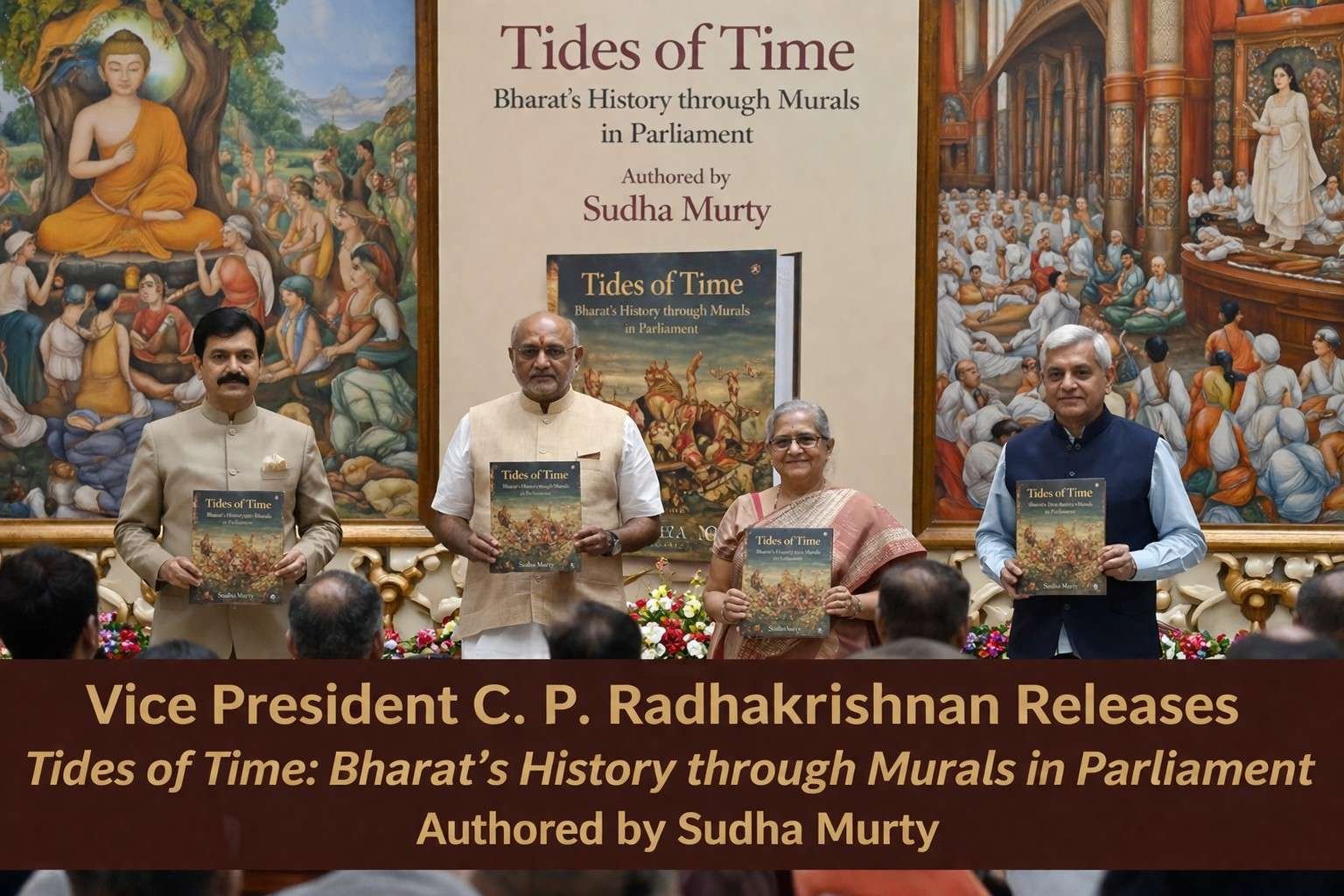
Vice President of India and Rajya Sabha Chairman C. P. Radhakrishnan released the book Tides of Time: Bharat’s History through Murals in Parliament at Samvidhan Sadan in New Delhi. The book, authored by Sudha Murty, is a publication of the Lok Sabha Secretariat.
Murals as a Reflection of India’s Civilisational Journey
Addressing the gathering, the Vice President praised Sudha Murty for capturing the timeless beauty and deep symbolism of the parliamentary murals. He noted that these murals are not just artistic expressions but visual narratives that trace India’s long civilisational journey.
He explained that the traditions depicted in these murals reflect India’s enduring democratic values, rooted deeply in its culture and history.
Book Showcases India’s Rich Historical Legacy
The Vice President described the book as a remarkable tribute to India’s heritage, bringing history alive through descriptions of 124 mural panels.
The book covers a wide range of themes, including:
- Indus Valley Civilization
- Teachings of Valmiki and Chanakya
- Spiritual messages of Mahavira and Gautama Buddha
- Contributions of rulers like Ashoka and Shivaji Maharaj
- Cultural landmarks such as the Konark Sun Temple
- Movements like the Bhakti movement
It also pays tribute to India’s freedom struggle, including the Dandi March, and leaders like Mahatma Gandhi and Subhas Chandra Bose.
“Vikas bhi, Virasat bhi” Vision
Referring to the vision of Viksit Bharat @ 2047, the Vice President highlighted the guiding principle of “Vikas bhi, Virasat bhi”—development alongside heritage.
He noted that the murals perfectly represent this philosophy by connecting progress with identity, values, and continuity.
Appreciation for Sudha Murty
Praising the author, he said that Sudha Murty embodies a rare blend of wisdom, humility, and commitment to public service. He also appreciated the efforts of the Lok Sabha Secretariat in bringing out the publication.
Call for National Unity
Quoting Tamil poet Subramania Bharati, the Vice President emphasized that despite India’s diversity in language, culture, and region, the country remains united in its national purpose.
He urged citizens to embrace the spirit of “Rashtra Pratham” and contribute to nation-building with dedication and integrity.
Conclusion
The release of Tides of Time highlights how India’s rich heritage and democratic traditions continue to inspire its present and shape its future, reinforcing the idea that progress and culture go hand in hand.