

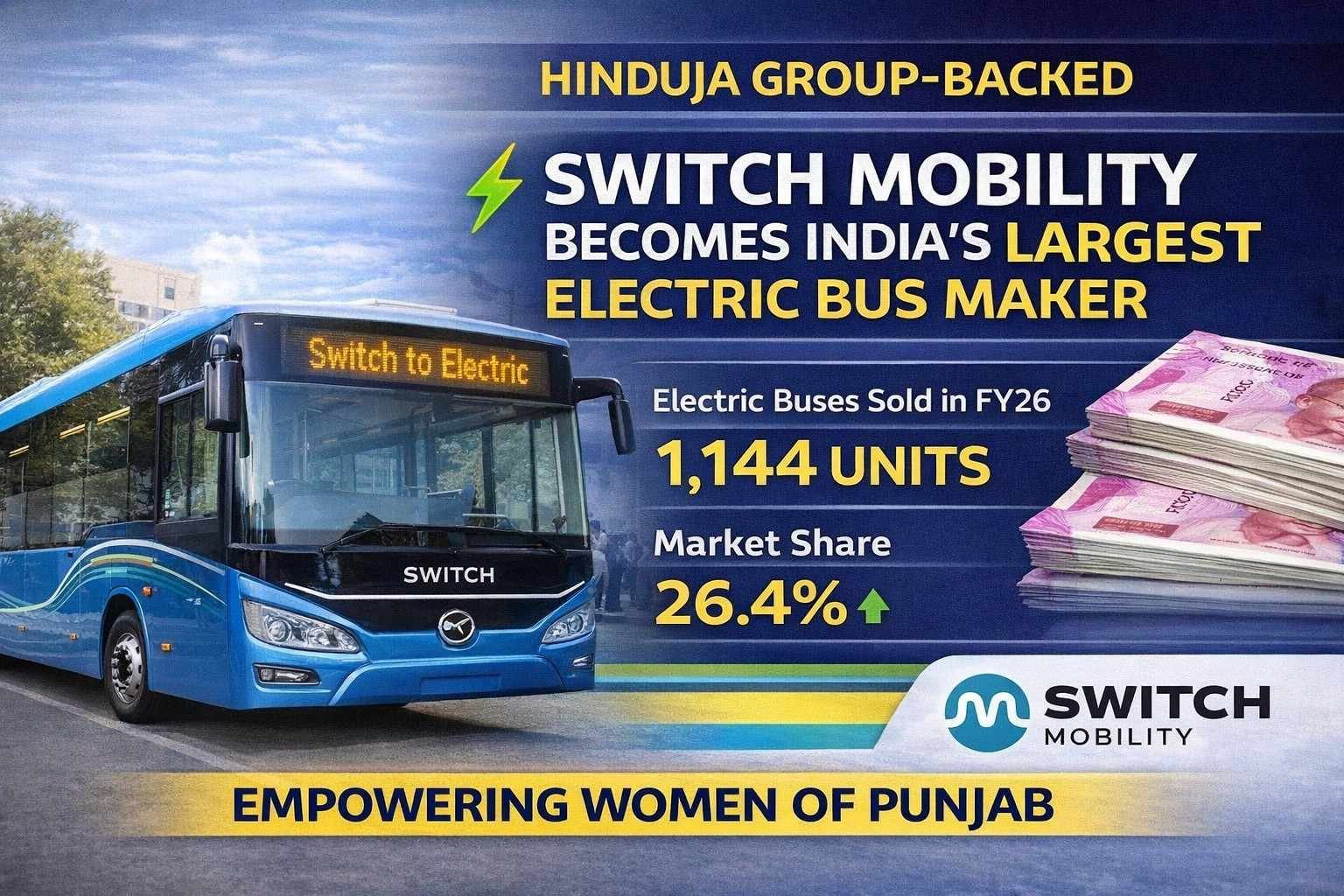
For the first time since entering the electric mobility space in 2022, Hinduja Group-backed Switch Mobility has emerged as India’s largest electric bus manufacturer in FY26, overtaking established players like Tata Motors and Olectra Greentech.
The company recorded a remarkable 177% growth in volumes, significantly outperforming the overall market growth of 44%, according to VAHAN data.
Strong Growth and Market Leadership
Switch Mobility sold 1,144 electric buses in FY26, up from just 413 units in the previous year.
- Market Share: 26.4%
- Growth driven by strong execution in state transport undertaking (STU) tenders
It narrowly edged past:
- PMI Electro Mobility – 25.6% share
- JBM Auto – 24.2% share
Tata Motors Sees Sharp Decline
Former market leader Tata Motors witnessed a steep decline:
- Sales dropped to 178 units in FY26 (from 1,058 units in FY25)
- Market share fell from 35.1% to just 4.1%
Experts attribute this to a strategic shift toward an asset-light model and reduced participation in certain large tenders.
Traditional Players Struggle
Other legacy players like Volvo Eicher Commercial Vehicles (VECV) also lagged behind, selling only 42 buses during the year.
Industry experts note that traditional manufacturers are facing challenges because:
- Large contracts now demand end-to-end service models
- Requirements include fleet operations, depot management, and financing
- Pure manufacturing strength is no longer enough
New-Age Players Gain Momentum
The shift in the market has benefited newer, service-oriented companies:
- PMI Electro Mobility:
- 1,113 buses (up 131%)
- JBM Auto:
- 1,052 buses (up nearly 198%)
These companies are focusing on:
- Integrated solutions (buses + charging + maintenance)
- Expansion into Tier 2 and Tier 3 cities
- Long-term operational contracts
Emerging players like EKA Mobility are also gaining ground, deploying around 164 buses and building partnerships for future tenders.
Market Enters High-Growth Phase
India’s electric bus market is now entering a scale-up phase:
- Total market size: 4,341 buses in FY26
- Growth: 44% year-on-year
Government initiatives like PM e-Bus Sewa and improved payment security mechanisms are boosting confidence among private operators.
Experts believe electric buses are now becoming viable even without heavy subsidies, thanks to improved total cost of ownership.
Olectra Greentech: Growth but Market Share Drops
Olectra Greentech saw moderate growth:
- Sales increased to 853 units (from 710 units)
- Market share declined from 23.5% to 19.6%
While the company remains strong in cities like Mumbai and Pune, it has faced supply chain constraints and slower expansion.
However, its future outlook remains positive:
- Secured a ₹1,800 crore order from Telangana State Road Transport Corporation
- Order includes 1,085 electric buses
- Expected delivery timeline: 9–20 months (boost likely in FY27)
Conclusion
The Indian electric bus market is undergoing a major transformation, shifting from manufacturing-led competition to execution and service-driven models.
With Switch Mobility taking the lead and new-age players rapidly scaling up, the sector is poised for strong growth in the coming years, especially across metro as well as Tier 2 and Tier 3 cities.