



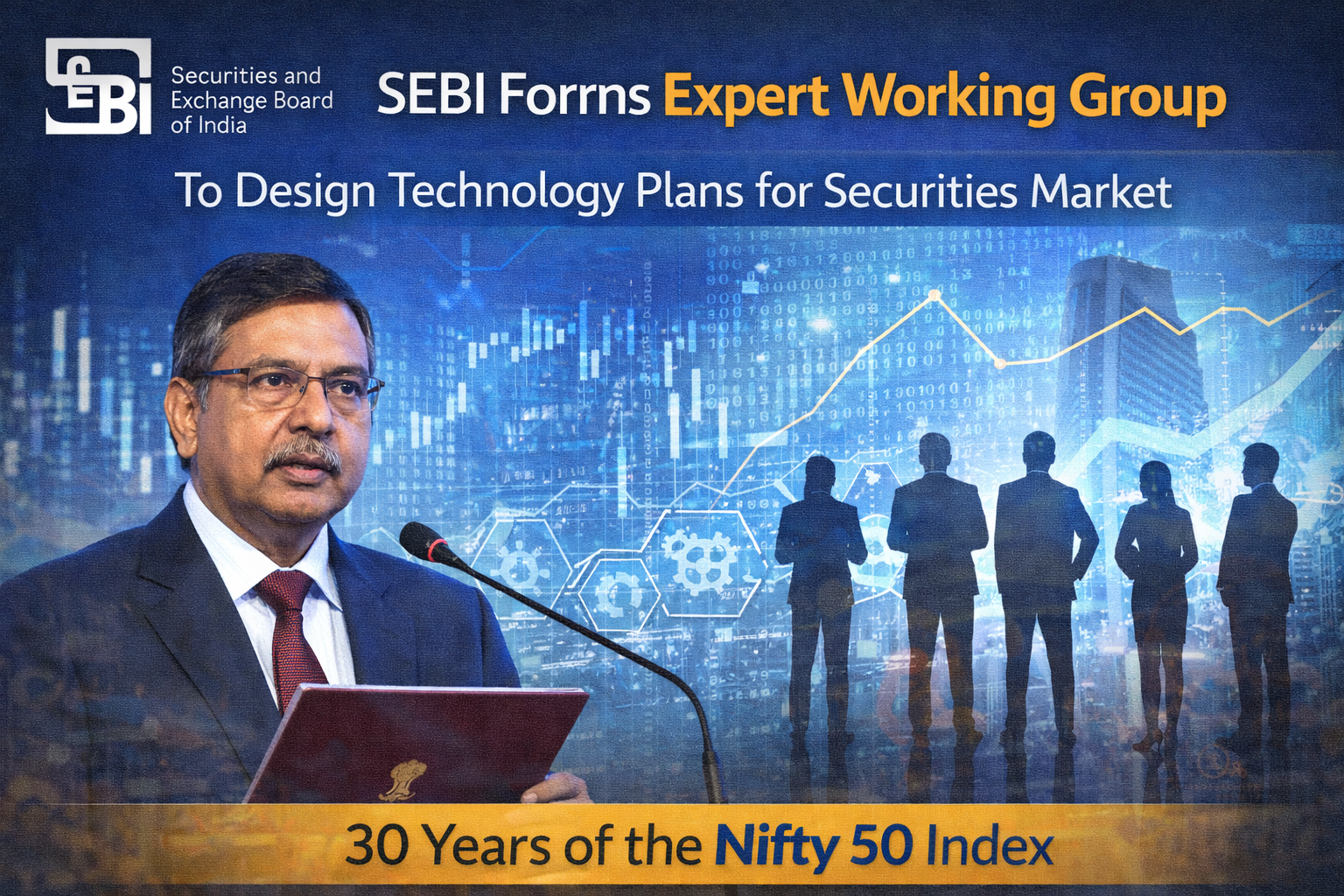
The Securities and Exchange Board of India (SEBI) has constituted a high-level expert working group to design both short-term and long-term technology roadmaps for India’s securities market ecosystem.
The announcement was made by Tuhin Kanta Pandey, Chairman of SEBI, while speaking at an event celebrating 30 years of the Nifty 50 index, hosted by the National Stock Exchange (NSE).
Objective of the Working Group
The newly formed expert group will evaluate the technology architecture required to support the next phase of growth in India’s capital markets. As trading activity and digital participation continue to increase, regulators are focusing on strengthening technological infrastructure and regulatory supervision.


According to SEBI Chairman Tuhin Kanta Pandey, the working group will create a strategic technology framework that will help the securities market handle rising transaction volumes, complex financial products, and increased participation from retail investors.
Increasing Role of Technology in Markets
Pandey highlighted that technology is becoming central to both market functioning and regulation. With the rapid expansion of digital trading platforms and financial technologies, SEBI is strengthening its internal technological capabilities to improve market monitoring and surveillance.
To enhance supervision, SEBI has developed several in-house digital tools.
Key Technology Tools Developed by SEBI
-
SEBI Sudarshan – A real-time surveillance scanner used to detect unauthorised digital activities related to securities markets.
-
SEBI R(AI)DAR – An artificial intelligence-based system designed to monitor and review advertisements and promotional material related to securities markets.
Additionally, SEBI is using advanced analytical tools to conduct sentiment analysis of corporate announcements, enabling regulators to detect potential market manipulation or misinformation.
Global Market Volatility
Speaking at the event, Pandey also addressed ongoing global market volatility, which has been influenced by geopolitical tensions and disruptions in global supply chains.
He noted that conflicts in the Middle East have affected major shipping routes and triggered shocks in oil and gas supply and prices, leading to uncertainty in global financial markets.
However, he emphasized that India’s domestic economic fundamentals remain strong, providing resilience despite global instability. He advised investors to remain calm and avoid panic during periods of market turbulence.
Strengthening Governance of Market Institutions
Apart from technological upgrades, SEBI is also taking steps to improve governance and oversight of Market Infrastructure Institutions (MIIs).
These institutions include:
-
Stock exchanges
-
Clearing corporations
-
Depositories
SEBI has introduced measures such as:
-
External independent performance evaluations of MIIs
-
Governance guidelines to strengthen board oversight
-
Clear reporting structures for key management personnel
These reforms aim to enhance transparency, accountability, and operational efficiency across India’s securities market ecosystem.
Significance
The initiative reflects SEBI’s focus on preparing India’s capital markets for future growth driven by digital technology, artificial intelligence, and advanced analytics. Strengthening technological capabilities and governance frameworks will help ensure market integrity, investor protection, and efficient regulation in an increasingly complex financial environment.