



The Reserve Bank of India (RBI) has amended its capital adequacy framework for commercial banks, introducing clearer guidelines on how lenders should calculate and maintain capital against Counterparty Credit Risk (CCR) exposures.
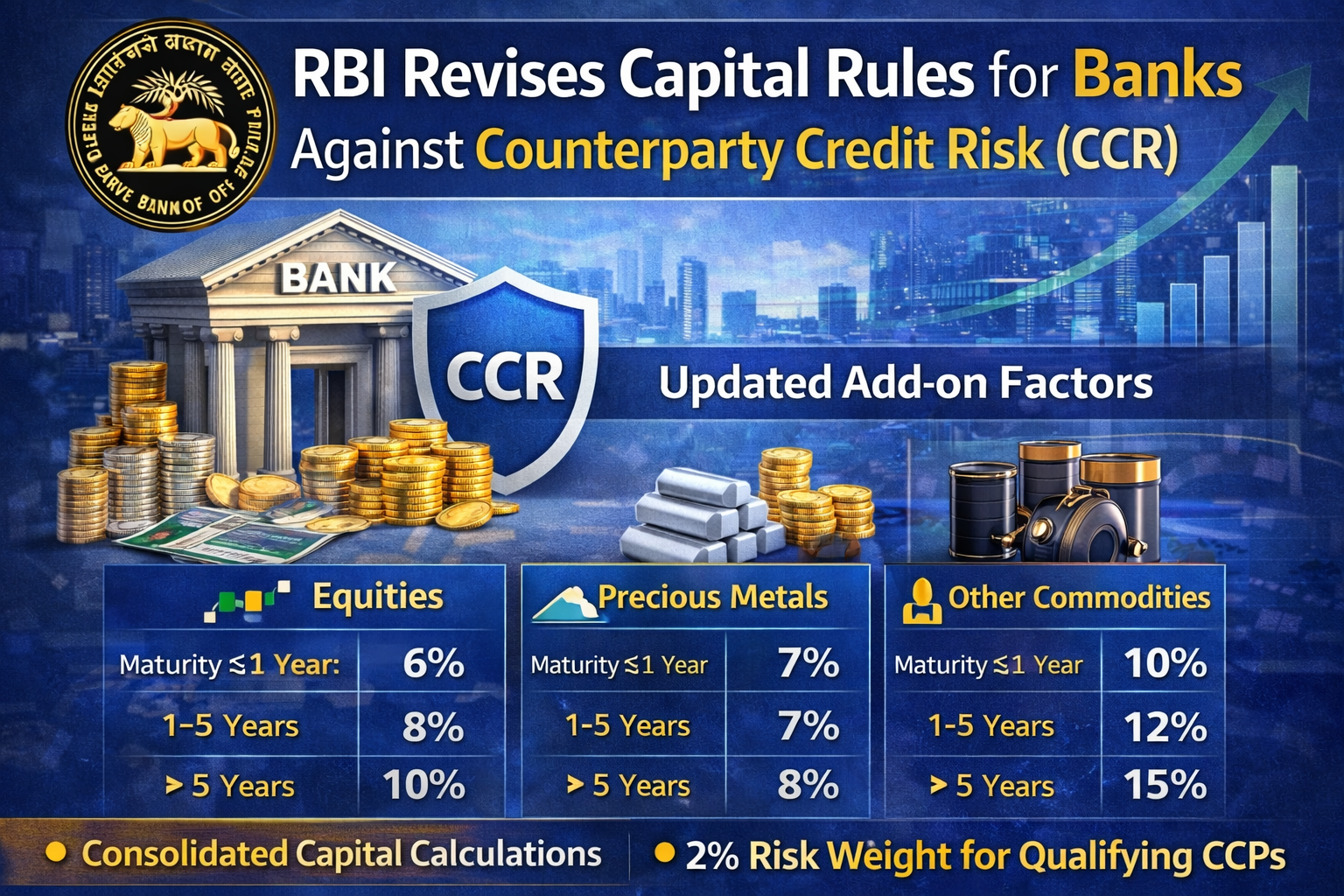
The revised rules have been issued under the “RBI (Commercial Banks – Prudential Norms on Capital Adequacy) Third Amendment Directions, 2026.” The updated framework has come into immediate effect and aims to strengthen risk management in the banking sector.
Revised Add-on Factors for Off-Balance Sheet Exposures
One of the key changes involves the revision of add-on factors for market-related off-balance sheet items, which banks must use while calculating their capital requirements.
Under the updated rules:
-
Equity contracts will carry add-on factors of
-
6% for maturities up to one year
-
8% for maturities between one and five years
-
10% for maturities exceeding five years
-
-
Precious metals (excluding gold) will attract add-on factors of
-
7% for maturities up to one year
-
7% for maturities between one and five years
-
8% for maturities beyond five years
-
-
Other commodities will carry higher add-on factors of
-
10% for maturities up to one year
-
12% for maturities between one and five years
-
15% for maturities beyond five years
-
These adjustments aim to ensure that banks maintain adequate capital buffers against potential market risks.
Rules for Clearing Member Banks
The Reserve Bank of India has also clarified rules for banks acting as clearing members of stock exchanges recognised by Securities and Exchange Board of India (SEBI) in the equity and commodity derivatives segments.
Such banks must now compute and maintain a capital charge for counterparty credit risk (CCR) arising from these transactions. The revised add-on factors for equities, precious metals, and commodities will apply specifically in these cases.
Consolidated Capital Requirements
Another important change relates to consolidated capital calculations. Banks will now be required to include CCR exposures of all entities that fall within the scope of consolidation under the capital adequacy framework.
This ensures that group-level risks are properly accounted for while assessing a bank’s capital position.
Treatment of Periodically Reset Contracts
For financial contracts that are periodically reset to zero market value, the RBI has clarified that residual maturity should be calculated from the next reset date rather than the original contract date.
Additionally, interest rate contracts with residual maturities exceeding one year will be subject to a minimum add-on floor of 0.50%.
Risk Weight for Qualifying Central Counterparties
The new directions also specify rules related to Qualifying Central Counterparties (QCCPs).
-
A 2% risk weight will apply to a bank’s trade exposure to QCCPs.
-
However, clearing member banks may be exempt from maintaining capital against QCCP trade exposure if they are not legally obligated to compensate clients for losses.
To claim this exemption, banks must obtain a written legal opinion confirming that they are not responsible for reimbursing client losses.
Objective of the New Framework
Through these amendments, the Reserve Bank of India aims to strengthen the capital adequacy framework and improve the management of counterparty credit risk in the banking system.
The revised guidelines are expected to enhance financial stability, transparency, and risk management practices across Indian commercial banks.