

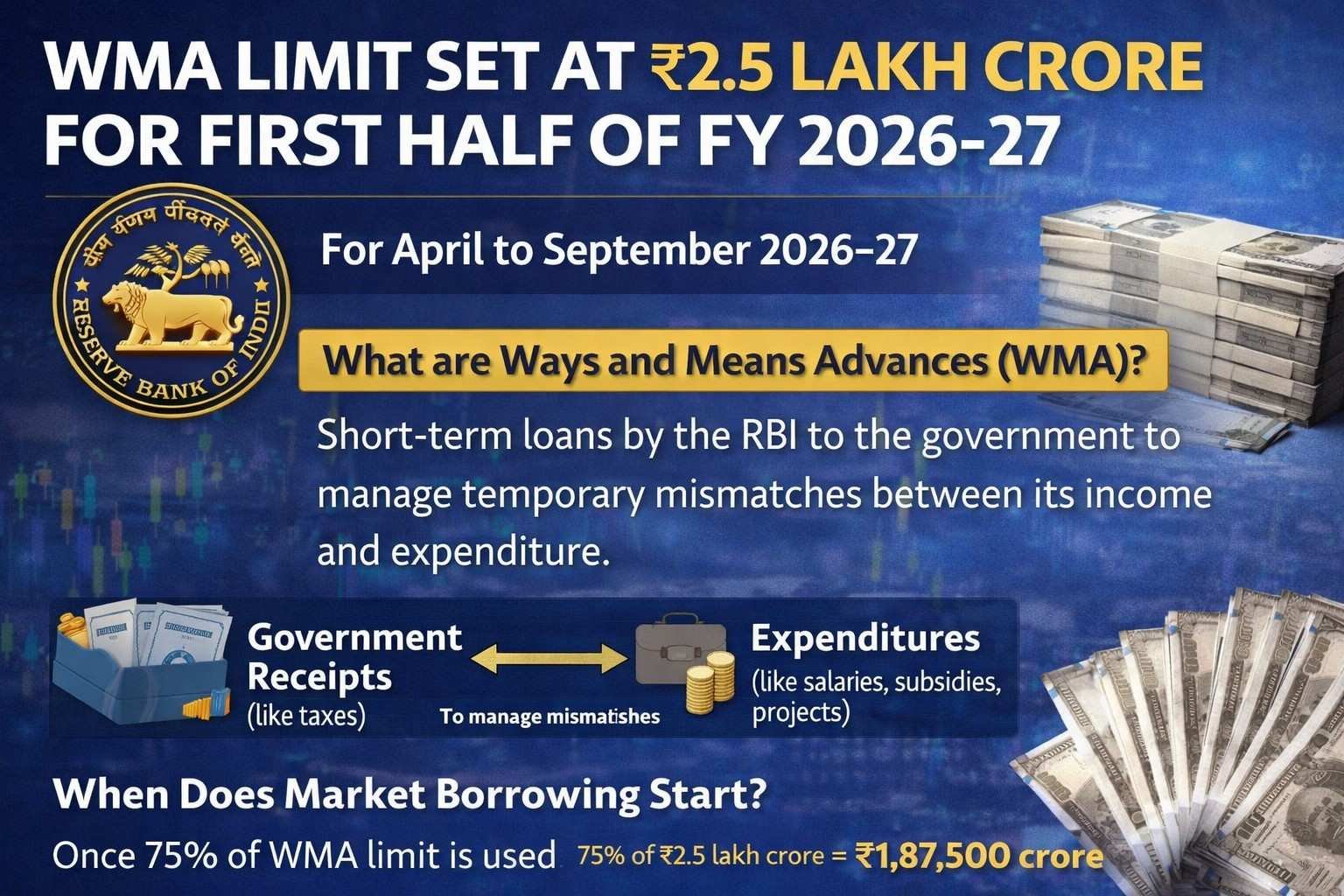
The Reserve Bank of India (RBI), in consultation with the Government of India, has set the Ways and Means Advances (WMA) limit at ₹2,50,000 crore for the first half of the financial year 2026–27 (April to September).
This decision is aimed at ensuring smooth cash flow management for the government while maintaining overall fiscal discipline.
What are Ways and Means Advances (WMA)?
Ways and Means Advances (WMA) are short-term loans provided by the RBI to the government to manage temporary mismatches between its income and expenditure.
Such mismatches usually happen because:
- Government receipts (like taxes) may come later
- Expenditures (like salaries, subsidies, projects) need to be paid earlier
WMA helps the government meet its immediate financial needs without sudden borrowing from the market.
When Does Market Borrowing Start?
According to RBI rules, once the government uses 75% of the WMA limit, it may need to shift towards market borrowing.
- 75% of ₹2.5 lakh crore = ₹1,87,500 crore
When this level is reached, the RBI may start issuing government securities (G-secs) to raise funds from the market.
This ensures that:
- WMA remains a temporary support tool
- Long-term funding is done through market-based borrowing
Flexibility in the System
The RBI has kept the option open to revise the WMA limit anytime during the financial year.
This flexibility allows adjustments based on:
- Changing economic conditions
- Government cash requirements
- Overall liquidity in the financial system
Interest Rate Structure
The interest rates on WMA are linked to the RBI’s policy framework:
- WMA Interest Rate → Same as the Repo Rate
- Overdraft Interest Rate → Repo Rate + 2%
This structure encourages the government to:
- Use WMA carefully
- Avoid overdrafts, which are costlier
Conclusion
The decision to set the WMA limit at ₹2.5 lakh crore reflects a balanced approach by the RBI and the Government of India.
It ensures:
- Smooth short-term liquidity management
- Controlled and disciplined borrowing
- Alignment with overall monetary policy
Overall, the framework helps maintain financial stability while giving the government enough flexibility to manage its cash flows effectively.